How to Create a Moon Phase Altar for Each Lunar Cycle
We may earn money or products from the companies mentioned in this post.
There’s something quietly powerful about having a dedicated space that shifts with the Moon. A moon phase altar isn’t a static decoration — it’s a living practice that keeps your intentions, rituals, and reflections moving in rhythm with the lunar cycle rather than feeling like disconnected one-off events.
The concept is simple: one altar, refreshed four times a month. You keep a core foundation in place all cycle long, then swap in phase-specific items as the Moon waxes, peaks, wanes, and disappears. Whether you’re drawn to crystals, candles, tarot, or just want a quiet corner to sit and journal, this guide walks you through exactly how to build and maintain a moon phase altar through every stage of the cycle.
Why Create a Moon Phase Altar?
Altars have been used across cultures and throughout history as intentional focal points for spiritual practice. You can read more about how these traditions developed in our post on the History of the Occult. But a moon altar, specifically, does something a little different — it creates a visual anchor that evolves alongside the lunar cycle.
Enhance Your Spiritual Practice
Discover our collection of digital planners and mystical tools designed to deepen your journey with tarot, crystals, and astrology.
Visit Our ShopWhen you walk past your altar and see it dressed for a Full Moon — candles lit, flowers in bloom, crystals laid out — you’re reminded of where you are in the cycle. That reminder alone can shift how you approach your day, your energy, and your intentions.
Practically speaking, it doesn’t need to be elaborate. An altar can be as minimal as a postcard, a tealight, and a single stone on a shelf. The space is yours to build in whatever way feels authentic. Some people keep their altars deeply personal, tied to deities or ancestors. Others treat it as a psychological tool — a physical representation of their inner work. Both approaches are equally valid.
Setting Up Your Base Altar
Before you start swapping items in and out with each phase, you need a solid foundation — a base altar that stays consistent throughout the lunar cycle and anchors everything else.
Choosing Your Location
Location matters more than most people realise. The best spots are places you’ll actually see every day: a windowsill, a bedside table, a small shelf, or a corner of your desk. If moonlight can reach it on clear nights, even better, though it’s absolutely not required.
Avoid tucking your altar somewhere out of sight. The whole point is to stay connected to it through the month, and out of sight really does mean out of mind.
The Core Elements
Think of your base altar as having a few non-negotiable layers that remain constant while phase-specific items rotate around them.
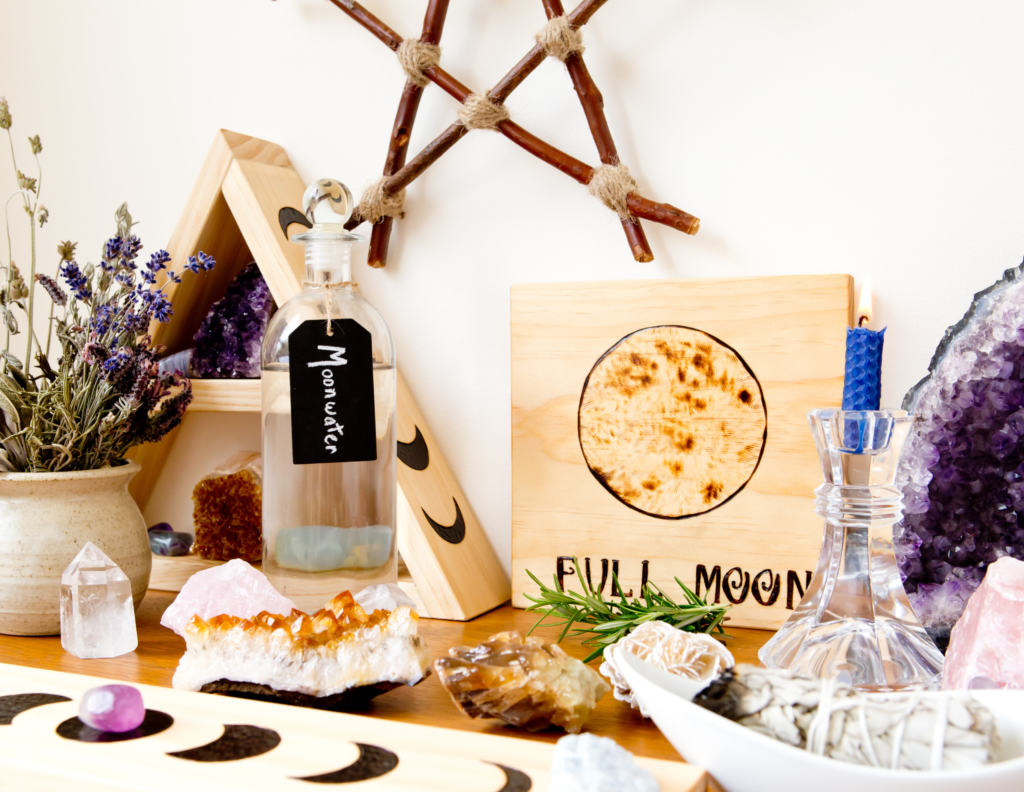
Start with a cloth or surface covering in moon colours — white, silver, pale blue, or black all work beautifully. This is what makes the space feel intentional rather than just a collection of objects on a shelf.
Every strong moon altar has a centrepiece — one object that always represents the Moon for you. This might be a selenite tower, a moonstone sphere, a bowl of water, a goddess figure, a moon art print, or simply a white pillar candle. Choose something that resonates and commit to it as your anchor. Everything else will shift around it, but this stays.
Representing the four elements grounds the altar in a balanced, holistic energy. A small crystal or stone covers earth, a shell or bowl of water handles water, a candle takes care of fire, and incense, a feather, or written prayers represent air. These can stay mostly static or shift slightly with each phase.
Finally, leave space for an intention anchor — a written intention, a tarot card, or a list that changes with each phase. This is what transforms the altar from a pretty display into an active spiritual tool.
The Four Phases and How to Dress Your Altar
The lunar cycle is typically broken into four main phases, each with its own energy, focus, and corresponding altar setup. Understanding what each phase represents helps you work with the Moon’s rhythm rather than against it.
If you want a deeper understanding of how these phases influence emotions and energy, our post on Moon Phases and Their Influence is a great companion read.
New Moon: Seeds and Stillness
The New Moon is a dark sky and a blank page. This is the phase of voids, beginnings, and quiet listening — not a time for action, but for planting seeds and resting before the cycle kicks into gear.
What to add to your altar:
- Keep things minimal. A dark or black cloth, one candle (preferably white or black), one Moon stone, and a small bowl of water creates the right atmosphere.
- Add a blank journal, a few sheets of paper, and a pen. These signal the openness and receptivity of this phase.
- Closed flower buds, seeds, or bare branches work well as symbolic “future self” objects.
- Clear away old wax stubs, wilted flowers, and any ash from the previous cycle. Smoke cleanse the space if that resonates with you.
A simple ritual to try:
Sit in low light or near candlelight. Breathe. Write one to three intentions for the coming cycle and place the paper beneath your centrepiece crystal or candle. If you work with tarot, The High Priestess is a natural card to draw for the New Moon — she represents the stillness before revelation, the wisdom held in silence.
Crystal suggestions: Selenite (for cleansing and fresh starts), moonstone (especially black moonstone for protection and depth), labradorite (for awakening intentions), obsidian (for grounding into the void).
Journal prompt: What tiny seed am I planting this New Moon?
Waxing Moon: Growth and Momentum
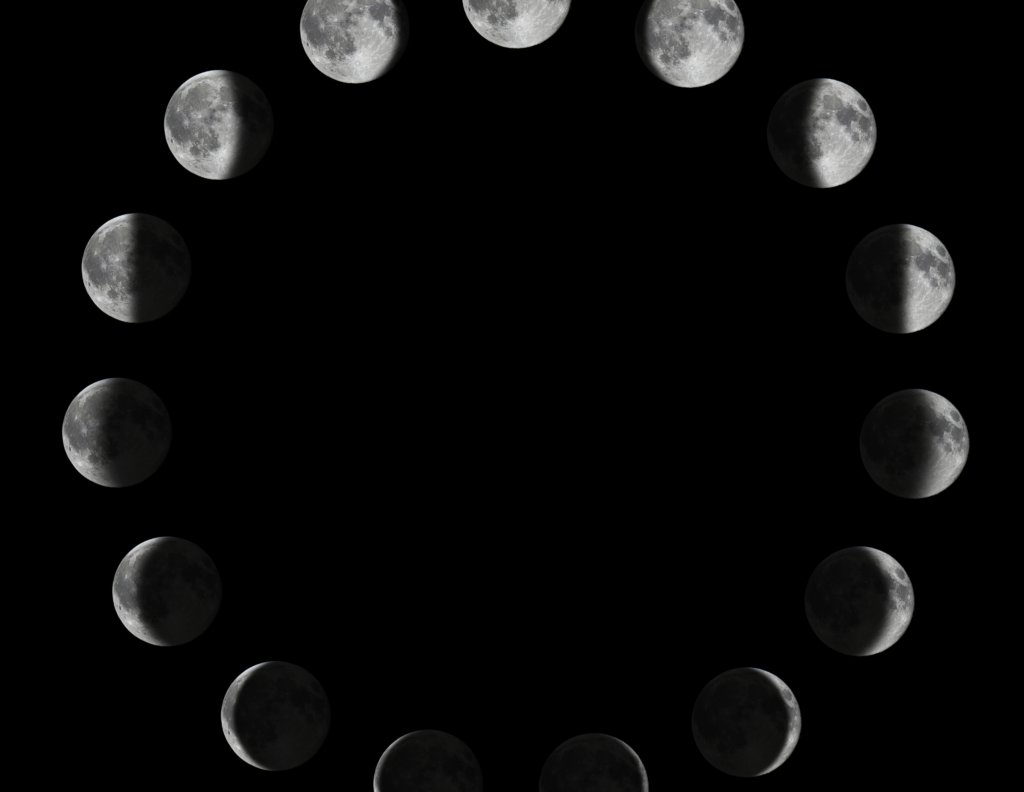
As the Moon grows from a sliver into a half-circle and beyond, so does the energy around your intentions. The Waxing Moon is the time for action, attraction, building, and commitment. If the New Moon is planting seeds, the Waxing Moon is watering them and watching for signs of life.
What to add to your altar:
- Introduce brighter colours — a yellow or green candle, sunflower yellow, living green. The altar should feel more energised than during the New Moon phase.
- Add tools that represent effort and forward movement: a planner, a list of steps toward your goal, a symbol of what you’re working toward (a coin for financial intentions, a small heart for relationship work, and so on).
- Crystals or herbs arranged in a growing crescent shape mirror the Moon’s form and reinforce the energy of expansion.
- Blooming flowers or fresh buds signal growth that’s actively happening.
A simple ritual to try:
Re-read the intentions you set at the New Moon. Pick one concrete action you can take this week and write it on a separate slip of paper — place it somewhere visible. Light your candle and spend a few minutes visualising the energy around that intention growing stronger and more tangible.
Crystal suggestions: Citrine (for manifestation and momentum), green aventurine (for luck and growth), clear quartz (to amplify your intentions), carnelian (for motivation and courage).
Journal prompt: What one action can I take this week that moves me closer to my New Moon intention?
Full Moon: Peak, Gratitude, and Release
The Full Moon is the crescendo of the lunar cycle — the moment when the Moon is fully illuminated and energy is at its peak. Celebrations, gratitude, charging practices, and release work all belong to this phase. Your altar should reflect that abundance.
What to add to your altar:
- Go all out. Multiple candles, abundant crystals, flowers in full bloom, offerings of water, herbs, or something sweet. This is the one phase where maximalism is entirely appropriate.
- Place a bowl or jar of water on or near the altar to make moon water overnight. Even a windowsill works if moonlight can reach it.
- Tarot cards like The High Priestess, The Chariot, or any card drawn for illumination fit beautifully here. These cards carry lunar energy that deepens the Full Moon’s themes.
- Use white or silver cloth, crystals laid out in a full circle, and candles in a range of sizes.
A simple ritual to try:
Write a list of what has grown or become clear since the New Moon. Read it aloud — gratitude spoken out loud carries weight. If you have release work to do, write what you’re ready to let go of on a separate piece of paper. Tear it carefully, burn it safely, or bury the pieces outside. Then spend time charging your crystals and any tools you use in your practice by placing them on the altar or on a windowsill in the moonlight.
Crystal suggestions: Moonstone (for amplifying lunar energy and intuition), selenite (for high vibration and cleansing), clear quartz (for charging and amplifying), amethyst (for spiritual connection and gratitude).
Journal prompt: What has grown or become clear for me since the New Moon? What am I ready to release?
Here’s a quick reference for the core altar elements at each phase:
| Phase | Theme | Add to Altar | Simple Practice |
|---|---|---|---|
| New Moon | Seeds, rest, vision | Minimal setup, one Moon stone, single candle, blank page | Write 1–3 intentions, place under centrepiece |
| Waxing Moon | Growth, action, attraction | Bright candle, “doing” tools, crescent-shaped crystal layout | Choose one concrete action and commit to it |
| Full Moon | Peak, gratitude, release | Many candles, flowers in bloom, moon water bowl, tarot cards | Gratitude list, release ritual, charge crystals and tools |
| Waning Moon | Release, boundaries, decluttering | Petals or dried herbs, dark candle, salt or protective stones | Write what you’re releasing, symbolically discard |
Waning Moon: Release, Protection, and Letting Go
After the Full Moon’s peak, energy begins to recede. The Waning Moon is the quieter, less glamorous half of the cycle — but arguably the most spiritually important. This is the phase of pruning, banishing, setting limits, and releasing what no longer serves you. Think of it as the compost phase: what goes back into the earth now will feed next month’s growth.
What to add to your altar:
- Swap out any fresh blooms for petals, dried herbs, or bare stems. The visual shift from abundance to simplicity mirrors the energetic release happening.
- Add protective or boundary-supporting items: black tourmaline for psychic protection and grounding, obsidian for shadow work and transformation, a handful of salt, scissors (representing cord-cutting), or a cord itself tied in a knot that you can symbolically undo.
- Dark cloth and a black candle support banishing work, though this doesn’t have to feel heavy or ominous — releasing what’s done its job is a deeply positive act.
A simple ritual to try:
Write down the habits, thought patterns, relationships, or situations you are releasing this cycle. Place the paper under a protective stone or in a small jar with salt or water. Throughout the Waning Moon’s weeks, do a small tidy of the physical altar — remove items that feel stale, clear dust, refresh the water. The physical act mirrors the energetic work.
Crystal suggestions: Black tourmaline (protection and grounding), obsidian (shadow work and transformation), smoky quartz (transmuting negative energy), selenite (for clearing and purifying between cycles).
Journal prompt: What am I ready to compost? What has been useful but is now finished?
Crystals for a Moon Altar Year-Round
Some crystals feel at home on a moon altar during any phase. Think of these as your evergreen collection — stones that carry lunar energy regardless of where the Moon sits in her cycle.
Selenite is named after Selene, the Greek Moon goddess, and carries that heritage in its high-vibration, cleansing energy. It works beautifully as an altar base — laying other crystals on a selenite plate keeps them cleared and charged without any additional effort.
Moonstone is the obvious choice. It amplifies the Moon’s energy, enhances intuition, and supports the emotional cycles that often track alongside the lunar one. Different colours of moonstone suit different phases: white moonstone for the Full Moon, black moonstone for the New Moon, green for the Waxing phase, and grey or peach for the Waning period.
Labradorite brings a quality of magic and inner fire that pairs naturally with moon work. It awakens psychic gifts, sharpens focus during dark moon periods, and protects the aura during more open, receptive practices.
Clear quartz amplifies whatever energy you bring to the altar, making it useful at every phase. It’s particularly powerful during the Full Moon, when you’re looking to charge intentions and crystals with maximum potency.

The four elements — earth, water, fire, and air — have long been connected to the Moon’s cyclical nature, and incorporating them into your altar brings that connection to life. You can read more about how the elements work in spiritual practice over at our post on Folklore of the Four Elements.
Herbs, Flowers, and Botanicals
You don’t need a garden to add botanical life to your moon altar — even a handful of dried herbs from your kitchen cupboard works beautifully.
Lunar herbs and flowers worth keeping on hand include mugwort (long associated with psychic visions and dreaming), jasmine, rose, elder, hawthorn, dandelion, and any white or pale blue flower. These have been connected to Moon magic across folk traditions for centuries.
One especially lovely practice is arranging petals or small herbs in the shape of the current Moon phase — a full circle for the Full Moon, a crescent for the Waxing or Waning. It takes two minutes and creates a surprisingly powerful visual reminder of where you are in the cycle.
Working with Tarot at Your Moon Altar
If tarot is part of your practice, the lunar cycle offers a natural framework for working with the cards. Drawing a card at the New Moon to represent the month’s theme, then returning to your altar at each subsequent phase to see how it’s playing out, creates a thoughtful throughline across the entire cycle.
Certain Major Arcana cards carry strong lunar energy and fit naturally into moon altar work: The Hermit, with his lantern in the dark, speaks to the introspective energy of the New and Waning Moon. The High Priestess embodies intuition and the stillness of the dark moon. The Moon card itself represents the subconscious, dreams, and the navigating of hidden truths — perfect for the Full Moon phase when things are illuminated.
When working with planets in your wider astrological practice, it’s also worth considering how Saturn in Astrology and other planetary transits interact with your lunar intentions. The Moon doesn’t move in isolation, and the other planets colour how each lunar phase feels.
Practical Tips for Maintaining Your Altar
You don’t need to do a full refresh every week. Even making one small swap — a different candle colour, a new crystal, a fresh flower — is enough to signal a phase shift and keep the practice feeling alive.
Timing is flexible. The traditional dates for each phase are easy to find online or in a lunar calendar, but you can dress your altar within a day or two of the exact phase and still feel the benefit. Rigidity isn’t the point — attunement is.
Cleansing matters. At least once a cycle, clear away old wax, expired flowers, and stale water. Wipe the surface. Smoke cleanse or spritz if that’s your practice. A clean altar supports clear energy, and the act of clearing is itself a ritual.
Let it evolve. Your altar at the start of year two of a moon practice will look nothing like it did in month one. That’s exactly as it should be. Let it grow and shift as your practice deepens.
Getting Started: Your First Moon Phase Altar
If you’re new to this and feeling unsure where to begin, start small. Find one surface you walk past every day. Choose one object that feels connected to the Moon — even a white candle or a printed image of the Moon works. Add a small bowl of water. On the next New Moon, sit with it for five minutes and write one intention.
That’s it. That’s the altar. From there, it grows.
The beauty of this practice is that there’s no ceiling on complexity and no floor on simplicity. You can pour as much or as little into it as feels right, and it will still work — because the power isn’t in the objects. It’s in the consistency of returning to the same space, again and again, in rhythm with something much larger than yourself.
Continue Your Journey
- The Folklore of the Four Elements: Earth, Water, Air, and Fire in Myth and Magic — Understanding elemental energy deepens your moon altar practice.
- The High Priestess Tarot Card: Meaning and Insights — The High Priestess is deeply tied to lunar cycles and New Moon energy.
- The Hermit Tarot Card Meaning — The perfect card companion for Waning Moon introspection.
- Black Tourmaline: Properties, Uses, and Meaning — A must-have crystal for Waning Moon and protection work.
- Saturn in Astrology: The Planet of Karma and Structure — Explore how planetary energy intersects with your lunar practice.
Have you tried working with a moon phase altar? I’d love to hear how you set yours up — what’s your anchor crystal, and which phase is your favourite to work with? Drop your thoughts in the comments below.