How to Cleanse & Charge Your Crystals: Every Method, Explained
We may earn money or products from the companies mentioned in this post.
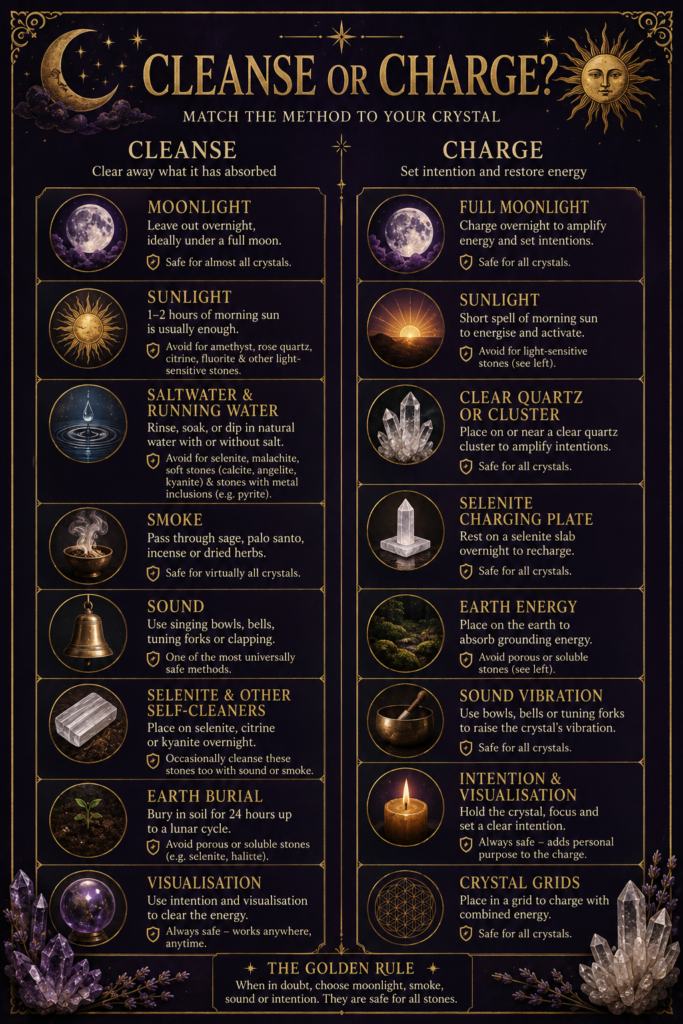
Cleansing a crystal clears the energy it has absorbed from handling, travel, and everyday use, while charging restores or sets its intention going forward. Most guides cover two or three methods and stop there. This one walks through every commonly used technique, moonlight, sunlight, saltwater, running water, smoke, sound, selenite, earth burial, and visualisation, along with which stones to avoid for each, so you can match the method to the crystal actually in your hand.
🔮 Why Cleanse and Charge Your Crystals in the First Place?
In crystal work, cleansing and charging are treated as two separate steps. Cleansing is about clearing out whatever energy a stone has picked up: a stressful week, a long journey, being handled by other people in a shop. Charging is about giving the crystal a fresh intention or purpose once it is clear.
Think of it as resetting, then setting. You would not expect a whiteboard to hold a new message clearly if the old one is still half visible underneath. The same logic applies here: many practitioners cleanse before every major use, and charge whenever they want to align a stone with a particular goal, ritual, or moon phase.
Enhance Your Spiritual Practice
Discover our collection of digital planners and mystical tools designed to deepen your journey with tarot, crystals, and astrology.
Visit Our ShopNone of this is presented as scientifically proven. It is a traditional practice with centuries of use across different cultures, much of it rooted in the folklore behind popular crystals, and its value lies in the ritual and intention behind it as much as the method itself.
🌙 Moonlight Cleansing
Leaving crystals out under the moon, particularly a full moon, is one of the gentlest and most widely used cleansing methods. Place your stones on a windowsill, in a garden, or anywhere they will catch moonlight overnight, then bring them in before sunrise.
Moonlight is considered safe for almost every crystal in a collection, including softer or more porous stones that cannot handle water or direct sun. It is the method most practitioners default to when they are not sure which technique suits a particular stone, and it pairs well with the wider lunar effects covered in our moon phases guide. If you want to make a habit of it, a dedicated moon phase altar gives your crystals a permanent spot to catch the light each cycle.
☀️ Sunlight Cleansing
Sunlight works similarly to moonlight but carries a more energising, active quality rather than a soft reset. An hour or two of direct morning sun is usually enough.
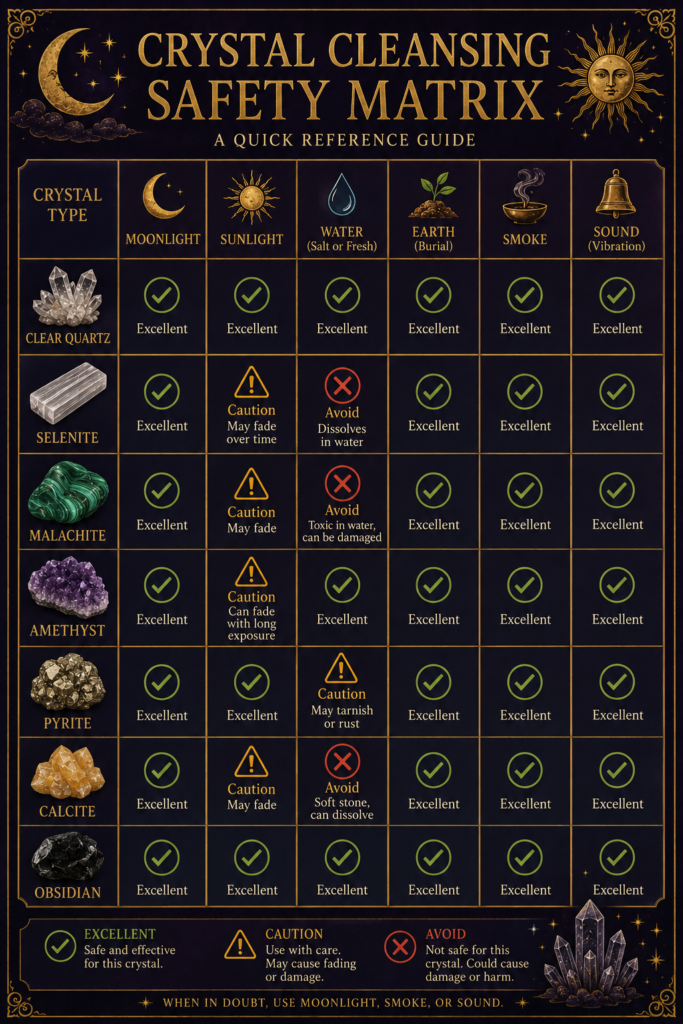
Sunlight is not suitable for every stone. Amethyst, rose quartz, citrine (the natural, heat-treated kind can be more resilient but is best avoided too), fluorite, and other pastel or dyed crystals can fade or discolour with prolonged sun exposure. If a stone is pale, translucent, or known to be light-sensitive, moonlight is the safer choice.
🧂 Saltwater and Running Water
Water-based cleansing, whether that is a saltwater soak, a rinse under a tap, or a dip in a natural stream, has long been used to wash away absorbed energy. Salt in particular is associated with purification in many traditions.
This is also the method with the longest list of exceptions. Selenite dissolves in water. Malachite is toxic when wet and should never be soaked. Softer stones on the Mohs scale, such as calcite, angelite, and kyanite, can be damaged or dulled by water. Anything with metal inclusions, like pyrite, can tarnish or rust. As a general rule, check a crystal’s hardness and composition before it goes anywhere near water or salt.
🕯️ Smoke Cleansing
Passing a crystal through the smoke of sage, palo santo, incense, or dried herbs is a widely used cleansing method, often called smudging in some traditions. Light your chosen material, let it smoke rather than flame, and pass the crystal through the smoke for a few seconds while setting the intention to clear its energy.
Smoke cleansing is safe for virtually any crystal, which makes it a reliable fallback for stones that cannot handle water or sun. It also has the benefit of clearing the energy of a room at the same time.
🔔 Sound Cleansing
Sound cleansing uses vibration rather than a physical element. Singing bowls, bells, tuning forks, or even a few claps near the crystal are used to disrupt and clear stagnant energy through resonance.
This is one of the most universally safe methods, since it involves no direct contact with water, salt, or heat. It is particularly popular for cleansing large collections at once, since the sound reaches every stone in the room rather than just the ones in direct contact with smoke or light.
💎 Selenite and Other Self-Cleansing Stones
Certain crystals are believed to cleanse themselves and, by extension, other stones placed near or on them. Selenite is the most commonly used for this, alongside citrine and kyanite. Placing a crystal on a selenite slab or charging plate overnight is a low-effort way to maintain a collection without constant intervention.
It is worth noting that even self-cleansing stones benefit from an occasional cleanse of their own using sound or smoke, since some practitioners find their effectiveness fades without periodic attention.
🌍 Earth Burial
Burying a crystal in soil, whether in a garden or a plant pot, is a slower method rooted in the idea that the crystal formed within the earth and can return there to release built-up energy. Stones are typically left buried for 24 hours to a full lunar cycle before being dug up and rinsed of soil.
This method suits robust, harder stones like clear quartz, obsidian, and jasper. It is generally avoided for soft or fragile crystals that could be scratched or damaged by direct contact with soil and grit, and it is worth marking the spot so nothing gets left behind.
🧘 Visualisation and Breath
For situations where none of the physical methods are practical, such as at work or while travelling, visualisation offers a method that needs nothing but the crystal itself. Hold the stone, take a few slow breaths, and visualise light or clean energy moving through it, carrying away anything it has absorbed.
This method relies entirely on focus and intention rather than an external element, which makes it useful as a quick top-up between more thorough cleanses rather than a full replacement for them. If you already work crystals into a sitting practice, our guide to using crystals in daily meditation covers how to pair the two.
⏳ How Often Should You Cleanse Your Crystals?
There is no fixed schedule, but most practitioners cleanse new crystals as soon as they arrive, since they have likely passed through many hands before reaching you. Beyond that, a monthly cleanse, often timed to the new or full moon, is a common baseline.
Signs a crystal may need cleansing sooner include the stone feeling unusually heavy, dull, or simply “off” to hold, a noticeable drop in how vivid or responsive it feels during use, or heavy recent use in readings, meditation, or emotional support. If in doubt, cleansing more often causes no harm, so it is generally the safer default.
✨ Cleansing vs Charging: What Is the Difference?
Cleansing and charging are often mentioned in the same breath, but they serve different purposes. Cleansing clears a stone of absorbed or stagnant energy and is a maintenance step. Charging sets or reinforces an intention, whether that is protection, focus, calm, or something specific to a ritual, and is closer to programming the stone for a purpose.
A useful way to remember it: cleanse first, then charge. A stone that is still holding old energy will not hold a new intention as clearly. Many of the methods above, particularly moonlight and sunlight, are also used for charging once the cleanse is complete, simply by leaving the crystal out with a specific intention in mind rather than just the goal of clearing it.
📋 Quick-Reference: Method by Crystal Type
- Safe for almost any crystal: moonlight, smoke, sound, visualisation
- Avoid with pale, dyed, or light-sensitive stones (amethyst, rose quartz, fluorite): sunlight
- Avoid with water-soluble or metal-bearing stones (selenite, malachite, pyrite, calcite): saltwater, running water
- Best for hard, robust stones (quartz, obsidian, jasper): earth burial
- Best for maintaining a whole collection with minimal effort: selenite plates, sound cleansing
🗝️ The Takeaway
Cleansing clears a crystal’s absorbed energy, charging sets its intention, and the two work together rather than interchangeably. Moonlight, smoke, and sound are safe for nearly any stone, while sunlight, saltwater, and running water need to be matched carefully against a crystal’s hardness and composition to avoid damage. Match the method to the stone, cleanse before you charge, and check in with your collection roughly once a month or whenever a piece feels like it needs it. If this is part of a wider routine you are building, see our guide to creating a personal spiritual practice for how cleansing fits into the bigger picture.