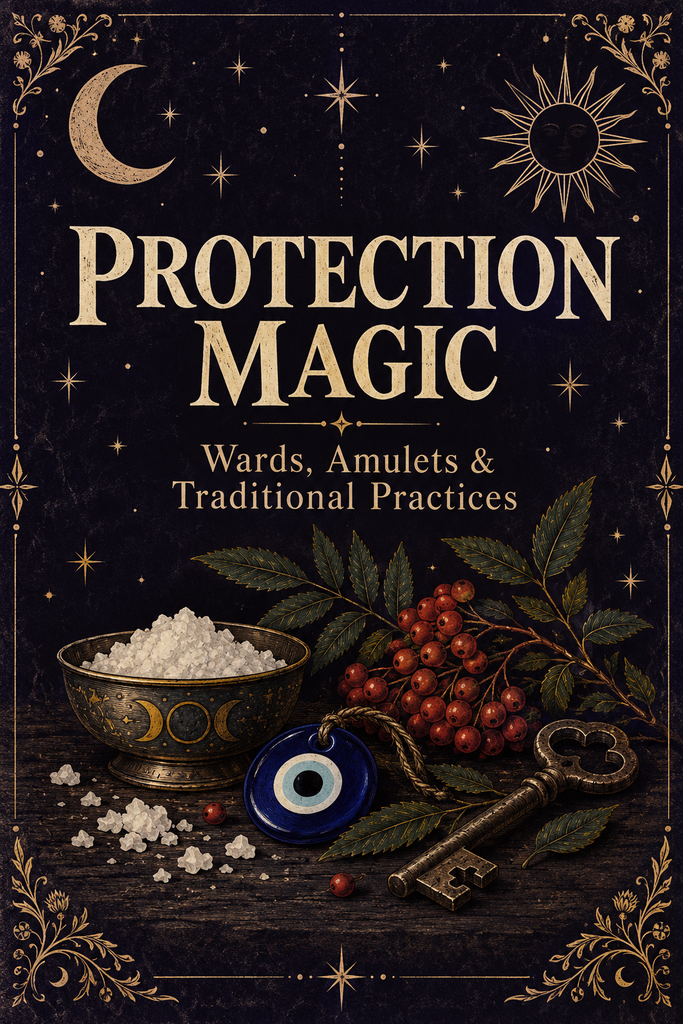
Protection Magic: Wards, Amulets & Traditional Practices for Shielding
We may earn money or products from the companies mentioned in this post.
Long before anyone talked about energy boundaries, people were hanging iron over doors, tucking salt into corners and wearing blue glass eyes on their clothes. Protection magic is one of the oldest threads in human folk practice, and it shows up in almost every culture on earth.
This guide is a tradition-by-tradition tour of how people have protected themselves, their homes and their belongings. Everything here is framed as belief and traditional use, not a promise of any outcome. Think of it as cultural context and a toolkit for the curious, finishing with a simple routine you can build yourself.
🛡️ What Is Protection Magic?
Protection magic is the broad family of practices that aim to keep a person, place or object “shielded” from unwanted influence. The word influence is deliberately loose. Depending on the tradition, it might mean envy, bad luck, careless energy or simply a general sense of being unsettled.
Enhance Your Spiritual Practice
Discover our collection of digital planners and mystical tools designed to deepen your journey with tarot, crystals, and astrology.
Visit Our ShopAt its heart is a belief that we live inside layers of boundaries, and that those boundaries can be reinforced with intention, symbols and everyday materials. Practitioners tend to see it as maintenance rather than drama, closer to locking your front door than to fighting a battle.
It helps to separate a few ideas that often get blended together:
- Warding is setting up a standing boundary around a space or person, so it works quietly in the background.
- Banishing is the active sending away of something already present, usually through a short, focused ritual.
- Shielding is a personal, in-the-moment practice, often visualisation, used to feel contained and steady.
- Boundaries in the everyday sense, such as saying no or limiting time with draining situations, sit alongside all of this and are the most practical protection of all.
This guide focuses on warding and shielding. Clearing spaces of ghosts or hauntings is a different subject entirely, and we leave it to our paranormal sister site.
🧂 Salt: The Everyday Guardian
Salt is probably the most widespread protective material in the world. Because it preserves food and was once precious, many cultures came to see it as pure, incorruptible and powerful.
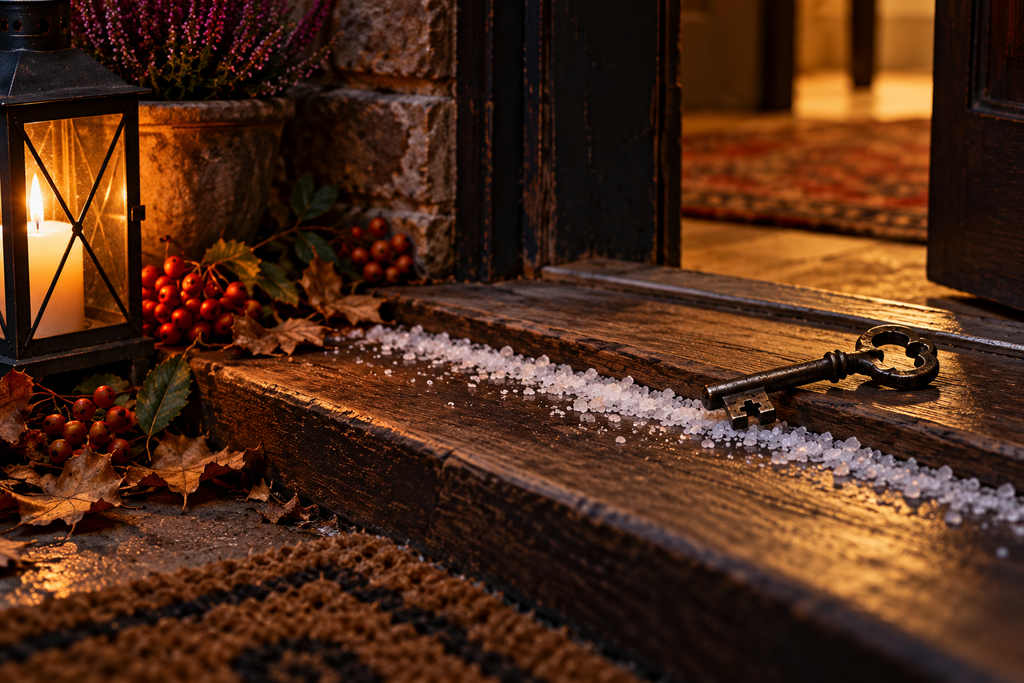
In British and European folk custom, a line of salt across a threshold was believed to keep unwelcome influence from crossing. Spilling salt was considered unlucky, and the habit of tossing a pinch over the left shoulder is a well-known remnant of that belief. In Japan, small piles of salt (morijio) are placed by the doors of shops and restaurants, and salt is scattered in Shinto purification customs.
Modern practitioners use salt in several simple ways:
- A bowl of coarse salt in a corner of a room, replaced regularly
- A pinch carried in a small pouch as a personal charm
- Salt dissolved in water for wiping down doorframes
🔩 Iron and Horseshoes
Iron carries a long reputation as a metal that unwelcome folklore creatures could not abide. In British and Irish tradition, tales of the fair folk often include a warning that cold iron keeps them at bay, which is why nails, scissors and knives were tucked into cradles and doorways.
The horseshoe is the best-known survivor of this idea. Folk custom disagrees about which way it should hang. Some say points up so the luck does not run out, others say points down so the luck pours over those who pass beneath. Both camps are very sure of themselves.
🌿 Rowan, Herbs and Protective Plants
Plants have always been the working materials of folk practice. If you enjoy the botanical side of this subject, our guide to magic plants and herbs goes deeper into their folklore.
The rowan tree, also called the mountain ash, is the star of British, Irish and Scandinavian protective custom. Its bright red berries and the tiny five-pointed star on each one were taken as signs of its guarding nature. People hung rowan sprigs over doors and byres, tied twigs with red thread into small crosses, and carried them as charms.
Other plants with a long protective reputation in European folk tradition include:
- Garlic, hung in kitchens and doorways
- Rosemary, burned or planted near the home
- Juniper, used as a cleansing smoke in Highland and Alpine customs
- Elder, planted by cottages as a guardian tree
- Bay and thyme, tucked into sachets and sleep pillows
A quick note on sage. White sage smudging belongs to Indigenous communities of North America and is considered a closed practice, with a living sacred context. It is also overharvested. If you want to burn herbs, rosemary, juniper or thyme grown and gathered respectfully are traditional alternatives from European folk practice.
🍶 Witch Bottles and Concealed Charms
Witch bottles are one of the more fascinating survivals of British folk protection. From the sixteenth and seventeenth centuries onwards, people in England buried or hid sealed bottles beneath hearths, doorsteps and floors. Archaeologists and museum curators have recorded many examples.
The contents varied, but often included bent pins, nails, thorns, hair or nail clippings and sometimes urine, all sealed with a cork or wax. The belief was that the bottle acted as a trap or decoy, drawing harmful intent away from the household.
Alongside bottles, some homes contained other concealed objects, such as worn shoes tucked into chimneys and wall cavities, and “witch marks” scratched near entrances, including overlapping circles often called daisy wheels.
A modern, gentler version of the idea might use:
- A small jar with salt, a rusty nail or pin, rosemary and a sprig of rowan or thyme
- A cork or beeswax seal
- A quiet spot buried in a plant pot, or hidden near the front door
You do not need the traditional, rather unpleasant, ingredients to appreciate the symbolism of a hidden guardian beneath your home.
🧿 The Evil Eye, Nazar and Hamsa
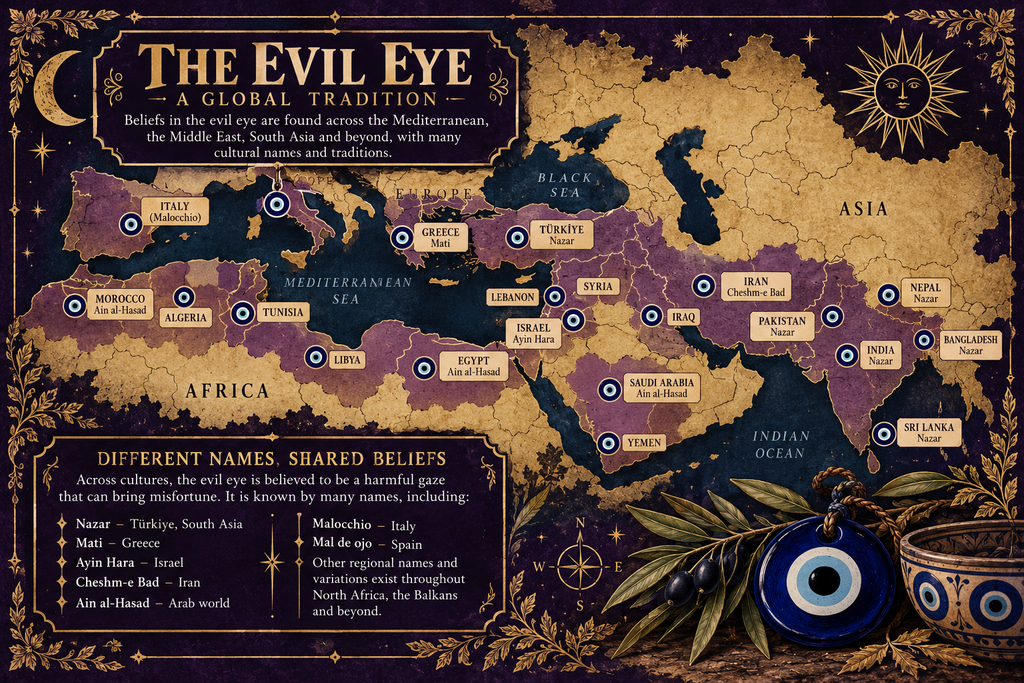
Few protective symbols are as widely recognised as the nazar, the blue glass eye. The belief in the evil eye, a harmful glance born of envy or admiration, is recorded across the Mediterranean, Middle East, South Asia and beyond, and is thousands of years old.
In Turkey, glass nazar beads are hung in homes, cars and nurseries, and pinned to babies’ clothes. In Greece, the matiasma tradition and the mati charm serve a similar role. In many places, a cracked or broken nazar is read as having done its job and is simply replaced.
The hamsa is a hand-shaped amulet, often with an eye in the palm. It is widely used in Jewish and Muslim communities, where it is known as the Hand of Miriam and the Hand of Fatima respectively, and it is also found in wider North African and Middle Eastern culture. For many people these are living religious and cultural symbols, not decorative trends.
If you would like to wear or hang one, it is kind to buy from artisans from those regions where possible and to learn the meaning behind the piece. A glass nazar bead is a small, lovely thing to hang by a front door as a nod to a very old custom.
✨ Sigils, Symbols and Wards
A sigil is a symbol made to hold a specific intention. The idea has roots in medieval and Renaissance ceremonial magic, and it was reshaped in the twentieth century by chaos magic practitioners into the simple method many people use today.
A common modern approach looks like this:
- Write a short intention, such as “my home is a calm and guarded place”
- Remove repeated letters, then combine the remaining ones into a single design
- Simplify the design until it no longer reads as letters
- Draw it where it will be seen only by you, such as on the back of a picture frame or under a doormat
Other traditional protective symbols include the Norse Web of Wyrd and the Vegvisir, the pentagram in various European traditions, protective runes, and the Eye of Horus from ancient Egypt. If you use a symbol from a living tradition, take a moment to learn what it means to the people it comes from.
For divination and symbolism across cultures more broadly, our piece on divination in different cultures is a good companion read.
📿 Amulets vs Talismans
These two words are often used as if they were the same thing, but traditionally they do slightly different jobs.
- An amulet is protective and passive. It is worn or kept to guard against harm, such as a nazar, a hamsa or a rowan cross.
- A talisman is active and purposeful. It is made or chosen to attract something, such as luck, courage or clarity.
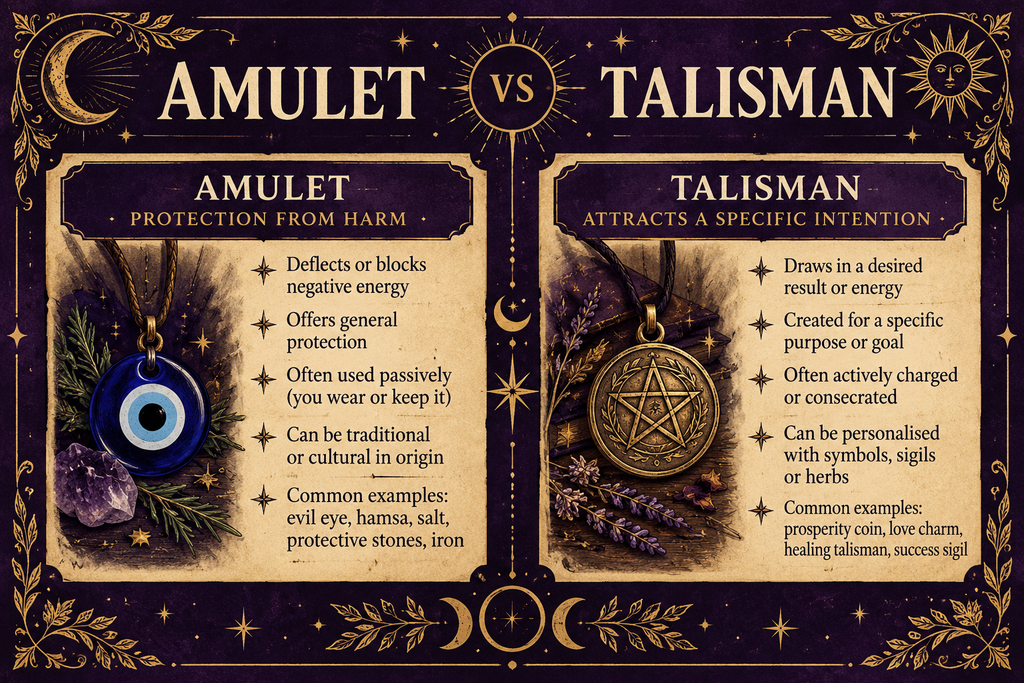
In practice, the line is blurry, and many objects are used both ways. The useful distinction is the intention you bring. If you are choosing an object to feel guarded, you are working in amulet territory.
🔮 Personal Shielding Visualisation
Not all protection requires materials. Shielding by visualisation is a long-standing contemplative practice in modern esoteric circles, and it is also simply a good grounding exercise.
A simple version works like this:
- Stand or sit comfortably and take three slow breaths
- Imagine a soft light gathering at your feet, rising to surround you like an egg or a bubble
- Choose a colour that feels calm to you, such as gold, white or deep violet
- Set the intention that the shield lets in what is welcome and lets go of what is not
- Finish with a breath, and let the image fade when you are ready
Many people use this before a crowded commute or a difficult conversation. It is best thought of as a centring habit, a way of marking a boundary for yourself, not a guarantee of any outcome. If you are struggling with persistent anxiety or distress, please speak to a qualified professional as well.
🪨 Protective Crystals in Brief
Crystals have a long place in modern protection practice, and each one has its own folklore. Rather than repeat those details here, these are the profiles worth reading next:
- Black tourmaline is the classic grounding and boundary stone
- Obsidian is a volcanic glass linked in tradition with shadow work and shielding
- Smoky quartz is a gentler, grounding choice
- Amber has been worn as a protective charm for centuries
- Selenite is associated with clarity and is often used to keep a space feeling light
If you would like to start a small collection, a set of tumbled black tourmaline stones is a friendly entry point, and smoky quartz tumbled stones pair well with it. As an Amazon Associate, we may earn a small commission from qualifying purchases, at no extra cost to you.
🕯️ Build a Simple Protection Routine
You do not need an elaborate ritual. A short, repeatable routine is easier to keep up and tends to feel more meaningful than something complicated.
Here is a three-step framework you can adapt, built around cleanse, set intention and renew.
1. Cleanse. Start by tidying the space or object. Open a window, wipe down the doorframe, and clear clutter near your entrance. If you are using crystals, our guide to cleansing and charging crystals covers the methods in detail.
2. Set intention. Choose one object or symbol, such as a bowl of salt, a nazar, a sigil or a stone. Hold it, and say or think your intention in simple words. Something like “may this home feel calm, settled and guarded” works well.
3. Renew. Protection practices have always been maintained, not done once and forgotten. Replace your salt monthly, refresh herbs with the seasons and revisit your intention at the new moon or whenever life changes.
If you are still shaping your wider practice, our guide to creating a personal spiritual practice is a useful place to continue.
🌙 A Final Thought
Across salt, iron, rowan, glass eyes and carefully drawn symbols, the pattern is clear. People have always wanted to feel safe at home, and they have always used what was close at hand to mark that feeling.
Whether you see these practices as spiritual, symbolic or simply as meaningful heritage, the heart of them is attention. A few minutes spent caring for your space and setting a clear intention can be a grounding ritual in itself.
Take what resonates, leave what does not, and credit the traditions you borrow from. That respect is part of the craft.