Shadow Work for Beginners: A Gentle Introduction
We may earn money or products from the companies mentioned in this post.
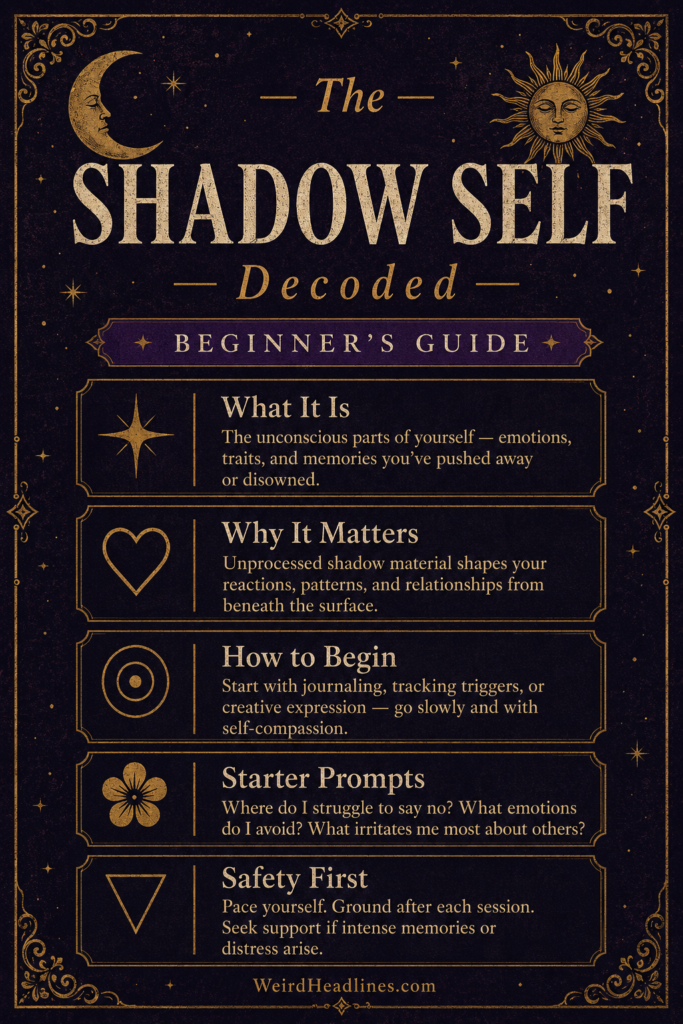
There’s a part of you that you don’t show anyone. Maybe it’s the anger you swallow down, the jealousy you feel ashamed of, or the fear you’ve been carrying since childhood that you can never quite name. In psychology, that’s known as the shadow — and shadow work is the practice of finally turning to face it.
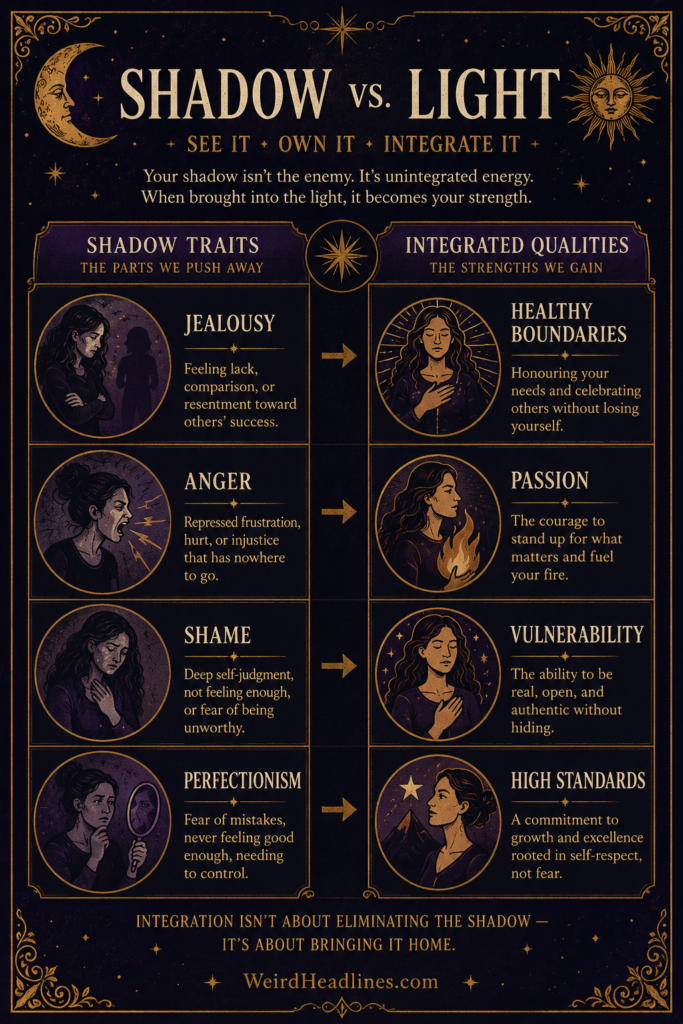
The term comes from Carl Jung, who described the shadow as the unconscious part of the personality that doesn’t fit our idealised image of ourselves. It’s not the “bad” version of you. It’s simply the version that got pushed away — the parts you were taught weren’t acceptable, or that felt too painful to hold onto. Shadow work is the process of bringing those parts back into the light, meeting them with curiosity instead of judgment, and slowly learning how to integrate them.
This isn’t about fixing yourself. It’s about getting honest with yourself in the kindest way possible — especially about the things you’d rather not look at.
Enhance Your Spiritual Practice
Discover our collection of digital planners and mystical tools designed to deepen your journey with tarot, crystals, and astrology.
Visit Our ShopWhat Is the Shadow Self, Really?
The shadow isn’t inherently dark or dangerous. It’s made up of anything you’ve disowned — which could include positive qualities too, like creativity you suppressed or confidence you were told to dial down. More commonly, though, the shadow holds emotions and experiences that were too overwhelming to process at the time: grief, shame, rage, fear, unmet needs.
Because these parts were never fully processed, they don’t just disappear. They influence you from below the surface, showing up as overreactions to criticism, inexplicable jealousy, patterns you keep repeating in relationships, or a persistent sense that something is “off.” Recognising this is actually a relief — it means those reactions aren’t random. They’re pointing at something real.
Shadow work isn’t therapy, and it isn’t a quick fix. But for many people, it becomes one of the most honest and valuable parts of their spiritual practice.
Why a Gentle Approach Matters for Beginners
Here’s the thing about shadow work that doesn’t always get said clearly enough: it can bring up big feelings. Old wounds. Complicated memories. Things you buried for a reason.
That’s not a warning to stay away — it’s a reason to go slowly and treat this a bit like emotional physiotherapy. You wouldn’t push through acute pain at the physio and expect it to help. The same logic applies here. Beginners are often advised to start with shorter, lighter sessions and to stop when something feels destabilising or overwhelming — not to push through, but to pause, breathe, and ground yourself first.
Self-compassion is the non-negotiable foundation. If you go into shadow work with a “fix what’s wrong with me” energy, you’ll likely find the process brutal. But if you approach it with genuine curiosity — as if you’re getting to know a part of yourself that has always deserved more kindness — it becomes something quite different. Something that can genuinely shift things.
If you have a history of trauma or significant mental health challenges, working with a therapist alongside your personal practice is worth considering. Shadow work can open doors that are better navigated with professional support.
Four Gentle Ways to Begin
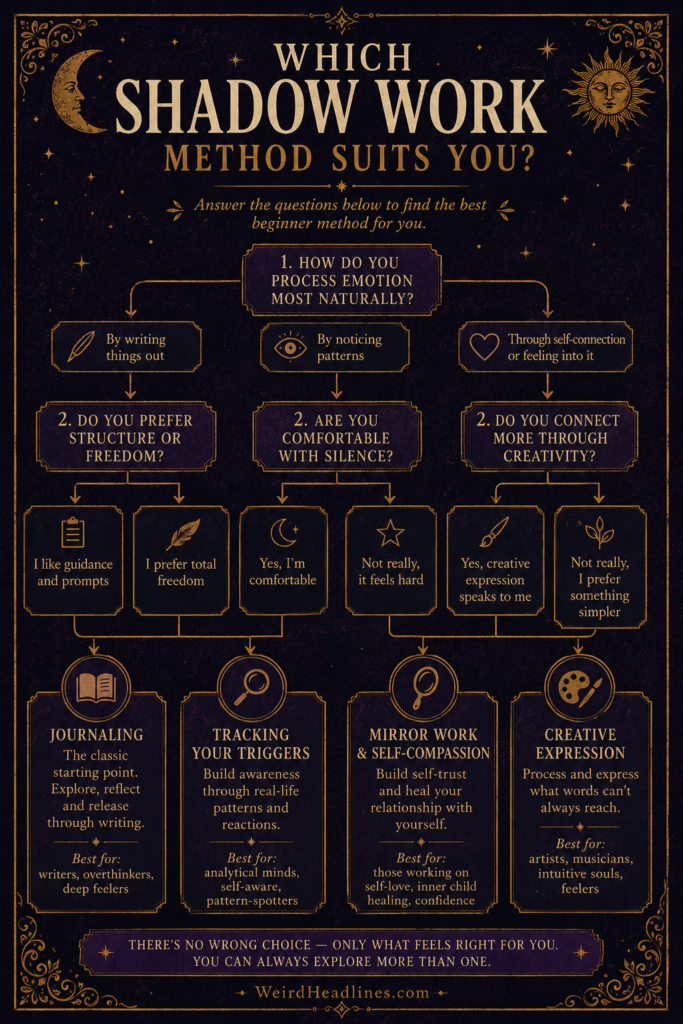
You don’t need a dramatic ritual or hours of alone time to start exploring your shadow. These are some of the most accessible entry points — choose what feels manageable, and start there.
Journaling
Journaling is probably the most widely recommended starting point for shadow work, and for good reason. It gives you a private, low-pressure space to explore thoughts and feelings without anyone watching. You can move at your own pace, stop when you need to, and come back when you’re ready.
A useful technique is stream-of-consciousness writing: set a timer for ten or fifteen minutes, write without stopping, and don’t censor yourself. Don’t worry about grammar, coherence, or what someone else would think if they read it. The point is to bypass the inner editor and let things surface that you wouldn’t normally say out loud.
If you’d like a structured companion for this kind of journaling, our Shadow Work Journal was designed exactly for this — with guided prompts that take you into your shadow gently and progressively, without throwing you in at the deep end.
Tracking Your Triggers
One of the most practical shadow work tools doesn’t require a journal at all. It just requires noticing.
Pay attention to moments when you react more strongly than the situation seems to warrant — disproportionate anger, sudden shame, an unexpected spike of jealousy or resentment. These are often where the shadow is closest to the surface. The reaction isn’t the problem; it’s the signal. It’s pointing at something underneath that hasn’t been fully felt or understood yet.
When you notice a trigger, try pausing before reacting and asking yourself: “What story am I telling myself right now?” and “Where have I felt this before?” You don’t need to answer those questions immediately — just holding them can begin to loosen something.
Mirror Work and Self-Compassion Exercises
This one can feel a little awkward at first, but it’s surprisingly effective. Mirror work involves looking at your own reflection and speaking to yourself with kindness — repeating a simple phrase like “I see you” or “I love you” and then sitting with whatever feelings come up. Then journaling about those feelings afterward.
What tends to emerge is revealing. The discomfort, the urge to look away, the self-critical thoughts that arise immediately — all of that is information. The practice is less about the words and more about maintaining an attitude of genuine care toward yourself, even when parts of you resist it.
Creative Expression
Not everyone processes through words, and shadow work doesn’t require them. Drawing, painting, music, movement, and poetry can all be powerful ways to access what’s underneath — sometimes more directly than journaling, because they bypass the analytical mind entirely.
You might try sketching or painting without a plan, letting whatever wants to come out, come out. Or put on music that matches how you’re feeling and let your body move however it wants to. Afterward, sit quietly and notice what arose. You can journal about it if you like, or simply stay with it. The expression itself is part of the work.
Starter Prompts for Shadow Work Journaling
These prompts are designed to be entry points, not excavations. They start with gentler territory and move toward more reflective ground. Answer slowly. If something feels too charged, come back to it another time.
- What are my core values? Am I actually living by them, or just claiming them?
- How would I describe myself to a stranger? How might someone close to me describe me differently?
- In what situations am I most hard on myself? What am I afraid it means about me?
- Where do I struggle to say no? What do I fear would happen if I did?
- What emotions am I most uncomfortable feeling? What do I do to avoid feeling them?
- Is there a quality in someone else that irritates or provokes me intensely? Could any part of that quality live in me too?
- Describe a complicated memory from childhood and how it may still be shaping how you move through the world today.
That last one can be heavy. Go gently. You don’t have to resolve anything — you just have to look, kindly, and then close the journal and go make a cup of tea.
Shadow Work Prompt Cards
Draw a card and sit with whatever surfaces
There are no right or wrong answers. Write slowly, and gently.
How to Create a Safe Container for Your Practice
Shadow work goes better when you build a few simple structures around it. Think of it less like sitting down to suffer through something, and more like creating a cosy, protected space where it’s safe to be honest.
A dedicated notebook just for shadow work can help — something that feels intentional rather than an afterthought. A regular time, even if it’s short (fifteen or twenty minutes once or twice a week), tends to work better than marathon sessions when you happen to be in the mood. The consistency signals to your nervous system that this is something you’re choosing, not something happening to you.
Grounding practices after a session are genuinely useful — a walk outside, a shower, making food, five minutes of breathing, or time with an animal. These aren’t just nice extras; they help you move the energy through and come back to the present. If you’d like a starting point for that kind of intentional, grounded practice, Creating Your Personal Spiritual Practice (Without the Overwhelm) has some practical ideas worth exploring.
And know when to stop. If something comes up that feels too big — panic, intense flooding of difficult memories, or a prolonged low that you can’t shake — that’s the moment to slow down and seek support. Not a failure. A completely reasonable human response.
Shadow Work and the Spiritual Path
For many people who come to shadow work through a spiritual lens, it becomes an essential part of the practice — not separate from it, but woven through it. The idea that you can do spiritual work without ever looking at your own shadow is one that most traditions, in their more honest moments, would push back on.
The Moon card in tarot speaks directly to this. It’s a card about what lives beneath the surface, the unconscious material that shapes perception — and it often appears when shadow work is calling. If you’ve been drawn to explore your inner world and you’re curious about how astrology and tarot can serve as mirrors, The Moon Tarot Card: Illusion, Intuition & the Shadow Self goes into that in depth.
Similarly, the Full Moon in Scorpio is one of the astrological moments most associated with shadow work and deep release — if you want to align your practice with the lunar cycle, that’s a powerful time to do it.
Some people also find that working with crystals supports the process. Obsidian, in particular, has long been associated with shadow work — it’s considered a truth-showing stone that doesn’t let you look away, while also offering protective grounding. You can read more about it in our guide to Obsidian Crystal: Shadow Work & Powerful Protection.
What Integration Actually Looks Like
One of the things that can be frustrating about shadow work is that there’s no dramatic finish line — no moment where the work is “done” and you’re suddenly a more enlightened version of yourself. Integration is quieter than that.
It looks like noticing a trigger and, instead of reacting from it, getting curious about it. It looks like a feeling you used to avoid becoming something you can sit with, if only briefly. It looks like recognising one of your old patterns in the middle of playing it out, and making a slightly different choice. Small shifts, accumulating over time.
You don’t need to love all parts of yourself to do this work. You just need to be willing to acknowledge them, to stop pretending they don’t exist, and to meet them — even just occasionally — with a little more kindness than you have before. That’s enough. That’s actually quite a lot.
Continue Your Journey
- Full Moon in Scorpio: Shadow Work, Release & Transformation — Working with the lunar cycle to support deeper release
- Obsidian Crystal: Shadow Work & Powerful Protection — A grounding ally for shadow work practice
- The Moon Tarot Card: Illusion, Intuition & the Shadow Self — Understanding what lives beneath the surface
- Creating Your Personal Spiritual Practice (Without the Overwhelm) — Building a sustainable practice that holds you
- Scorpio Season: Your Guide to Transformation and Shadow Work — The season most aligned with this kind of inner work
Have you started exploring your shadow self? Share what’s brought you to this practice — or what’s made you hesitant — in the comments. There are no wrong answers here.
Want more gentle guidance for your spiritual practice? Subscribe to the Weird Headlines newsletter and get new posts delivered straight to your inbox.