Six of Pentacles: Generosity, Reciprocity & the Balance of Giving and Receiving
We may earn money or products from the companies mentioned in this post.
The Five of Pentacles left us out in the snow, cold and overlooking the lit window beside us. The Six of Pentacles is where someone finally opens the door. But this is not a simple card about kindness, because it puts a pair of scales in the middle of the picture.
Who has the coins, who needs them, and who decides what is fair? This guide walks through the card’s imagery, its upright and reversed meanings, and what it asks of you whether you are the one giving or the one receiving.
🪙 Card Description: The Merchant and the Scales
In the Rider-Waite-Smith tradition, the Six of Pentacles shows a well-dressed merchant standing in the centre of the card. In one hand he holds a set of scales. With the other, he drops a coin into the palm of one of two figures kneeling at his feet.
Enhance Your Spiritual Practice
Discover our collection of digital planners and mystical tools designed to deepen your journey with tarot, crystals, and astrology.
Visit Our ShopThe kneeling figures look worn and in need. Above them, six pentacles float in the air, arranged so that the eye travels from the giver down to the people waiting below.
Waite’s own description is brief: a person in the guise of a merchant weighs money in a pair of scales and distributes it to the needy and distressed. That one sentence carries the whole card, and the word “weighs” matters as much as the word “distributes”.
⚖️ Symbolism: What the Scales Are Really Saying
The scales are the heart of this card. Unlike the open-handed generosity of some other suits, the Six of Pentacles shows giving that is measured, deliberate and, ideally, fair.
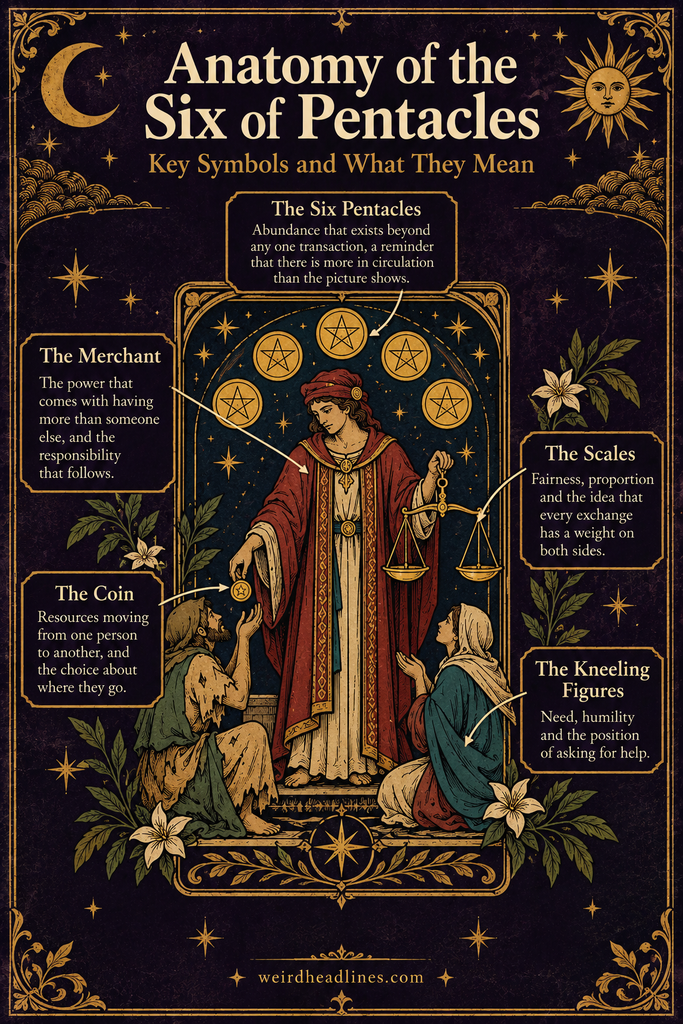
Here are the main symbols and what they traditionally represent:
- The scales: fairness, proportion and the idea that every exchange has a weight on both sides.
- The coin in the merchant’s hand: resources moving from one person to another, and the choice about where they go.
- The kneeling figures: need, humility and the position of asking for help.
- The six pentacles above: abundance that exists beyond any one transaction, a reminder that there is more in circulation than the picture shows.
- The merchant’s status: the power that comes with having more than someone else, and the responsibility that follows.
Notice that the merchant stands while the others kneel. That difference in height is the card’s quiet question. Is this exchange between equals, or is someone holding the scales over someone else?
This is why the card reads as more than “charity”. It asks about the structure of giving, not just the act.
🌟 Upright Meaning: Generosity, Fair Exchange and Support
Upright, the Six of Pentacles is traditionally read as a card of generosity, support and balanced exchange. Resources are moving, and they are moving in a way that feels fair.
It can point to a time when help is on offer, or when you are in a position to offer it. It can also describe a healthy give-and-take in a relationship, a workplace or a community.
Common upright themes include:
- Sharing what you have without strings attached
- Receiving help gracefully
- Fair pay, fair terms and fair treatment
- Mentorship, where knowledge is passed down freely
- Community care and mutual support
If you are asking a question in a reading and this card appears, it may be inviting you to look at the flow of energy and resources in your life. Where is it moving freely? Where is it stuck?
The key word is balance. The upright card is not about giving until you are empty, and it is not about taking whatever is offered.
🔄 Reversed Meaning: Strings Attached, Debt and One-Sided Giving
Reversed, the scales tip. The Six of Pentacles in reverse is traditionally linked to giving that comes with conditions, help that creates debt and exchanges that feel uneven.
Waite’s reversed meanings include desire, envy and illusion, which gives a good clue to the shadow side of this card. Generosity can become a way of buying loyalty, and gratitude can become a leash.
Reversed themes often include:
- Gifts with strings attached
- One person always giving and the other always taking
- Debt, owing and feeling obligated
- Pride that stops you from asking for help
- Resentment on either side of an exchange
- Charity used to show status rather than to help
Sometimes the reversed card is a mirror, asking whether you are keeping score, giving to be seen or refusing help because accepting it feels like weakness.
For a deeper look at how reversals work in general, our guide to upright versus reversed tarot explains the different ways readers approach them.
💞 Love and Relationships
In a relationship reading, the Six of Pentacles is about reciprocity. It asks whether care is flowing in both directions.
Upright, it can suggest a partnership where each person gives according to their capacity and receives without guilt. One partner might carry more at certain times, such as during illness, a career change or grief, and the other steps in without making it a debt.
Reversed, it can point to an imbalance. One person may be doing the emotional labour, the planning, the listening or the earning, while the other quietly accepts it. Or it may show a relationship where affection is used as currency: “after everything I’ve done for you”.
If you are single, the card may be asking how you handle giving and receiving in your friendships and family. Are you the one who always helps, but never asks?
💼 Career and Finance
The Six of Pentacles is one of the most direct cards for work and money, because the merchant is literally handling currency. Traditionally, it relates to fair exchange in professional life.
Upright, it may point to fair pay, a generous employer, a useful mentor or a team that shares credit. It can also represent your own position as someone with resources, knowledge or influence to share.
Reversed, it can suggest unfair terms, an employer who gives with one hand and takes with the other, or a favour that turns out to be a trap. It can also describe the pressure of owing someone professionally.
This card should not be read as financial advice or a prediction of a particular outcome. In a reading it works best as a prompt to look at the fairness of your working relationships and how you handle shared resources.
Useful questions: am I paid and recognised fairly for what I give? Do I share knowledge freely, or hold it back out of fear?
🔮 Spiritual and Personal Growth
On a personal level, the Six of Pentacles is a lesson in circulation. In many esoteric traditions, the idea is that what we hold too tightly stagnates, and what moves tends to renew itself.
The card invites you to examine your relationship with both sides of the exchange. Some people are comfortable giving but cannot receive. Others take easily but never offer anything back.
Neither position is wrong in itself, but both can be habits worth noticing. Learning to receive can be a spiritual practice as much as learning to give.
It also asks about intention. When you give, what are you really offering: help, or a performance of helpfulness? When you receive, can you accept without turning the gift into shame?
If you work with a spiritual practice, you might use this card as a prompt for a quiet reflection on what you owe, what is owed to you and what you can release.
🎭 Reading It as the Giver and as the Receiver
One of the most useful ways to read this card is to ask which figure you are in the picture. The answer may change depending on the question, and it can change from one week to the next.
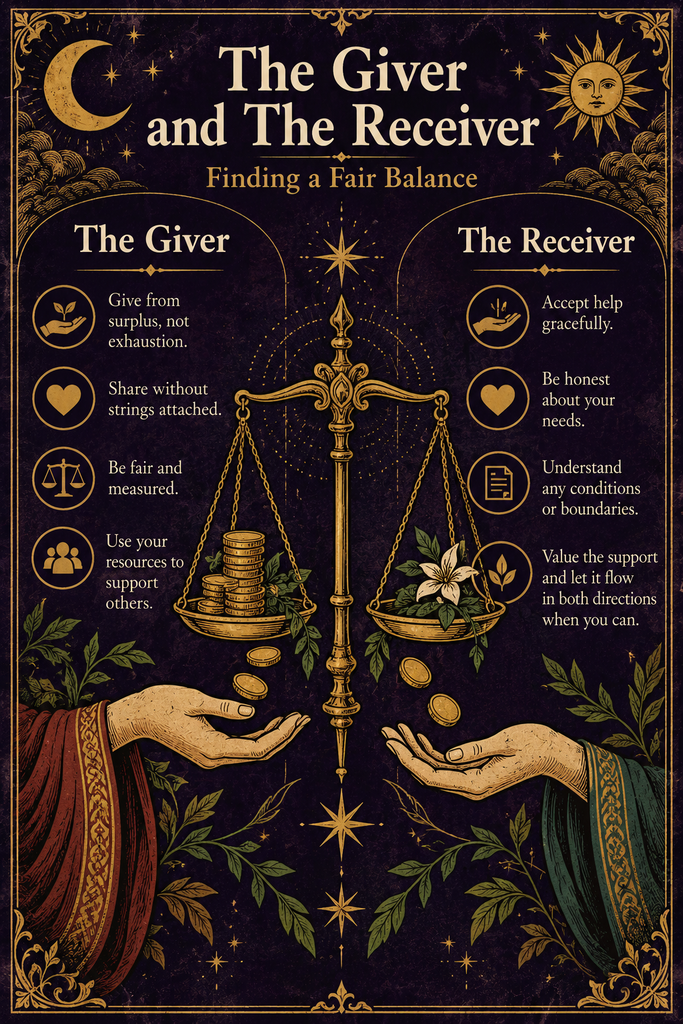
If you are the giver (the merchant):
- Are you giving from surplus, or from exhaustion?
- Do you expect something in return, and have you said so?
- Are you treating the person receiving as an equal?
- Are you giving what is needed, or what makes you feel good?
If you are the receiver (the kneeling figure):
- Can you accept help without apologising for needing it?
- Are you honest about what you need, rather than what feels acceptable to ask for?
- Do you understand the terms, if there are any?
- Are you ready to give back when your situation changes?
Both positions require honesty. The giver has to be honest about motives, and the receiver has to be honest about need.
It also helps to remember that these roles are not fixed. The person kneeling today may be the merchant next year, and the best version of this card knows it.
🔗 How It Follows the Five of Pentacles
The Six of Pentacles comes straight after the Five of Pentacles, and the progression is worth noticing. The Five shows two figures struggling through the snow, passing a lit church window without seeing it. The help is there, but they do not notice it.
In the Six, the help has arrived. The question is no longer “is anyone going to help?” but “how does help actually work between people?”
Seen this way, the Six of Pentacles is the answer to the Five’s overlooked help. It also adds complexity: help can be wonderful, and it can also come with power, pride and expectation.
If you want to see where the suit began, the Ace of Pentacles introduces its themes of practical foundations.
🧭 Tips for Interpreting the Six of Pentacles in a Spread
How you read the card depends on the question, the position in the spread and the cards around it.
- In a past position: it may describe help you received, or a time when you gave generously. Consider whether the exchange still feels settled.
- In a present position: it may point to a current exchange of resources, support or obligation. Ask which side of the scales you are standing on.
- In a future position: it may suggest that an offer or opportunity for support is approaching, or that you will soon be in a position to give. Treat this as a theme to watch rather than a promise.
- As advice: it often means to look at fairness. Give what you can, accept what you need and say what you expect.
- As an obstacle: it can show that pride, debt or an imbalanced exchange is getting in the way.
Next to the Justice card, it can strengthen the theme of fairness and consequence. Our Justice tarot card guide shows how the two cards share scales but ask different questions.
Alongside the Four of Pentacles, it contrasts holding on with letting go.
If you are new to reading spreads, Tarot 101 is a good place to build confidence before working with court cards and layered meanings.
✨ Reflection Prompts
Use these journaling questions on their own or alongside a reading. There are no right answers, only more honest ones.
- When did someone last help you without making you feel small, and how did you respond?
- When did you last give and feel resentful afterwards? What was missing?
- What do you find easier, giving or receiving, and why might that be?
- Is there an exchange in your life that feels uneven? What would a fairer balance look like?
- What could you share this month that costs you little but means a lot to someone else?
📝 Keywords at a Glance
Upright: generosity, fair exchange, support, gratitude, sharing, mentorship, community, balance
Reversed: strings attached, debt, one-sided giving, pride, envy, power imbalance, obligation, resentment
❓ Frequently Asked Questions
Is the Six of Pentacles a yes or a no?
Tarot cards are not strictly yes or no, but the Six of Pentacles leans towards a positive answer when the exchange is fair and generous. Reversed, it suggests the answer depends on conditions that have not yet been made clear.
Does the Six of Pentacles mean money is coming?
Not necessarily. It is a card about the movement of resources, which can include money, but also time, knowledge, care and support. It describes a theme rather than predicting a specific outcome.
What does the Six of Pentacles mean as a person?
It often describes someone generous, fair-minded and resourceful, such as a mentor, a benefactor or a dependable colleague. Reversed, it can describe someone who gives with conditions or likes to be seen as generous.
💬 Over to You
The Six of Pentacles asks a question that is easy to avoid: are the scales in your life balanced, and who is holding them?
Next time you pull this card, pause on the position of the merchant and the position of the kneeling figures. Which one feels more familiar right now?
If you have a story about giving, receiving or finding the balance between the two, share it in the comments. And if you are working through the Pentacles suit, keep an eye out for the next card in the series.