Four of Pentacles: Security, Control & Holding On
We may earn money or products from the companies mentioned in this post.
The Pentacles suit has moved from the raw promise of the Ace, through the balancing act of the Two, and into the collaborative mastery of the Three. Now the sequence turns inward and gets quieter. The Four of Pentacles asks a more private question: once you have something worth keeping, what are you willing to do to keep it?
This is a card about grip rather than growth. It rewards a closer look at where security tips into fear, and where sensible caution curdles into isolation.
🪙 Symbolism & Meaning
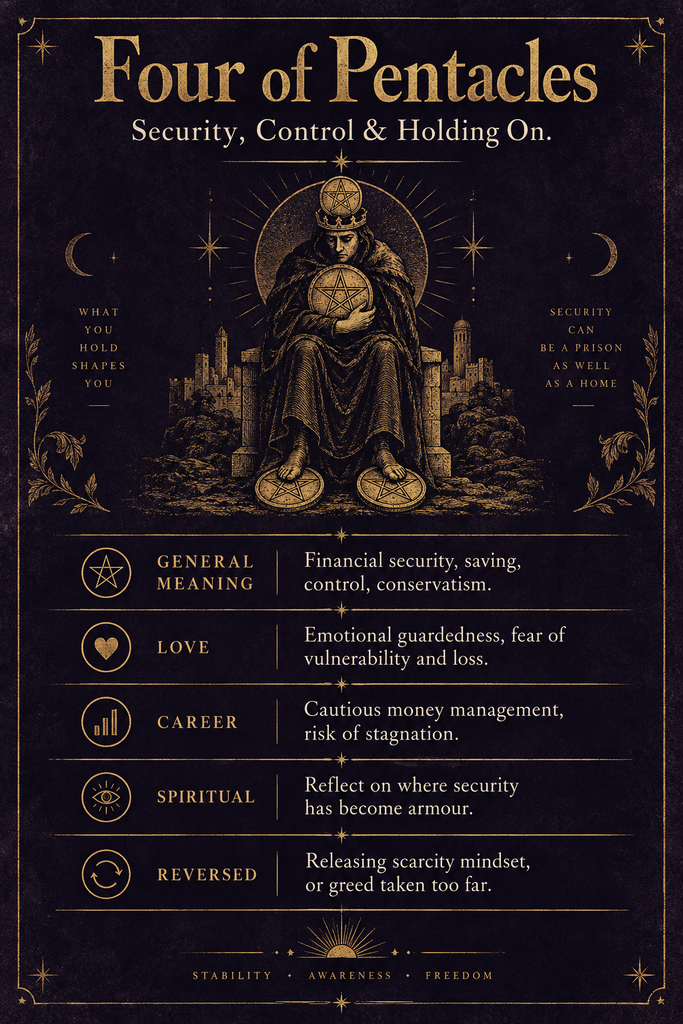
In the Rider-Waite-Smith image, a figure sits on a stone bench at the edge of a city, spine straight and expression closed. A coin balances on his crown, another is clutched flat against his chest, and two more sit trapped beneath his feet.
Enhance Your Spiritual Practice
Discover our collection of digital planners and mystical tools designed to deepen your journey with tarot, crystals, and astrology.
Visit Our ShopEvery pentacle on this card is pinned down. None of them are being spent, shared, or even properly looked at. He has built a wall of coins around his own body, and the town behind him carries on without him.
Look closer at where each coin sits and the card starts to describe several kinds of holding on at once. The coin balanced on his crown suggests control over his own thinking, the coin pressed to his chest suggests emotional attachment, and the two coins trapped beneath his feet suggest a foundation built on past security rather than present growth. Together, they sketch someone defending every angle simultaneously.
That posture is really the whole card. The Four of Pentacles is not primarily about wealth. It is about the instinct to seal resources off from risk, from other people, and sometimes from your own enjoyment of them.
Where the Three of Pentacles asked what you build with others, the Four asks what happens once the building is finished and you are standing in front of it alone, unwilling to let anyone move a single stone. For context on how this card follows on, Three of Pentacles is the previous instalment in this series.
🔒 Upright Meaning
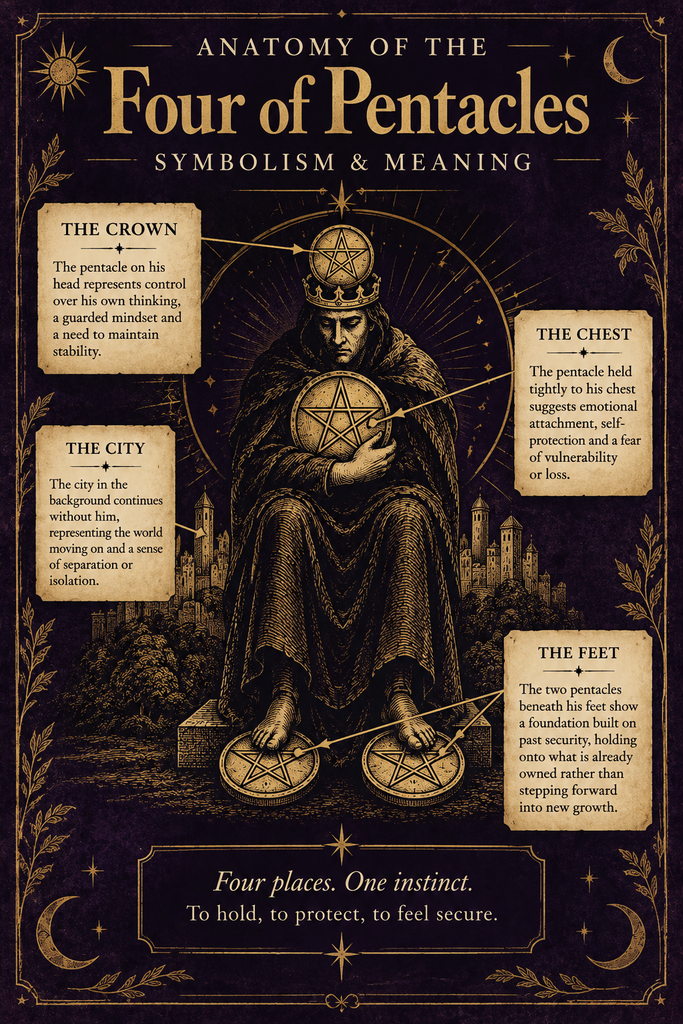
Upright, the Four of Pentacles is traditionally read as financial security, saving, and a conservative approach to resources. In its healthiest form, it reflects the discipline of someone who has worked hard for stability and intends to protect it.
This is the card of the closed fist rather than the open hand. It favours holding onto what you already have over gambling on something new, and there is genuine wisdom in that instinct when it is used with intention.
The catch is that tradition also treats this card as a caution. Held too tightly for too long, the same discipline stops being sound stewardship and starts to look like fear dressed up as good planning.
Common upright associations include:
- Saving, budgeting and financial caution
- A strong need for control over outcomes
- Conservatism and resistance to change
- Emotional or material self-protection
🔄 Reversed Meaning
Reversed, the Four of Pentacles can point in two quite different directions, and reading it well means paying attention to which one fits the rest of the spread.
One reading is release. The grip loosens, scarcity thinking eases, and generosity becomes possible again, whether that is generosity with money, time, or affection.
The other reading sits at the opposite extreme. Reversed, this card can also describe greed, materialism, or self-interest that has stopped answering to anyone else, where the earlier caution has hardened into something closer to hoarding.
Traditional practice holds that context decides which meaning fits. A reading already full of openness and movement points toward release. A reading full of tension around money or possessions points toward the harder edge of the same instinct.
A useful way to tell the two apart is to notice what question is actually being asked. A querent working through letting go of fear tends to point toward release, while one facing the consequences of excess or self-interest tends to point toward the harder, greed-tinged reading.
🖤 Love & Relationships
In matters of the heart, the Four of Pentacles speaks to emotional guardedness. It can describe someone who finds it genuinely difficult to be vulnerable, not out of coldness, but from a quiet fear that openness invites loss.
For those already partnered, this card may reflect a fear of losing what has been built together. In practice, that fear can look like reluctance to discuss feelings honestly, or a habit of holding onto old grievances rather than releasing them.
For those reading for themselves while single, it often points to boundaries that have hardened into walls. Self-protection has its place, and this card is traditionally read as a nudge to notice when caution has quietly become the only mode available to you.
None of this means the connection or the capacity for one lacks depth. It often means the depth is there but heavily guarded, with care expressed through steadiness and providing rather than through open emotional exchange.
💰 Career & Finance
Professionally, this card is traditionally associated with cautious, methodical money management. It favours steady saving over speculative risk, and a preference for the familiar over the untested.
That caution can be a genuine strength, particularly after a period of instability. Traditional readings note that it becomes a liability when it slides into stagnation, where fear of losing ground quietly prevents any forward movement at all.
At work specifically, the Four of Pentacles can describe someone clinging to a role, a process, or a level of control that once served them but now limits their growth. It is less a card about scarcity of resources and more a caution about scarcity of willingness to loosen the hold.
In practical terms, this can look like turning down a promotion because change feels risky, or resisting a new system simply because the old one still technically works. The instinct to protect what is already functioning is not wrong in itself, but tradition reads this card as a reminder that no position stays safe forever purely because it once did.
✨ Spiritual & Personal Growth
Read as a belief-based practice rather than a prediction, the Four of Pentacles invites an honest look at where security has quietly become armour. It does not tell you what will happen. It offers a prompt for reflection on a pattern you may already recognise in yourself.
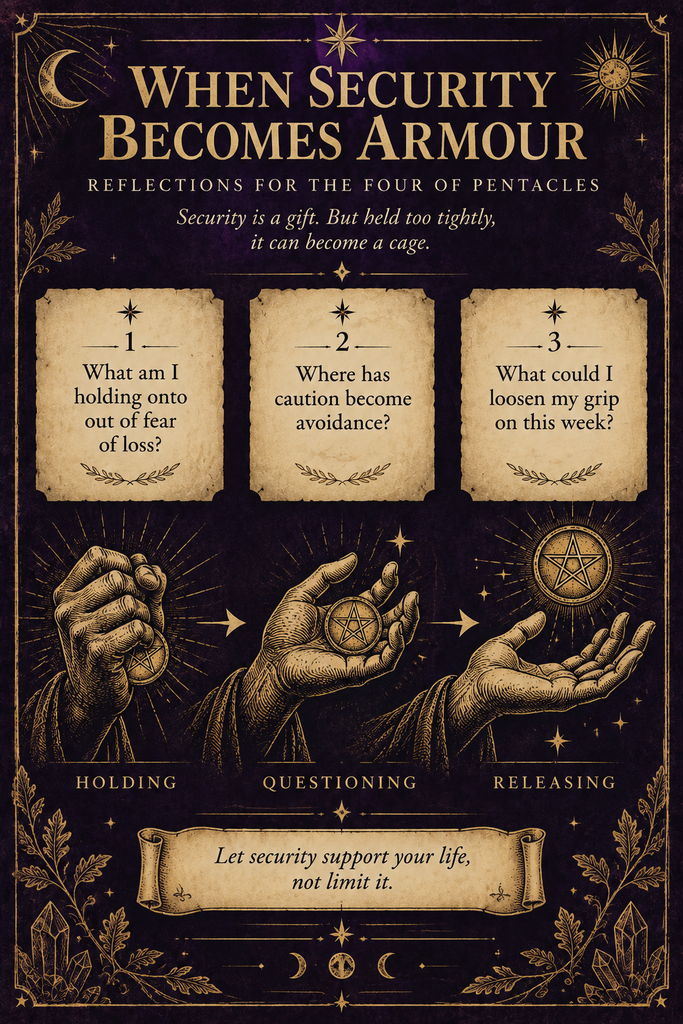
If this card appears in your own spread, it can help to sit with a few questions rather than reaching straight for an answer:
- What am I holding onto right now purely out of fear of loss?
- Where has caution served me well, and where has it quietly become avoidance?
- If I loosened my grip on one thing this week, what would that look like in practice?
Traditional tarot practice treats this kind of reflection as the real value of the card, whether it turns up in a love spread, a career spread, or a general daily pull. For a fuller sense of how this suit’s energy evolves, the Ace of Pentacles is worth revisiting as a counterpoint, showing the same material energy before it hardens into control.
Practical Interpretation Tips
When the Four of Pentacles turns up, pay attention to its neighbours in the spread. Cards of movement or change sitting alongside it often suggest the grip is due to loosen, deliberately or otherwise.
Position matters almost as much as the card itself. In a past position, it may describe old scarcity thinking you have already outgrown. In a future position, it is worth treating as a gentle caution rather than a fixed outcome.
If you are working through a full tarot spread built around this card, resist the urge to read it in isolation. The Four of Pentacles rarely tells the whole story on its own, and its meaning shifts considerably depending on what surrounds it.
Above all, this is a card of instinct rather than destiny. Traditional belief holds that naming the instinct, whether protective or fearful, is usually the first step in deciding whether to keep holding on.