Egyptian Zodiac Signs: A Complete Guide to Astrology of the Nile
We may earn money or products from the companies mentioned in this post.
If you have already found your place in the Celtic tree calendar or traced your year through the Chinese zodiac, Egyptian astrology offers a genuinely different way of reading a birth date. Rather than mapping the sky’s constellations, this system follows the ancient Nile’s agricultural calendar and hands each stretch of the year to the protection of a particular deity. It sits alongside the other alternative zodiacs in modern esoteric practice, built on Egyptian cosmology rather than tropical astronomy. Here is how the system works, what the twelve signs are, and how to find where your own birthday falls.
🌊 How Egyptian Astrology Works
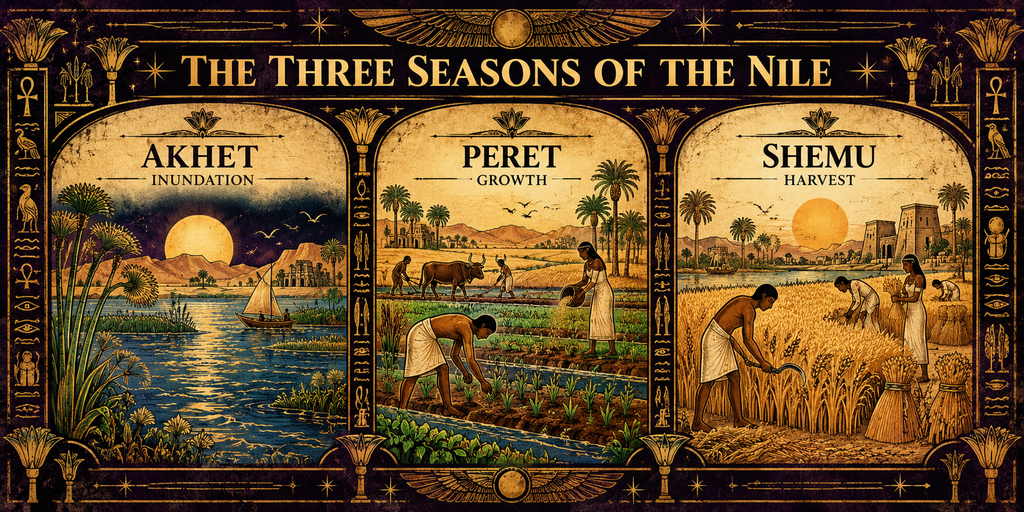
Ancient Egypt ran on a 365-day civil calendar built around the Nile’s yearly flood cycle, not the zodiac constellations used in Western tropical astrology. The year split into three seasons: Akhet (inundation), Peret (growth) and Shemu (harvest), each governing when fields flooded, when crops were sown and when they were brought in.
Modern Egyptian astrology, a revival practice rather than a surviving ancient text, maps twelve sign-periods onto that agricultural year. Each period is placed under the protection of a specific deity from the Egyptian pantheon, such as Amun-Ra, Isis or Anubis, rather than a constellation.
Enhance Your Spiritual Practice
Discover our collection of digital planners and mystical tools designed to deepen your journey with tarot, crystals, and astrology.
Visit Our ShopThe most noticeable difference from Western astrology shows up straight away. A Western sun sign covers one continuous month. An Egyptian sign often appears twice, or even three times, scattered across the calendar. Someone ruled by Isis, for instance, might be born in March, October or December. This reflects the Nile’s own rhythm, where the same agricultural conditions recur more than once a year, rather than following one uninterrupted seasonal arc.
Because the system centres on deity rulership and river-linked timing, it is best understood as a parallel symbolic language rather than a literal ancient artefact. It gives practitioners another lens for self-reflection, sitting comfortably alongside Western, Chinese, Norse and Celtic frameworks rather than replacing any of them.
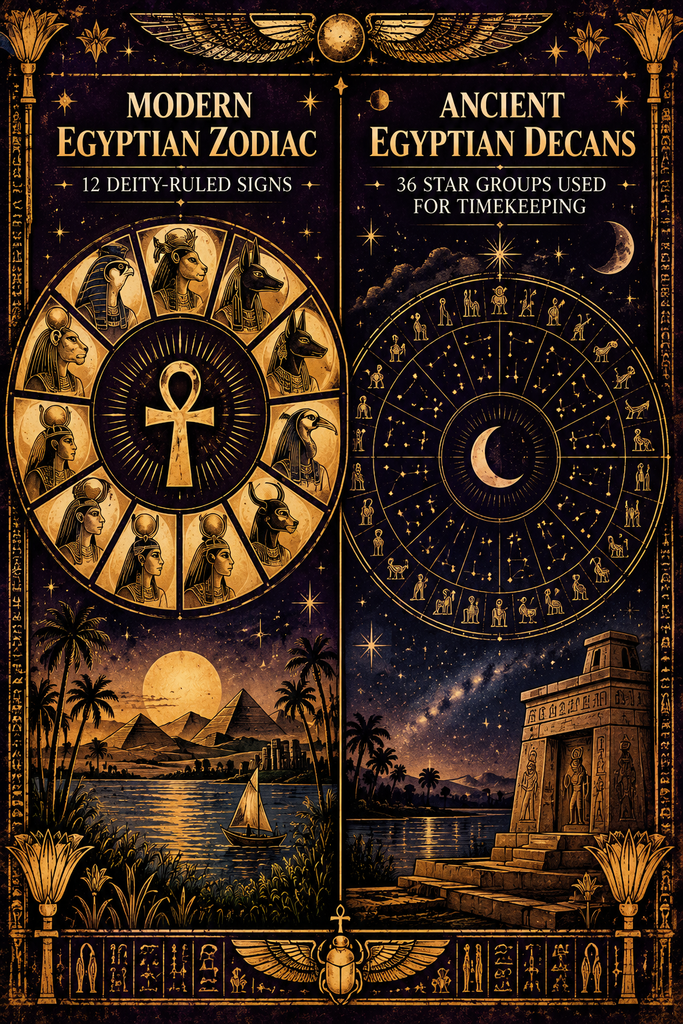
It is worth distinguishing this modern zodiac from the ancient Egyptian decans, a genuinely old system of thirty-six star groups used for timekeeping and funerary astrology. The decans are a separate, more technical body of astronomical knowledge. The twelve-sign Egyptian zodiac discussed here is a later, more accessible synthesis built for personal reflection, closer in spirit to how people use Western sun signs today than to the priestly star-charts of antiquity.
☥ The 12 Egyptian Zodiac Signs and Their Ruling Deities
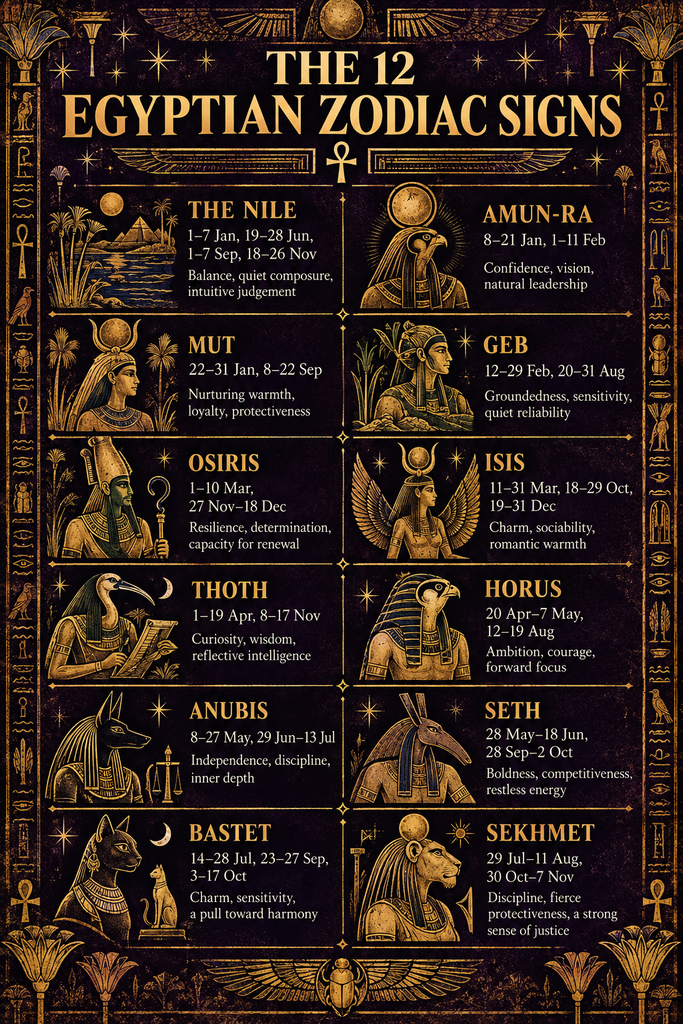
Each sign below lists every date range associated with it, since most periods repeat more than once through the year. Traits are offered in the traditional, belief-based spirit in which this system is used, not as fixed personality verdicts.
| Sign (Ruling Deity) | Date Ranges | Traditionally Associated Traits |
|---|---|---|
| The Nile | 1–7 Jan, 19–28 Jun, 1–7 Sep, 18–26 Nov | Balance, quiet composure, intuitive judgement |
| Amun-Ra | 8–21 Jan, 1–11 Feb | Confidence, vision, natural leadership |
| Mut | 22–31 Jan, 8–22 Sep | Nurturing warmth, loyalty, protectiveness |
| Geb | 12–29 Feb, 20–31 Aug | Groundedness, sensitivity, quiet reliability |
| Osiris | 1–10 Mar, 27 Nov–18 Dec | Resilience, determination, capacity for renewal |
| Isis | 11–31 Mar, 18–29 Oct, 19–31 Dec | Charm, sociability, romantic warmth |
| Thoth | 1–19 Apr, 8–17 Nov | Curiosity, wisdom, reflective intelligence |
| Horus | 20 Apr–7 May, 12–19 Aug | Ambition, courage, forward focus |
| Anubis | 8–27 May, 29 Jun–13 Jul | Independence, discipline, inner depth |
| Seth | 28 May–18 Jun, 28 Sep–2 Oct | Boldness, competitiveness, restless energy |
| Bastet | 14–28 Jul, 23–27 Sep, 3–17 Oct | Charm, sensitivity, a pull toward harmony |
| Sekhmet | 29 Jul–11 Aug, 30 Oct–7 Nov | Discipline, fierce protectiveness, a strong sense of justice |
A few of these deities carry meanings worth sitting with. Amun-Ra, king of the gods, lends his period an association with authority and clear-sighted leadership. Isis, goddess of magic and devotion, colours her periods with warmth and connection. Anubis, guardian of the underworld, marks his stretches of the year with introspection and quiet resolve. Sekhmet, the lioness goddess of war, brings a dual nature of ferocity and discipline to hers.
Osiris, ruler of death and rebirth, lends his periods a theme of resilience and coming back stronger after hardship. Thoth, god of wisdom and writing, is traditionally linked to sharp thinking and a love of learning for its own sake. Horus, the falcon-headed sky god, carries associations of ambition and clear-eyed focus on long-term goals. Mut, the protective mother goddess, is tied to loyalty and a steady, nurturing presence within family and friendship circles.
⚖️ How Egyptian Astrology Differs From Other Traditions
Egyptian astrology is not a rival to Western tropical astrology, it is a parallel tradition built on entirely different foundations. Western astrology tracks the sun’s apparent path through twelve constellations across a continuous solar year. Egyptian astrology instead tracks deity-ruled periods tied to river and harvest cycles, which is why the same sign can resurface at different points in the year.
It also sits differently from the other alternative systems already covered on this site. The Chinese zodiac assigns one animal sign per birth year within a twelve-year cycle, layered with five elements. The Norse zodiac draws on Viking-era symbolism and runic meaning tied to the old Scandinavian calendar. The Celtic tree zodiac assigns a sacred tree to each stretch of the year, rooted in Ogham symbolism and the natural cycle of the seasons.
None of these systems, including the Egyptian one, are more or less valid than Western astrology. Each reflects the cosmology, calendar and spiritual priorities of the culture that shaped it. Many practitioners enjoy comparing their placements across two or three of these systems, treating each as a different facet of the same underlying curiosity about the self.
🔍 How to Find Your Egyptian Zodiac Sign
Finding your sign is straightforward: locate your birth date in the table above and note which deity rules that period. Because several signs repeat, it is worth checking the full list of ranges rather than assuming your sign only appears once.
If your birthday falls right on the edge of two date ranges, you are considered to sit on a cusp. Some practitioners feel a blend of both signs’ qualities in this case, while others simply lean on whichever deity’s period technically contains their birth date.
It is also worth remembering that these date ranges come from a modern reconstruction of an older calendar system, so you may see very slight variations of a day or two between different sources. This is normal for a revival practice built on historical material rather than a single, unbroken original text.
🌙 Using Egyptian Astrology in Spiritual Practice Today
Within modern esoteric practice, Egyptian zodiac signs are generally used as a tool for reflection rather than prediction. Many practitioners like to research their ruling deity in more depth, learning the myths, symbols and offerings traditionally associated with that figure, and using this as a doorway into meditation or journaling.
Some incorporate their sign into altar work, choosing candles, incense or imagery linked to their deity to mark birthdays or seasonal transitions. Others use the recurring nature of Egyptian sign periods as a prompt: since your sign resurfaces more than once a year, those windows can become natural check-in points for revisiting personal intentions.
As with any belief-based system, it is generally treated as a framework for self-inquiry rather than a fixed script. A sign associated with Sekhmet’s discipline, for example, might be read as an invitation to lean into structure during that period, rather than as a guarantee of a particular temperament. This traditional-use framing is part of what keeps Egyptian astrology feeling alive in contemporary spiritual circles, decades after its modern revival began.
Common Questions About Egyptian Zodiac Signs
Is Egyptian astrology an authentic ancient Egyptian practice? It draws on real elements of ancient Egyptian cosmology, including the Nile calendar and the deity pantheon, but the twelve-sign zodiac format itself is a modern esoteric synthesis rather than a system ancient Egyptians used exactly this way. This puts it in similar territory to several other modern alternative zodiacs that reinterpret older cultural material.
Can two people share a sign but feel very different? Yes, and that is expected within a belief-based framework. Traditional traits are offered as themes to explore, not fixed descriptions, so two people ruled by the same deity may express those qualities in quite different ways depending on their wider chart, upbringing and personal outlook.
Is there such a thing as Egyptian zodiac compatibility? Some modern practitioners have extended the system informally to look at how different deity energies might complement or challenge one another, similar to compatibility work in Western or Chinese astrology. It is a much newer and less standardised corner of the practice, so approach any compatibility claims as playful exploration rather than settled tradition.
Do the date ranges ever shift or vary? Slightly, depending on the source. Because this is a modern reconstruction rather than a single surviving ancient document, different astrologers and writers have published minor variations in the exact boundary days between signs. If your birthday sits within a day or two of a listed range, it is worth reading both neighbouring signs and seeing which resonates.
Whichever tradition you explore first, Egyptian astrology, Celtic, Norse or Chinese, the value tends to lie in the reflection it prompts rather than in treating any one system as the final word on who you are.