Chinese Zodiac in Spiritual Practice
We may earn money or products from the companies mentioned in this post.
The Chinese zodiac is not a horoscope column translated into animal mascots. It is a living framework within Chinese astrology, used for centuries to read character, guide compatibility, and time major decisions against a twelve-year cycle. If your only exposure has been placemats at a restaurant, this guide is the deeper version: how the system actually works, and how practitioners engage with it today.
Origins Within Chinese Astrology and Cosmology
The twelve-animal cycle sits inside a much older cosmological structure than most people realise. It is bound up with the Chinese lunar calendar and with the Five Elements, or Wu Xing: Wood, Fire, Earth, Metal, and Water. Each animal year is also assigned one of these five elements in rotation, which means the same animal sign recurs with a different elemental flavour every sixty years rather than every twelve.
This matters because two people born in Horse years, say, are not considered astrologically identical. A Fire Horse and a Metal Horse carry the same core animal traits but expressed through different elemental temperaments, which is part of why the system is considered far more nuanced than a simple twelve-sign rotation might suggest. The full sixty-year cycle, combining twelve animals with five elements, is the traditional unit practitioners use for the deepest compatibility and fortune work, even though the twelve-animal version is what most people encounter day to day.
Enhance Your Spiritual Practice
Discover our collection of digital planners and mystical tools designed to deepen your journey with tarot, crystals, and astrology.
Visit Our ShopThis is worth separating clearly from Western sun-sign astrology from the outset, since the two systems are frequently confused. Western astrology is based on the sun’s position through twelve constellations over a single year. The Chinese zodiac is based on a twelve-year cycle tied to the lunar calendar, assigns a sign by birth year rather than birth month, and layers in the five-element rotation on top. They are related in that both are used for character reading and timing, but the mechanics are entirely different systems with separate histories.
The Twelve-Year Animal Cycle: Reading Personality and Life Path
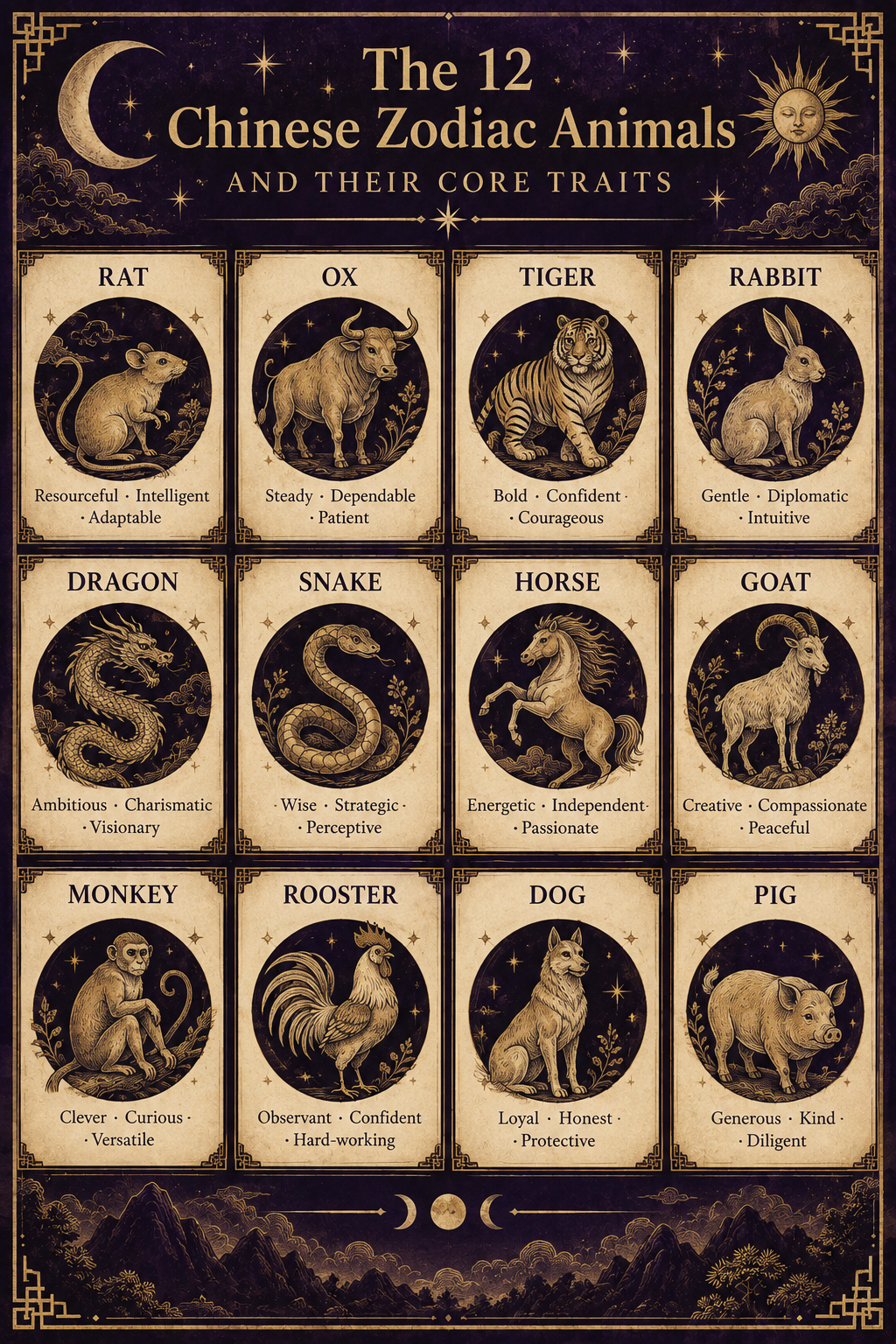
The twelve animals, in order, are the Rat, Ox, Tiger, Rabbit, Dragon, Snake, Horse, Goat, Monkey, Rooster, Dog, and Pig. Each is understood to carry a distinct set of core traits: the Rat is read as resourceful and quick-witted, the Ox as steady and dependable, the Tiger as bold and confident, and so on through the full cycle. Your sign is determined by your birth year, though because the Chinese lunar new year falls at a different point each year (typically late January to mid-February), anyone born in early January or February should check the exact date their sign changed, since being born a few weeks either side of the new year can place you in the neighbouring animal’s year instead.
Practitioners use these animal traits as a lens for self-understanding in much the same way Western astrology enthusiasts use sun signs, but with the added layer of the ruling element for that specific year. A person’s sign is read as a description of underlying tendencies rather than a fixed script, and most practitioners treat it as one input among several rather than the whole picture.
Compatibility Matching in Relationships and Business
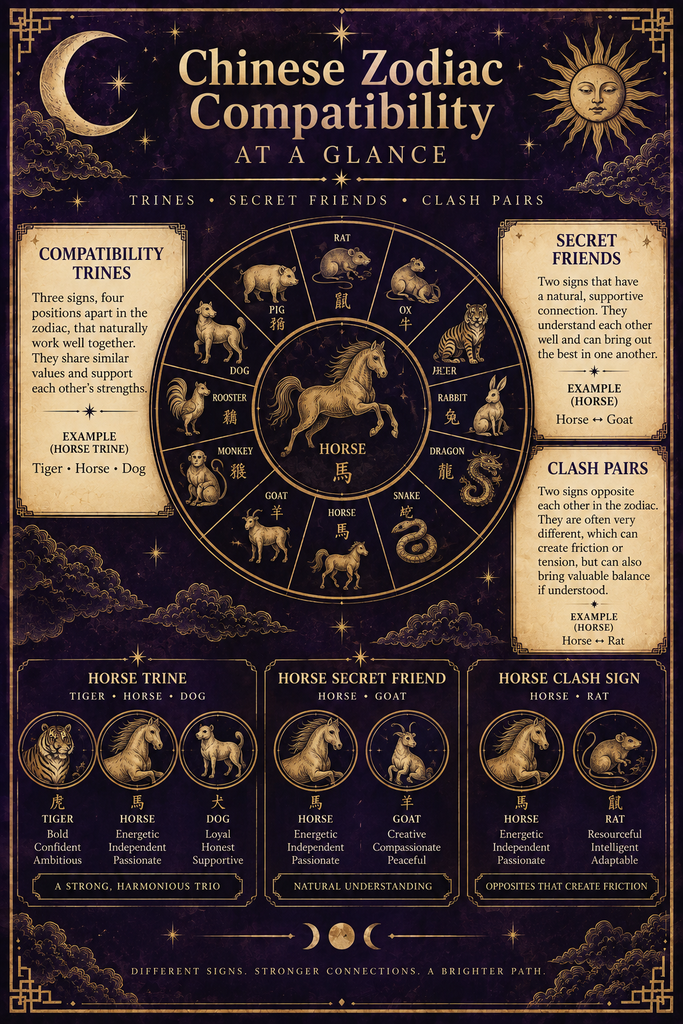
Compatibility is one of the zodiac’s most enduring practical applications, and it operates on a specific structural logic rather than simple animal-to-animal preference. Signs are grouped into compatibility trines (sets of three signs, four positions apart in the cycle, considered naturally harmonious) and secret friend pairings (two signs considered a strong one-to-one match). There are also known clash pairs, typically the sign directly opposite another in the twelve-year wheel, which are read as bringing friction or tension rather than ease.
This compatibility framework gets used for far more than romantic matchmaking. Historically and in ongoing practice, it has informed business partnerships, family planning decisions, and even the timing of major agreements, on the logic that aligning a decision with compatible signs and elements gives it a better foundation. Modern practitioners still consult compatibility charts before major relationship milestones or business ventures, treating it as one factor to weigh rather than a deciding vote.
Yearly Fortune-Telling and Timing Decisions
Each year is read through the lens of its ruling animal and element, and practitioners use this yearly reading to anticipate broad themes and time decisions accordingly. 2026, for instance, is a Fire Horse year, a combination that last occurred sixty years ago in 1966. Because the year’s element (Fire) matches the Horse’s own innate element, practitioners read this as a year of intensified, doubled energy for Horse-related themes: movement, ambition and bold action, amplified rather than tempered.
The animals considered most harmonious with the Horse this year are the Tiger and the Dog, forming a compatibility trio, alongside the Goat as a secret friend pairing. The Rat is traditionally read as the Horse’s clash sign. For colour and element guidance specific to a Fire year, Wood, Earth and Fire-associated tones (purple, yellow and brown) are considered auspicious, while Metal and Water tones (black, dark blue and white) are considered less favourable, since Metal and Water are the elements that clash with Fire in the traditional five-element cycle.
Practitioners use this kind of yearly reading to time everything from launching a new venture to planning a wedding date, treating years and even specific months within the lunar calendar as carrying different energetic weight for different undertakings.
Chinese Zodiac vs Western Zodiac: Belief Frameworks Compared
The two systems are often placed side by side, but they rest on genuinely different foundations. Western astrology maps the sun’s position against twelve constellations across a single year and assigns a sign by birth month. The Chinese zodiac assigns a sign by birth year across a twelve-year cycle, layers in a five-element rotation across sixty years, and is rooted in a lunar calendar rather than a solar one.
The practices built on top of each system diverge too. Western astrology commonly produces detailed natal charts mapping planetary positions at the exact moment of birth. Chinese astrology’s zodiac component is more focused on year-based character and compatibility reading, though it exists alongside other, more granular Chinese astrological practices, such as Bazi (Four Pillars of Destiny), which does map a more detailed birth chart using year, month, day and hour. Readers interested in a comparable Western system with a similar seasonal, cyclical logic might also look at our guide to Celtic astrology signs, which organises its own zodiac around tree-based cycles rather than either the solar or lunar-animal models.
How Practitioners Engage With It Today
For many people with Chinese heritage, the zodiac remains an active, living part of cultural and family life rather than a historical curiosity, showing up in everything from Lunar New Year celebrations to decisions about auspicious wedding dates and even, in some families, preferred birth years for children. It continues alongside, rather than instead of, other belief systems many practitioners hold, in the same way many people comfortably read both their Western sun sign and their Chinese zodiac sign without treating the two as in competition.
Outside of Chinese cultural contexts, growing interest in comparative astrology and zodiac systems has brought new practitioners to the tradition, often through the same enthusiasm that drives interest in systems like Norse zodiac signs or other cultural astrological frameworks. As with any belief system practised across cultures, approaching it with genuine interest in its actual structure, rather than treating it as a lighthearted personality quiz, makes for a far more respectful and ultimately more useful engagement with the tradition.
A Note on Compatibility Beyond the Zodiac Alone
It’s worth saying plainly that zodiac compatibility, Chinese or otherwise, is best treated as one lens among several rather than a verdict on any relationship’s viability. Our broader piece on astrological compatibility covers how practitioners tend to weigh zodiac-based compatibility alongside other factors, and the same principle applies here: a clash pairing is a prompt to pay closer attention to a dynamic, not a reason to write it off.
The Five Elements: What Each One Adds to a Sign
Understanding the five elements in more depth makes the whole system click into place. Wood years are associated with growth, flexibility and expansion, often read as bringing a generative, forward-building energy to whichever animal sign they pair with. Fire years bring intensity, passion and visibility, amplifying whatever the animal sign already tends toward, which is part of why a Fire Horse year like 2026 is read as such a heightened one. Earth years are associated with stability, practicality and groundedness, often tempering a more volatile animal sign with steadiness. Metal years bring precision, discipline and structure, valued for clarity but sometimes read as rigid. Water years bring intuition, adaptability and emotional depth, often softening a more assertive animal sign’s edges.
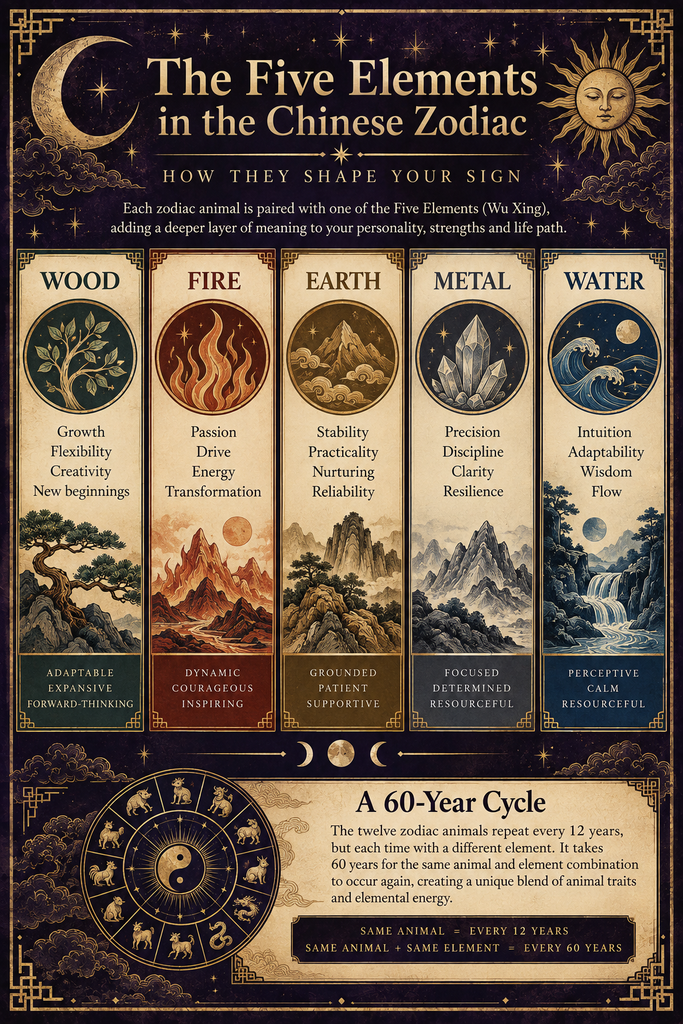
Each animal sign, in its own right, is also traditionally associated with one of the five elements as its fixed, innate element, separate from the rotating yearly element. The Horse’s fixed element is Fire, which is exactly why a Fire year lands with such intensified force. Working out both the fixed element of your birth animal and the rotating element of your specific birth year is what gives a full elemental reading, rather than relying on the animal sign alone.
Common Misconceptions Worth Clearing Up
A few misunderstandings come up often enough to be worth addressing directly. The first is treating the Chinese zodiac as a simplified, animal-themed version of Western sun-sign astrology, when the two are built on entirely separate calendars, cycles and calculation methods rather than one being a lighter variant of the other. The second is assuming your sign is determined by the calendar year printed on your birth certificate without checking the lunar new year date, which catches out a meaningful number of people born in January or early February.
A third misconception worth naming is treating a clash pairing as a definitive incompatibility rather than one traditional data point among many that a practitioner would weigh together. Reducing the system to a single yes-or-no compatibility check misses the more nuanced way it is actually used in practice, where element, trine groupings, and individual birth details all factor in alongside the base animal-to-animal relationship.
Quick FAQ
How do I find my Chinese zodiac sign if I was born in January or early February? Check the exact date of the Chinese lunar new year for your birth year, since it shifts annually and typically falls between late January and mid-February. If you were born before that date, your sign is the one from the previous year’s cycle rather than the year printed on your birth certificate.
Is the Chinese zodiac the same as Chinese astrology as a whole? Not quite. The twelve-animal zodiac is one well-known component of Chinese astrology, but the broader tradition also includes more detailed practices such as Bazi (Four Pillars of Destiny), which maps a fuller birth chart using the year, month, day and hour of birth rather than the year alone.
Can two people share a zodiac sign but have different elements? Yes, and this is central to how the system works. The same animal sign recurs every twelve years, but its paired element (Wood, Fire, Earth, Metal, or Water) rotates on a separate cycle, so the full sign-and-element combination only repeats once every sixty years.
Does a clash pairing mean two signs are incompatible? Not necessarily in an absolute sense. A clash pairing is traditionally read as bringing more friction or requiring more conscious effort to harmonise, rather than ruling out compatibility entirely. Many practitioners treat it as useful information about where extra care may be needed, rather than a verdict against the relationship.