Eight of Pentacles: Mastery, Diligence & the Craft of Skill-Building
We may earn money or products from the companies mentioned in this post.
The Eight of Pentacles shows a figure who has stopped waiting and started working. Where the previous card asked what has grown, this one asks a quieter question: are you willing to do the work properly, again and again? In tarot tradition it is the card of the apprentice, the practitioner and the person who treats skill as something built stroke by stroke.
If you have been feeling the pull to get better at something, this card is worth sitting with.
🔨 The Card at a Glance
The Eight of Pentacles belongs to the suit of Pentacles, which tradition links with the material world, work, the body and everyday craft. It is the eighth step in a ten-card journey, sitting after the long pause of the Seven and before the comfort of the Nine.
Enhance Your Spiritual Practice
Discover our collection of digital planners and mystical tools designed to deepen your journey with tarot, crystals, and astrology.
Visit Our ShopIts traditional keywords are diligence, focus, apprenticeship, skill and mastery through repetition. Reversed, readers often connect it with perfectionism, burnout, rushed work and a sense of drifting through routine.
Quick reference:
- Upright: diligence, dedication, skill development, focus, craftsmanship
- Reversed: perfectionism, burnout, mediocre work, loss of purpose, autopilot
🪙 Card Imagery and Symbolism
In the Rider-Waite-Smith version, a craftsman sits at a bench, head bowed, hammer in hand. He is carving a pentacle into a disc of metal, with his full attention on the piece in front of him.
Eight pentacles appear in the scene, most of them finished and displayed, with one still under the hammer. Many readers see the row as a record of repetition: each finished piece is a small proof of effort.
His clothing is plain and practical. He wears an apron and a simple tunic, with no crown or robe to suggest status. The tradition reads this as a person who cares more about the quality of the work than about being seen doing it.
In the distance sits a small town, set on a hill. It is easy to miss, and that seems to be the point. The craftsman has chosen to work apart from the crowd for now, and the town is where the finished work may eventually travel.
Notice, too, that the scene has no audience. Nobody is watching or applauding. The card pictures motivation that comes from within, the quiet satisfaction of getting a detail right.
⚒️ Upright Meaning: Diligence and Mastery
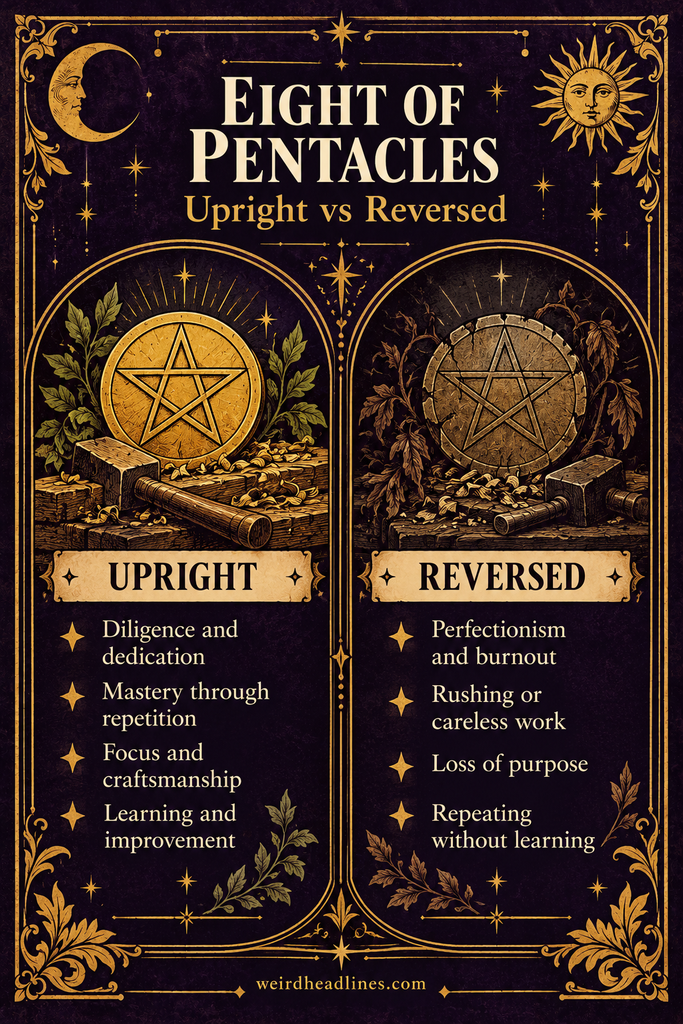
Upright, the Eight of Pentacles is traditionally read as a call to commit to your craft. It speaks of the stretch where progress is made through repetition rather than inspiration.
Here are the themes readers most often draw from it.
Mastery through repetition. The row of pentacles suggests that skill is rarely a lightning strike. In the tradition of this card, each piece teaches something the last one could not.
Focus. The craftsman works on one thing. Many practitioners read the card as encouragement to narrow your attention and let the work have all of it.
Apprenticeship. This card often points to a learning phase, with the humility that comes with it. Being a beginner at something, again, is part of the picture.
Solo skill-building. Unlike cards that speak of teamwork, this one is about the hours you put in alone. It is the practice session, the draft, the scale played slowly.
When it lands in a reading, some people take it as an invitation to ask what they are ready to learn properly. Others see it as a nod to effort already being made, quietly, without applause.
🔁 Reversed Meaning: When Craft Turns Sour
Reversed, the same bench can look very different. The Eight of Pentacles reversed is often read as diligence that has lost its way.
Perfectionism. The craftsman keeps carving, but nothing is ever finished. Readers often link the reversed card with the fear that work is never good enough to share.
Burnout. Repetition without rest can wear a person down. The traditional reading here is a warning that dedication and depletion can look alike from the outside.
Mediocre work. Going through the motions can produce pentacles that are technically complete but have no care in them. The reversed card may point to attention that has drifted elsewhere.
Loss of purpose. When the routine stops meaning anything, the card can reflect that hollow feeling. You may remember why you started but not why you are still going.
None of these are verdicts. In the tradition, a reversed card is an invitation to look more closely, not a prediction that anything is doomed. If you would like a refresher on how reversals tend to be read, our guide to upright vs reversed tarot covers the different approaches.
❤️ In Love and Relationships
In love readings, the Eight of Pentacles is usually read as a card of steady, deliberate effort. It suggests that a relationship is something you tend, not just something that happens.
Upright, readers often connect it with showing up consistently. Small, repeated acts of care are the relationship equivalent of the craftsman’s row of pentacles.
It can also speak to the work you do on yourself. Some readers see it as a prompt to learn how you communicate, listen or handle conflict, and to practise doing it better.
For those who are single, the card may be read as a season of focusing on your own development. That is not a prediction about anyone arriving or not arriving. It is a reading of where energy might be well spent.
Reversed, the card can suggest that one person is working far harder than the other, or that effort has become routine without warmth. It may also hint at holding yourself to an impossible standard before letting anyone close. Treat these as questions to ask yourself rather than answers.
💼 In Career and Money
In career readings, the Eight of Pentacles is often called the craftsperson’s card. Traditionally it points to training, skill development and committing to doing a job well.
Readers sometimes take it to suggest that this is a good moment for study, practice or deliberate improvement of a trade. It is a card about the process of becoming skilled rather than about any particular outcome.
In money readings, the card is generally linked with earning through effort and skill, and with the patience that takes. As with any tarot card, this is reflective symbolism and not financial advice, and it does not promise any result.
Reversed, the tradition connects the card with feeling stuck in a role that no longer stretches you, or with working long hours that no longer feel meaningful. Many people use that as a prompt to ask what, if anything, they would like to change.
🌱 Deepening Skill or Grinding on Autopilot?
This is where the card becomes personal. The upright and reversed Eight can look almost identical from the outside: someone at a bench, doing the same task again and again.
The difference is inside the person. One is paying attention, and the other is simply getting through the day.
Here is one way to think about it. Deepening skill usually involves noticing. You can name what you did better this week than last. You are curious about small differences, and the work still surprises you now and then.
Grinding on autopilot usually involves the opposite. Hours pass, the output looks the same, and you could not say what you learned. The work is finished but you were not really in it.
If you want to bring the card into your own practice, try these reflection prompts. Journal on them, talk them over, or simply let them sit.
- What am I practising right now, and what specifically am I trying to improve?
- When did this work last surprise me or teach me something?
- Am I repeating a skill, or just repeating a habit?
- Where am I polishing something that is already good enough?
- What would a rested, curious version of me do differently at this bench?
- Who or what am I doing this for, and does that still feel true?
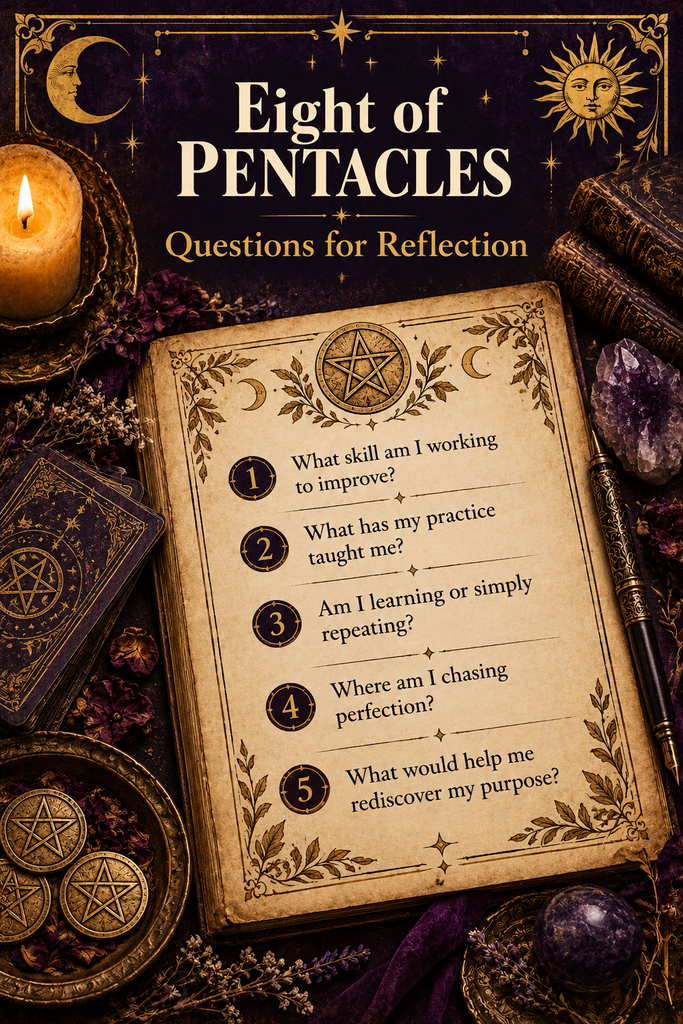
Many readers find that simply writing the answers by hand makes the difference visible. A tarot journal can be a good home for this, but any notebook will do.
🕯️ Spiritual and Personal Growth
On a spiritual level, the Eight of Pentacles is often read as the card of practice itself. Many esoteric traditions hold that depth comes through repetition: the same meditation, the same ritual, the same card pulled and studied over many years.
In that sense the craftsman is a figure for devotion. He is not chasing a dramatic breakthrough. He is making the same shape with growing awareness, and the tradition suggests that awareness is where mastery lives.
If you read tarot yourself, this card has a lovely lesson. Your skill grows by pulling cards regularly, noticing your impressions and returning to the same images. A reading practice built over months often feels very different from one built in a weekend.
For anyone starting out, a classic deck is a sensible companion for this kind of study. The imagery of the Rider-Waite-Smith system is the one most guides and teachers refer to, which makes it easy to follow along. (Disclosure: this link is an affiliate link, so we may earn a small commission if you buy through it, at no extra cost to you.) If you would like to work with one, you can find a Rider-Waite-Smith tarot deck here.
🧭 How It Follows the Seven of Pentacles
The suit of Pentacles moves through a progression, and the Eight has a particular place in it. The Seven shows a gardener leaning on a tool, looking at what has grown and wondering whether it was worth the wait. Our piece on the Seven of Pentacles explores that pause in detail.
The Eight is the answer to that question, or at least one answer. The gardener has looked, assessed and decided to learn. The patience of the Seven becomes the practice of the Eight.
That is why many readers see these two cards as a pair. One reflects on the long game, and the other gets on with the daily steps that make a long game possible.
It is also worth a brief nod to the Three of Pentacles, which pictures a craftsman working with others and being recognised for it. If you want that side of the story, see our guide to the Three of Pentacles. The Eight is the solitary counterpart: the work done before anyone is looking.
🔮 Tips for Reading the Eight of Pentacles
Context matters in any spread, so here are a few ways readers tend to approach this card.
Ask what is being practised. Rather than reading the card as a general good sign or bad sign, look at what skill, habit or craft the question touches.
Look at neighbouring cards. If the cards beside it suggest frustration or fatigue, you might lean towards the reversed themes of burnout or perfectionism. If they suggest curiosity, the focus on learning may stand out.
Note the position. In a past position, it may point to a period of learning that shaped you. In a future position, it may suggest a stretch of focused effort. In an advice position, it often reads as an invitation to commit to one thing and see it through carefully.
🗝️ Keywords at a Glance
Upright: diligence, mastery, skill, apprenticeship, dedication, focus, craftsmanship, steady effort
Reversed: perfectionism, burnout, mediocre work, loss of purpose, autopilot, rushing, lack of care
✨ Final Thoughts
The Eight of Pentacles is not a glamorous card, and that is part of its charm. It shows a person at a bench, absorbed in something small and real, with the town waiting patiently in the distance.
Whether it appears upright or reversed, it offers a useful question: is the way I am working teaching me anything? If the answer is yes, that is something to be quietly proud of. If it is no, the card gently suggests it may be time to look up from the bench and check what you are carving.
Which skill are you working on at the moment, and what does your own row of pentacles look like? Share your thoughts in the comments, we would love to hear how this card shows up in your practice.