Celtic Astrology Signs: A Complete Guide to the Tree Zodiac
We may earn money or products from the companies mentioned in this post.
If you’ve ever wondered whether there’s a version of astrology built around trees instead of constellations, the Celtic tree zodiac is exactly that. It assigns a tree, and a whole set of symbolic personality traits, to a slice of the calendar year, offering a different lens on who you are. Here’s a complete guide to all 13 signs, where the system actually comes from, and how to find your own tree sign.
🌳 What the Celtic Tree Zodiac Actually Is
The Celtic tree zodiac, also called the Ogham tree calendar, assigns a tree to a stretch of the calendar year, much like the solar zodiac assigns a constellation. Instead of a ram or a crab, your sign might be Birch, Oak, or Willow, each carrying its own symbolic personality themes.
It’s worth being upfront about where this system actually comes from, because a lot of pages online overstate its age. The tree-and-Ogham connection is genuine: Ogham is a real early-medieval Irish alphabet, and some of its letters were named after trees. But the 13-month tree calendar itself, the one most “Celtic zodiac” content is built on, traces back to poet and writer Robert Graves, who proposed it in his 1948 book “The White Goddess.”
Enhance Your Spiritual Practice
Discover our collection of digital planners and mystical tools designed to deepen your journey with tarot, crystals, and astrology.
Visit Our ShopGraves built his calendar on the earlier, also-inaccurate work of 19th-century antiquarian Edward Davies, who believed the ancient Celts used a 13-month tree-based calendar. There’s no solid historical evidence that druids or ancient Celts actually organised time this way. What we have is a 20th-century literary reconstruction, later turned into a popular divination and personality system by Colin and Liz Murray in their 1988 book “The Celtic Tree Oracle,” with further modern interpretations from writers like Edred Thorsson.
None of that makes the system less worth exploring. Plenty of belief-framed practices are modern in origin and still meaningful. It just means the tree zodiac is best understood as a modern codification of real Celtic tree symbolism, not an unbroken ancient practice, and that framing matters if you want to talk about it accurately.
🍂 The 13 Tree Signs and Their Dates
Because the tree calendar follows 13 lunar months of roughly 28 days rather than 12 solar months, the dates don’t map neatly onto standard calendar months. Here’s the most widely used version of the sign dates:
- Birch: 24 December – 20 January
- Rowan: 21 January – 17 February
- Ash: 18 February – 17 March
- Alder: 18 March – 14 April
- Willow: 15 April – 12 May
- Hawthorn: 13 May – 9 June
- Oak: 10 June – 7 July
- Holly: 8 July – 4 August
- Hazel: 5 August – 1 September
- Vine: 2 September – 29 September
- Ivy: 30 September – 27 October
- Reed: 28 October – 24 November
- Elder: 25 November – 23 December
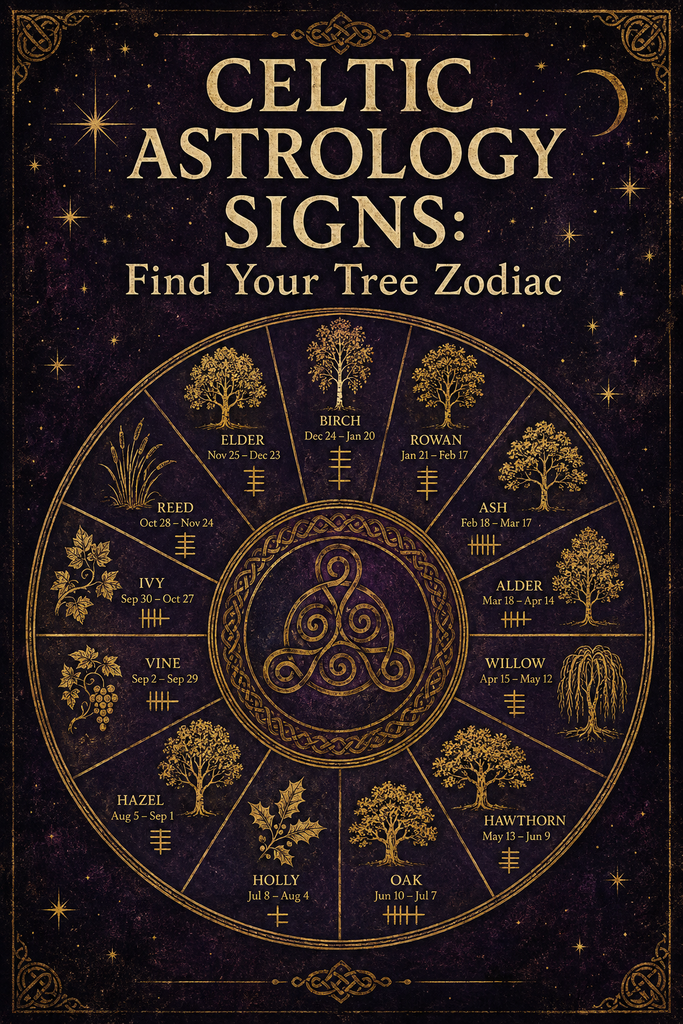
Because this calendar is based on a fixed lunar cycle rather than the solar year, some versions shift the date ranges by a day or two depending on the source and the specific year. Treat the ranges above as the standard reference, and if you fall right on a boundary date, read both signs and see which resonates.
🌿 Sign Profiles: Trees, Traits, and Symbolic Meaning
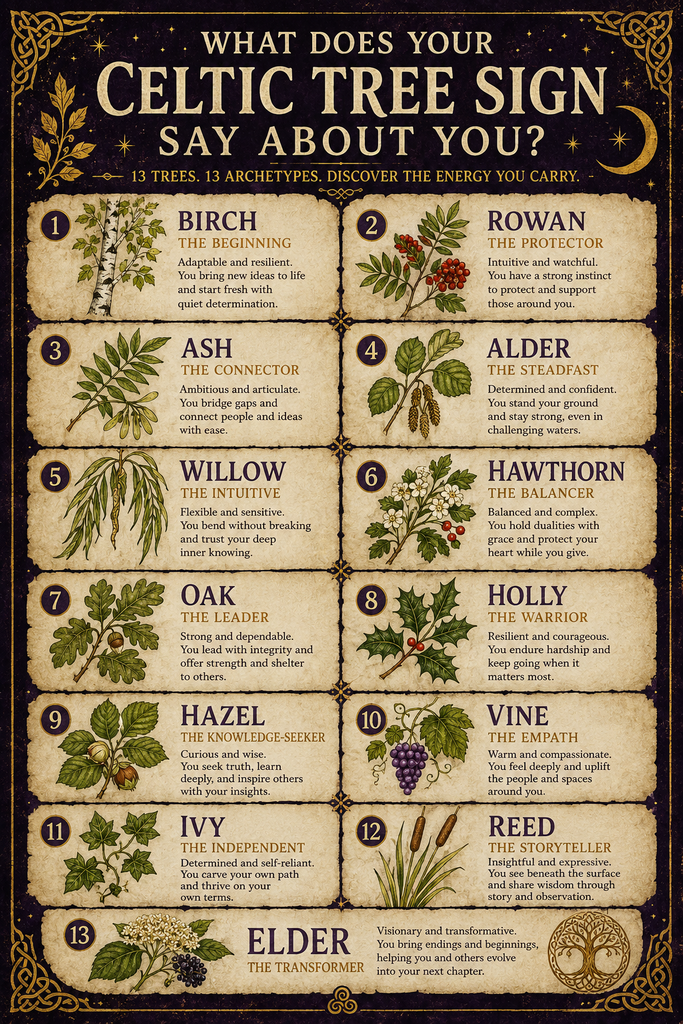
Birch: The Beginning
Birch is the first tree of the calendar, associated with new starts, purification, and quiet resilience. Birch people are often described as adaptable and steady under pressure, the ones who get a fresh project off the ground.
Rowan: The Protector
Rowan carries strong protective symbolism in Celtic folklore, often planted near homes to ward off ill fortune. Rowan signs are linked to sharp intuition and a natural instinct to look out for others.
Ash: The Connector
Ash trees were seen as a bridge between worlds in Celtic myth. Ash signs are associated with communication, ambition, and a talent for connecting people or ideas that wouldn’t otherwise meet.
Alder: The Steadfast
Alder wood doesn’t rot easily in water, and that resilience carries into the sign’s meaning: determination, self-confidence, and a willingness to stand firm on unpopular ground.
Willow: The Intuitive
Willow bends without breaking, and Willow signs are described as flexible, emotionally perceptive, and deeply connected to intuition and the subconscious.
Hawthorn: The Balancer
Hawthorn marks a seasonal turning point and is tied to duality and balance. Hawthorn signs are often described as contradictory in a good way: playful but private, romantic but self-protective.
Oak: The Leader
Oak has long symbolised strength and endurance across European folklore generally, not just Celtic tradition. Oak signs are cast as natural leaders: confident, steady, and generous with their protection of others.
Holly: The Warrior
Holly stays green through winter, and its sign carries themes of resilience under hardship and quiet courage. Holly people are often the ones who keep going when a project or relationship gets difficult.
Hazel: The Knowledge-Seeker
Hazel is tied to wisdom and inspiration in Celtic myth, most famously in the legend of the Salmon of Knowledge. Hazel signs are curious, quick-witted, and drawn to learning for its own sake.
Vine: The Empath
Vine signs are associated with emotional depth, sensitivity to others’ moods, and a love of beauty and pleasure. The vine’s habit of intertwining with what’s around it mirrors this sign’s relational, empathic nature.
Ivy: The Independent
Ivy grows resiliently in difficult conditions, and Ivy signs are described as self-sufficient, tenacious, and quietly ambitious, often preferring to work things out on their own terms.
Reed: The Storyteller
Reed is linked to communication and truth-seeking, sometimes cast as the “detective” of the tree signs. Reed people are often drawn to uncovering hidden information and telling the stories others miss.
Elder: The Transformer
Elder closes the calendar year and carries themes of transformation, endings, and renewal. Elder signs are associated with deep wisdom that comes from having weathered real change.
🔤 The Ogham Letter Behind Each Tree
Each of the 13 trees in the calendar also corresponds to a letter in the Ogham alphabet, the medieval Irish script the whole system borrows its structure from. Ogham letters were carved as a series of notches along a central line, traditionally cut into wood or stone, which is part of why the tree associations stuck so firmly to the alphabet in the first place.
Birch pairs with Beith, Rowan with Luis, Ash with Nion, Alder with Fearn, Willow with Saille, Hawthorn with Uath, Oak with Duir, Holly with Tinne, Hazel with Coll, Vine with Muin, Ivy with Gort, Reed with Ngetal, and Elder with Ruis. If you see a tree-sign guide reference “your Ogham,” this letter-and-tree pairing is what it means, rather than a separate divination system.
Some readers use their Ogham letter as a simple meditation focus, or write it alongside their tree sign when journaling, treating it as one more layer of the same symbolism rather than anything requiring separate study.
☀️ How the Tree Zodiac Compares to the Solar Zodiac
The tree zodiac and the familiar 12-sign solar zodiac run on entirely different logic: one is lunar and tree-based, the other tracks the sun’s position against the constellations. They’re not meant to replace each other. Many practitioners read both a solar sign (like Virgo or Libra) and a tree sign side by side, treating the tree sign as an additional lens on personality rather than a competing system. Where solar astrology draws on Babylonian and Greek astronomical tradition stretching back millennia, the tree zodiac’s Celtic framing is a 20th-century overlay onto much older tree symbolism, worth keeping in mind if you ever see the two systems described as equally ancient.
If you’re also curious about other correspondence-based systems, the Sun’s placement in your birth chart covers core identity in the solar framework, which pairs naturally with tree-sign reading for a fuller picture.
🔮 Finding Your Tree Sign
Finding your sign is as simple as matching your birth date to the ranges above. If you were born within a day or two of a boundary, it’s worth reading the profiles for both neighbouring signs, since lunar-calendar date ranges shift slightly year to year and different sources round differently.
Some people also look at the tree sign for a specific year (rather than a fixed birth-date range) as a kind of “theme for the year,” similar to how some astrology systems layer a yearly influence over a fixed birth sign. That’s a more advanced, less standardised practice, so treat any yearly tree-sign claims you find elsewhere with a bit more scepticism than the basic birth-date system above.
❓ Common Questions About the Tree Zodiac
Does the tree zodiac work the same way in the Southern Hemisphere? The date ranges above are fixed to the calendar, not to a hemisphere’s actual growing season, so most practitioners use the same dates worldwide rather than shifting them by six months. Some Southern Hemisphere writers experiment with a mirrored version, but it isn’t the standard approach.
Can your tree sign change from year to year? Not under the standard birth-date system used in this guide. A small number of more elaborate variations layer a “sign of the year” on top of your fixed birth sign, similar to how Chinese astrology layers a yearly animal, but that’s a separate and much less standardised practice.
What if my birth date falls right on a boundary? Read both neighbouring sign profiles. Because the calendar is built on a 28-day lunar cycle rather than fixed solar months, published date ranges can shift by a day or two depending on the source and the specific year in question.
Is this the same as Ogham card or stick divination? No, though they’re related. Ogham divination, as popularised by the Murrays’ “Celtic Tree Oracle,” uses the tree and letter set as a card or stick-based fortune-telling system, closer in spirit to tarot, while the tree zodiac applies the same trees to a fixed birth-date calendar the way sun-sign astrology does.
🌲 A Nordic Companion System
If the idea of a nature-based sign system appeals to you, it’s not unique to Celtic tradition. Norse zodiac signs, based on Viking-era symbolism, work on a similar principle of assigning archetypal meaning to birth dates, just drawn from an entirely different mythological well. Reading both side by side is a fun way to compare how different cultures built meaning-systems around the calendar.
For more on the mythological backdrop the tree calendar draws from, Celtic mythology’s gods, goddesses, and sacred symbols is a useful next read, since several tree-sign meanings echo figures and symbols covered there.
Whichever way you come to it, whether for a quick personality read or a deeper interest in tree symbolism, the tree zodiac rewards treating it the way most modern esoteric systems deserve to be treated: with genuine curiosity about where it came from, and an equally genuine willingness to take from it whatever actually resonates.