Autumn Equinox (Mabon) 2026: Gratitude Rituals & Harvest Magic
We may earn money or products from the companies mentioned in this post.
Every year, the wheel turns toward the equinox and asks you to pause between abundance and rest. Mabon is where the harvest season finds its balance point, a moment as good for reflection as it is for celebration. Here’s how to mark it in 2026 with a gratitude ritual, a simple altar, and a walkthrough you can adapt to fit your own practice.
🍂 What Mabon Marks on the Wheel of the Year
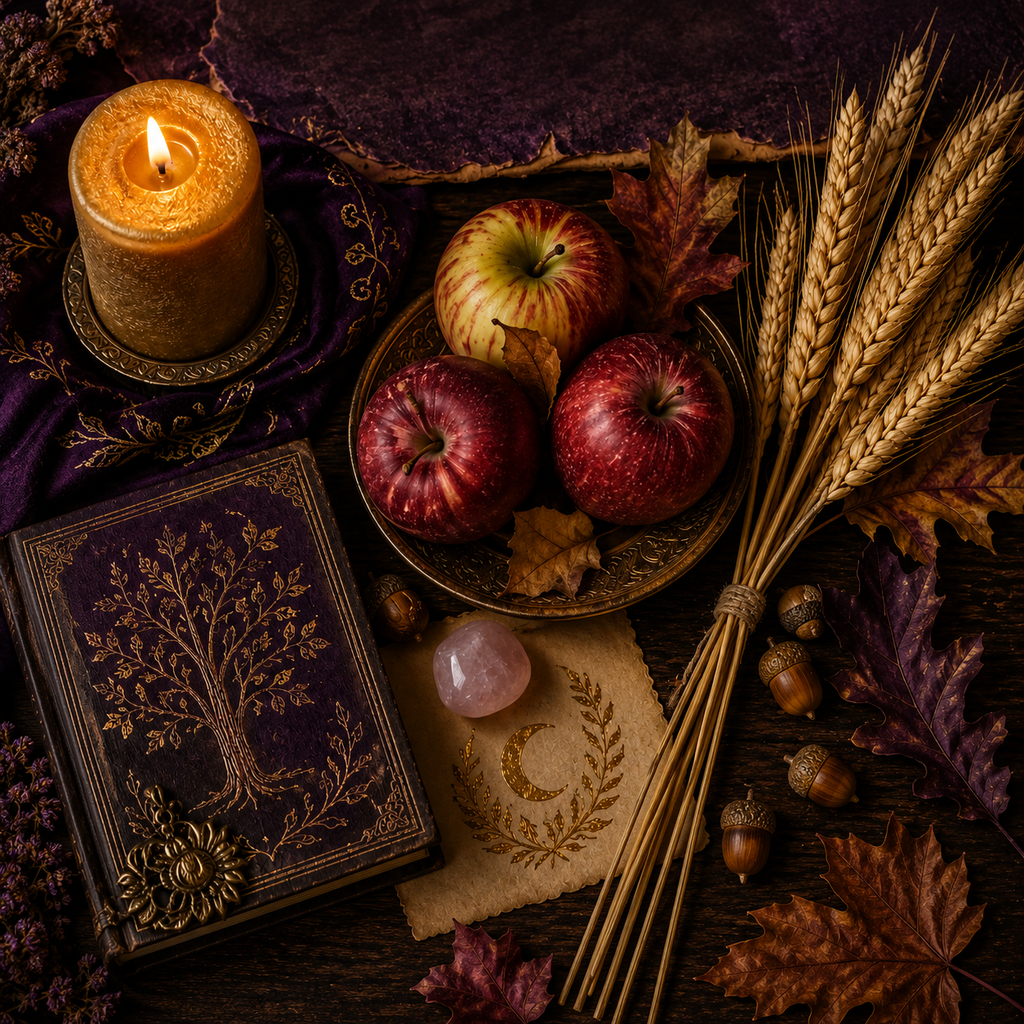
Mabon sits opposite Ostara on the Wheel of the Year, the second of the three harvest festivals after Lughnasadh and before Samhain. It falls on the autumn equinox, the point when day and night stand in near-perfect balance before the dark half of the year takes hold.
That balance is the whole point of the sabbat. Where Lughnasadh is about the first cut of the harvest and the relief of abundance, Mabon asks you to pause in the middle of it and actually take stock. It’s a threshold moment: light and dark are equal, so it’s traditionally seen as a good time to weigh what you’ve gathered this year against what you’re ready to release.
Enhance Your Spiritual Practice
Discover our collection of digital planners and mystical tools designed to deepen your journey with tarot, crystals, and astrology.
Visit Our ShopMany modern practitioners frame Mabon as a pagan Thanksgiving, and that’s not far off. The themes are gratitude, reflection, and reciprocity: acknowledging what the year has given you and thinking about what you owe back, to the land, to your community, or simply to your own future self.
🌾 When Is the Equinox in 2026?
The September equinox falls on 23 September 2026 at 00:06 UTC. If you’re in North America, that moment lands late in the evening of 22 September in most time zones, so many practitioners in the US and Canada will mark the sabbat on the 22nd rather than the 23rd.
There’s no wrong choice here. Solitary practitioners in this tradition typically celebrate whichever evening fits their calendar and their timezone, sometimes extending the observance across both days if the mood calls for it.
🏛️ Where the Name “Mabon” Actually Comes From
It’s worth knowing that “Mabon” is a modern label, not an ancient one. Wiccan writer Aidan Kelly coined it in the 1970s when he set out to give the autumn equinox a Celtic-sounding name to match Imbolc, Beltane, Lammas, and Samhain, which already had one.
Kelly borrowed the name from Mabon ap Modron, a figure from Welsh mythology whose name roughly translates to “son of the mother.” In the medieval tale where he appears, Mabon is rescued from imprisonment, a story Kelly likened to the Persephone myth of loss and return that many cultures associate with the turning seasons.
The direct link between Mabon ap Modron and the equinox doesn’t exist in older Welsh folklore; Kelly made the connection himself. That doesn’t make the name any less useful as a label for the sabbat today, but it’s a good example of how much of modern pagan practice is a genuinely modern, thoughtfully constructed tradition rather than an unbroken ancient one, and there’s nothing wrong with that.
🕯️ Gratitude Ritual Ideas for Mabon
Building a Harvest Altar
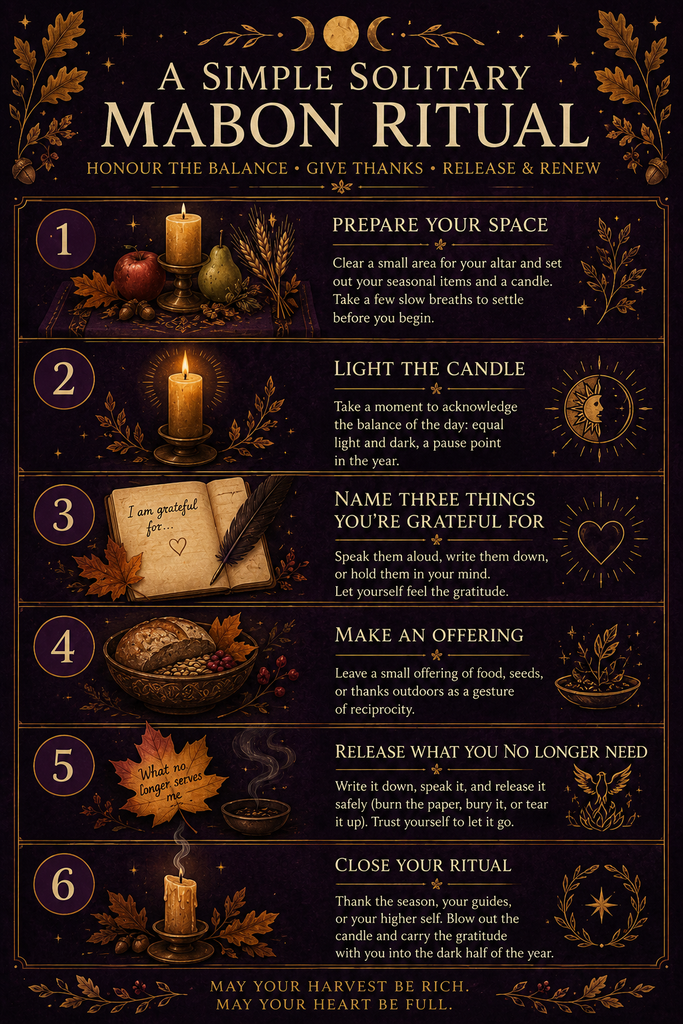
A Mabon altar is usually built around the idea of abundance made visible. Common choices include:
- Seasonal produce: apples, pears, squash, corn, or whatever is actually ripening where you live
- Dried leaves, acorns, or pinecones gathered on a walk
- Candles in deep gold, burnt orange, or brown to reflect the turning light
- A small dish or bowl set aside for offerings or written gratitude notes
Keep it simple if you’re short on space or new to altar work. A single candle and one piece of seasonal fruit is a complete Mabon altar; the ritual intent matters more than the volume of objects on it.
Harvest Offerings
Many practitioners leave a small offering outdoors as a gesture of reciprocity: a piece of bread, a bit of the meal you’re eating that day, or seeds for the birds. This is a belief-framed practice rooted in the idea that the harvest is a gift that deserves acknowledgement, not a guarantee of any particular outcome in return.
Reflective Journaling Prompts
Journaling is one of the most accessible ways to mark Mabon, ritual tools or not. A few prompts to sit with:
- What did I plant, literally or figuratively, at the start of this year, and how did it grow?
- What am I ready to harvest, and what am I ready to let go to seed for next year?
- Who or what supported my growth this year that I haven’t properly thanked?
- What imbalance in my life does this season of equal light and dark ask me to notice?
✨ Harvest Magic Correspondences
Correspondence lists are a starting point for your own practice, not a fixed rulebook. Use whatever already feels meaningful to you alongside these traditional Mabon associations.
Herbs and plants: sage, marigold, thistle, oak leaves, wheat, and rosehip are all commonly used in Mabon work, largely for their seasonal availability and their long association with protection and abundance.
Colours: deep gold, burnt orange, russet brown, and deep red run through most Mabon altars and decor, echoing the turning leaves.
Crystals: citrine and tiger’s eye are popular for their association with abundance and confidence, while grounding stones like smoky quartz are often used to anchor gratitude work in something steadier as the season shifts. A rose quartz piece on the altar is a gentle nod to self-compassion, useful if part of your reflection involves being kinder to yourself about what didn’t get finished this year.
Seasonal foods: apples, root vegetables, bread, and anything from a personal or local harvest carry natural symbolic weight for Mabon meals or offerings.
Symbols: the cornucopia, apples cut crosswise to reveal the five-pointed star in the core, scales (for the equal balance of light and dark), and grapevines all appear frequently in Mabon imagery and decor, again as symbolic touchstones rather than fixed requirements.
🍁 A Simple Solitary Mabon Ritual
This is a beginner-friendly walkthrough. Adapt the wording, the order, or the tools freely; there’s no single “correct” version of this ritual.
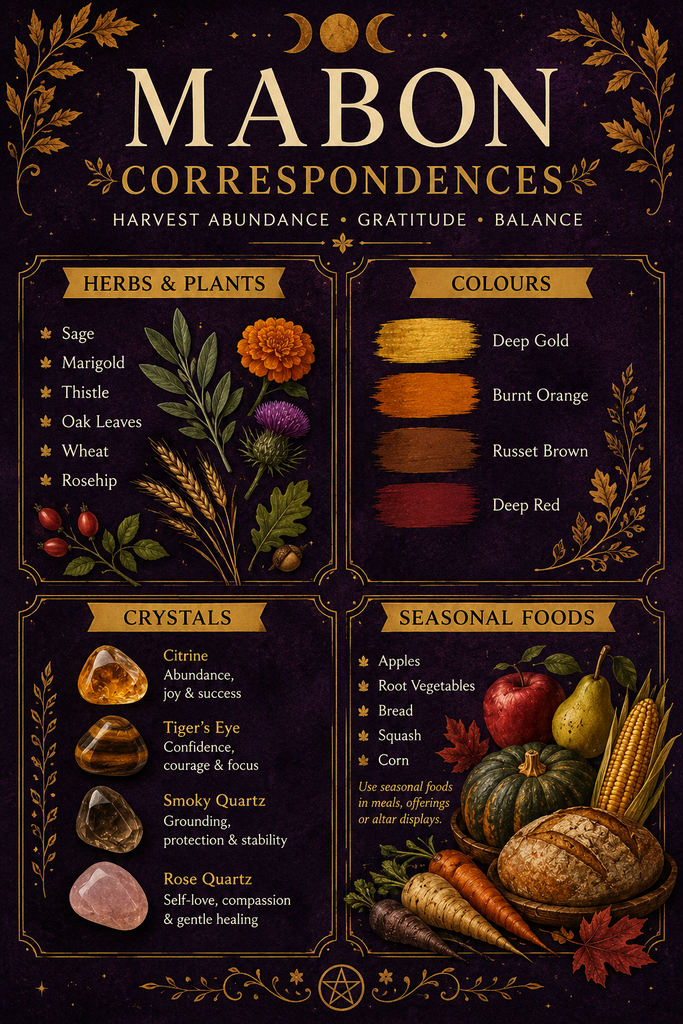
- Prepare your space. Clear a small area for your altar and set out your seasonal items and a candle. Take a few slow breaths to settle before you begin.
- Light the candle and take a moment to acknowledge the balance of the day: equal light and dark, a pause point in the year.
- Name three things you’re grateful for from the past season. Say them aloud or write them down. Be specific rather than general; “the friend who checked in on me in June” carries more weight than “my friends.”
- Make your offering, whether that’s food set outside, a written note placed in a harvest bowl, or simply a spoken thank-you to whatever or whoever you feel supported you.
- Sit with one thing you’re ready to release as the year turns toward its darker half. This doesn’t need to be dramatic; it might just be a habit, a worry, or a plan that no longer fits.
- Close the ritual by extinguishing the candle with intention, thanking the season, and returning to your day.
If you only have five minutes rather than a full evening, steps 3 and 4 (naming gratitude and making a small offering) carry most of the ritual’s weight on their own. A shortened version, candle lit, three things named, one small offering made, still counts as a complete Mabon observance.
🍎 Marking Mabon With Others
Mabon doesn’t have to be a solitary practice. A shared harvest meal is one of the most natural ways to mark the sabbat with friends or family, especially if not everyone at the table shares your practice; a seasonal dinner with a moment of spoken gratitude before eating captures the spirit of the sabbat without requiring anyone else to take part in ritual.
If you do practice with a small group, consider going around and having each person name one thing they’re grateful for and one thing they’re ready to release, mirroring the solitary ritual below but shared aloud. It tends to make the balance theme land more clearly when you hear it echoed back by other people going through their own version of the same season.
🌙 Adapting Mabon for Your Own Practice
Mabon has no single lineage or fixed liturgy, so there’s plenty of room to shape it around what actually resonates with you. Some practitioners fold it into a shared meal with friends or family rather than a solitary ritual. Others skip the altar entirely and mark the day with a long walk to notice the season changing, or a batch of seasonal cooking as the “ritual” itself.
If you already work within a specific tradition, use its existing Mabon or equinox correspondences instead of the general list here. And if this is your first sabbat, treat it as a low-pressure experiment: the goal is a moment of genuine reflection and gratitude, not a technically perfect ceremony.