Creating Your Personal Spiritual Practice (Without the Overwhelm)
We may earn money or products from the companies mentioned in this post.
You’ve probably seen it — the serene morning routine where someone wakes at 5am, meditates for an hour, journals three pages, does yoga, and somehow has a green smoothie ready by 6. And you’ve probably thought, “that’s never going to be me.” Good news: it doesn’t need to be.
A personal spiritual practice isn’t a performance or a productivity system. It’s simply your own consistent way of coming home to yourself — and it can look radically different from anyone else’s. This guide is here to help you build something that actually fits your real life, rather than a version you’ve borrowed from someone else’s Instagram.
What Does a “Spiritual Practice” Actually Mean?
The word “spiritual” carries a lot of baggage. For some people it’s deeply religious; for others it has nothing to do with organised religion at all. In the context of this post, a spiritual practice is any consistent way you connect with yourself, with something larger than your day-to-day concerns, and with what genuinely nourishes you.
Enhance Your Spiritual Practice
Discover our collection of digital planners and mystical tools designed to deepen your journey with tarot, crystals, and astrology.
Visit Our ShopThat might be tarot. It might be sitting quietly with a crystal in your hand and letting your thoughts settle. It might be walking in the park without your phone, or spending five minutes journaling before bed. There’s no universal formula — and that’s exactly the point.
What these practices share is intention. When you do something with awareness and care, it becomes a form of connection rather than just another task.
Why Bother at All?
Research across wellness and mindfulness consistently finds that regular, simple practices — even very short ones — support greater emotional resilience, a clearer sense of purpose, and reduced anxiety. Not because of anything mystical (though that’s there too, if you’re open to it), but because they create pockets of presence in a life that can otherwise blur past.
When you have a practice, you have an anchor. Something you return to even when everything else feels uncertain.
Why So Many People Feel Overwhelmed Before They Even Start
If you’ve tried to build a spiritual practice before and burned out by day three, nothing went wrong with you. The routine was simply never designed for your nervous system or your life.
A few patterns show up repeatedly in why people struggle:
- All-or-nothing thinking. The belief that a “real” practice must be long, daily, and perfectly executed. Miss one day, and suddenly you’ve failed. This mindset is the fastest route to quitting altogether.
- Over-scheduling. Locking yourself into a rigid 6am slot can feel like another demand rather than a source of support — especially if you’re a parent, a carer, someone with chronic illness, or just a person who doesn’t function beautifully at dawn.
- Comparison and content overload. Consuming endless spiritual content online without any offline integration can actually increase anxiety and disconnection. It starts to feel like homework.
The overwhelm is a signal, not a character flaw. It’s telling you that the approach doesn’t fit — not that spirituality isn’t for you.
A Gentler Framework: Rhythm, Not Rules
Instead of a rigid schedule, think about rhythm. Rhythm is flexible by nature — it flows with your life rather than fighting it. Some mornings it’s five minutes; some evenings it’s twenty. The point is returning, not never missing a day.

One practical way to build rhythm is to anchor your practice to something that already happens — not to a clock time. Before your morning coffee cools. On the walk from the car park. Before you open your laptop. In bed before you sleep. These natural pauses already exist in your day; you’re just making one of them intentional.
Even the smallest gesture counts. Two minutes of conscious breathing while the kettle boils is still a spiritual practice. Placing your hand on your heart and taking one slow breath before a difficult meeting is still a spiritual practice. Don’t let the idea that it “should” be more keep you from starting with what you actually have.
A Two-Minute Starting Point
If you want a concrete starting place, try this:
- One minute: Place your hand on your heart, inhale for four counts, exhale for six.
- One minute: Silently name three things you genuinely appreciate — not gratitude-list filler, but things that actually matter to you today.
That’s it. That’s enough to begin.
Finding Your Doorways
A spiritual practice is built from the things that genuinely help you feel connected, grounded, or alive. These are different for everyone — and part of the work is discovering what yours are rather than adopting someone else’s list wholesale.
Some common doorways include:
- Meditation — from breath awareness to guided visualisation. Strong evidence base for reducing anxiety and improving emotional regulation. Also endlessly customisable.
- Tarot or oracle cards — a reflective tool for checking in with yourself. If you’re new to reading for yourself, pairing this with an understanding of how to connect with tarot cards can make all the difference.
- Journaling and reflection — low barrier, high return. Free-writing for ten minutes has a way of surfacing what you didn’t know you needed to say.
- Crystal work — holding, carrying, or simply sitting with a crystal you’re drawn to can function as a grounding anchor within a practice. Our guide to crystals for meditation has plenty of ideas if you’re exploring this.
- Embodied movement — yoga, qigong, or even mindful stretching help to ground spiritual experience in the body rather than keeping it purely mental.
- Nature connection — time outdoors with your phone in your pocket. Moon phases offer a beautiful natural rhythm if you want a framework to hang your practice on.
- Breathwork — one of the fastest ways to shift your nervous system state, and accessible anywhere with no equipment.
- Prayer or contemplation — whether this is religious or entirely personal, the act of speaking or sitting with something larger than yourself is one of the oldest spiritual practices there is.
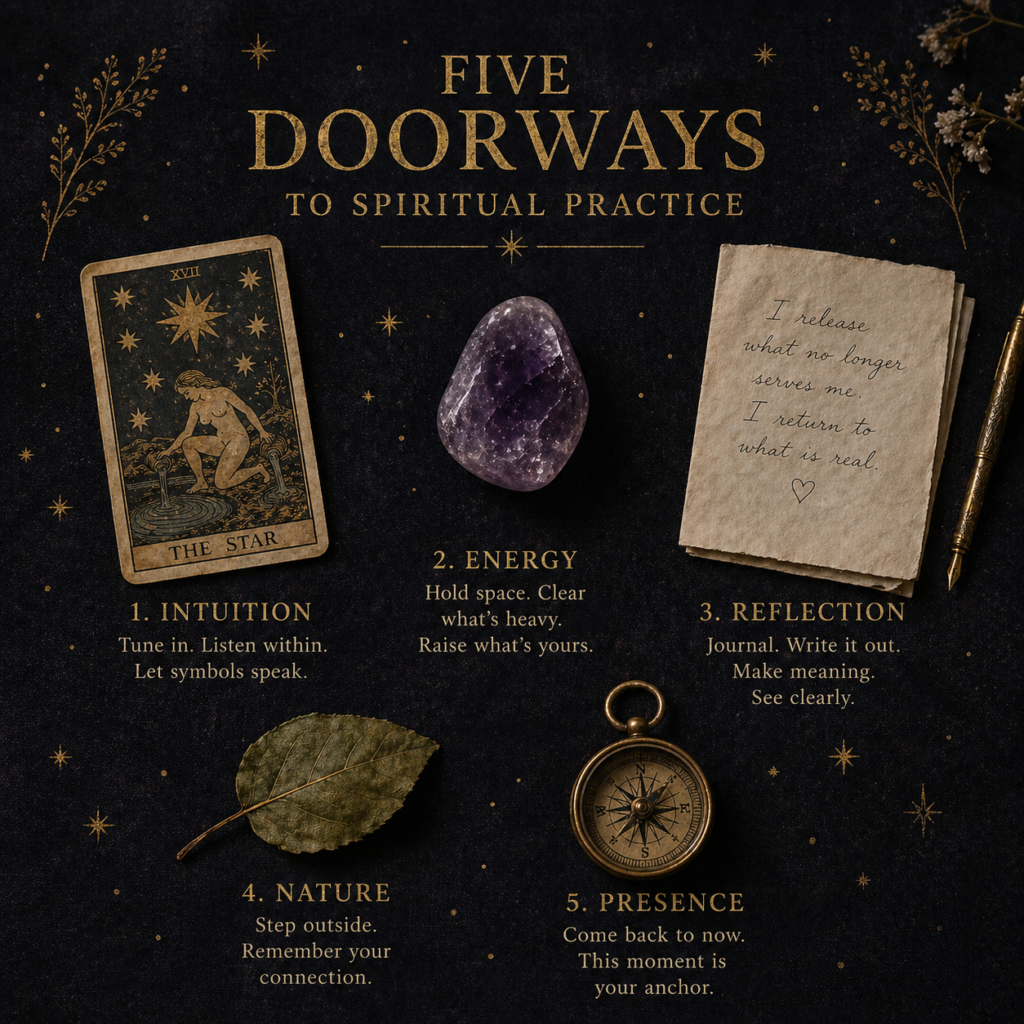
You don’t need all of these. Start with one or two that genuinely appeal, not the ones you think you “should” be doing.
Making It Embodied — and at Least Partly Offline
There’s a reason so many spiritual traditions involve physical ritual: lighting a candle, ringing a bell, placing objects on an altar. These small acts signal to your body and nervous system that something different is happening. You’re entering a different quality of time.
Creating a simple starting ritual for your practice — even just lighting a candle or taking one deliberate breath — helps mark the transition from ordinary mode to intentional mode. It doesn’t need to be elaborate. It just needs to be yours.
It’s also worth naming that your practice lives in your body and your breath, not in your phone. Digital tools can support a spiritual life beautifully, but they work best as supplements rather than the substance. Building in some screen-free, analogue elements — a journal you write in by hand, a crystal you hold, time outside — tends to deepen the quality of connection considerably.
If you’re thinking about setting up a dedicated space, our post on chakra balancing touches on how to create an environment that supports grounded, intentional practice.
Your First Seven Days: A Gentle Experiment
Rather than committing to a lifelong practice immediately, try a seven-day experiment. The goal isn’t to judge how you did — it’s simply to notice how you feel.
Each day for seven days, do one small thing with intention. It could be the same thing each day, or different things. Keep it to five to ten minutes maximum. At the end of the week, ask yourself:
- What felt natural or genuinely enjoyable?
- What felt like effort in a good way?
- What felt forced or wrong for me?
Use those answers to shape what comes next. A practice that works is one that you actually return to — and you’ll only return to something that resonates.
| Practice | Time needed | Tools needed | Best for | Notes |
|---|---|---|---|---|
| Meditation | 2–20 min | None | AnxietyFocusConnection | Strong evidence base. Works best with a consistent anchor — breath, body scan, or mantra. Many styles, so explore what suits you. |
| Tarot / oracle cards | 5–15 min | A deck | ConnectionCreativityGrounding | Reflective rather than predictive. Works well as a daily check-in, especially alongside journaling. |
| Journaling | 5–20 min | Pen + paper | FocusCreativityAnxietyConnection | Low barrier, high return. Free-writing is the easiest entry point. Prompts help if you hit a blank. |
| Crystal work | 2–10 min | A crystal | GroundingAnxietyFocus | Works well as a grounding anchor during meditation or a mindful moment. Hold, observe, breathe. |
| Breathwork | 1–10 min | None | AnxietyGroundingFocus | Fastest way to shift your nervous system. Inhale 4 counts, exhale 6 counts is a simple starting point. |
| Nature time | 15–60 min | Outdoors access | GroundingFocusConnection | Phone-free is key. Moon phases or seasons can give your practice a beautiful natural rhythm. |
| Embodied movement | 10–45 min | Mat (optional) | AnxietyGroundingFocusConnection | Yoga, qigong, or mindful stretching. Grounds spiritual experience in the body rather than keeping it purely mental. |
| Prayer / contemplation | 2–15 min | None | ConnectionCreativityFocus | Works within or outside religious frameworks. Speaking or sitting with something larger than everyday concerns. |
| Moon / seasonal rituals | 10–30 min | Candle, journal | ConnectionGroundingCreativity | Ties practice to a natural cycle. New moon for setting intentions, full moon for reflection and release. |
| Chakra balancing | 10–30 min | Crystals (optional) | AnxietyFocusConnectionCreativity | Works through body-based awareness and energy centres. Pairs well with meditation or breathwork. |
Time ranges are guides, not requirements. Even the shortest version of any practice counts.
What to Do When Life Gets in the Way
There will be weeks where the practice disappears entirely. Work explodes, someone gets ill, you’re exhausted, or you simply forget. This is not failure. This is being human.
The most useful thing you can do when you’ve been away from your practice is not to rebuild the whole thing from scratch — it’s to return with the smallest possible step. One breath. One moment of stillness. One card pulled. Just returning matters more than how you return.
Falling off and coming back is actually part of the practice. It builds the habit of returning, which may be more spiritually significant than consistency ever was.
Anchoring Your Practice in Self-Kindness, Not Self-Fixing
This is worth saying clearly: your spiritual practice is not a project to make you more worthy. You don’t need to meditate for thirty days to deserve peace. You don’t need to have the right crystals, the right tarot deck, or the right intentions to be doing it properly.
A practice rooted in self-kindness feels different from one rooted in self-improvement. One feels like coming home; the other feels like homework. Compassion-focused approaches to spiritual work often begin with simply wishing yourself well — “may I be well, may I be at ease” — as a way to soften the inner critic before anything else begins.
Your practice is not asking you to become someone else. It’s asking you to spend a little more time with who you already are.
Practical Tools to Support Your Practice
If you want to track your practice, explore your patterns, or simply have a beautiful space to reflect, a dedicated journal or planner can make a real difference. Our Spiritual Practice Journal in the Weird Headlines shop is designed exactly for this — with space for daily reflections, moon phase tracking, and prompts that don’t take themselves too seriously.
If crystals feel like part of your practice, knowing a bit about what you’re working with helps. Our guides to individual stones — from moonstone to labradorite — are a good place to explore what might resonate. And if you’re drawn to tarot as a reflective tool, the tarot card spreads post has some excellent simple layouts for daily or weekly self-check-ins.
You Don’t Need to Have It Figured Out First
The biggest barrier to starting a spiritual practice is usually the belief that you’re not ready — that you need to know more, choose the right tools, or understand your path better before you begin. But the practice itself is what clarifies the path. You can’t think your way into it.
Start with what you have, where you are, with the five minutes that already exist in your day. Adjust as you learn what works. Let it be imperfect and irregular and entirely yours.
That is already a spiritual practice.
Continue Your Journey
- Meditation Techniques to Try at Home — a practical overview of different styles and how to find what works for you
- Moon Phases and Their Meanings — using lunar cycles as a natural anchor for your practice
- How to Connect with Tarot Cards — developing a genuine relationship with your deck
- Chakra Balancing Explained — understanding energy centres and how to work with them
- Tarot Card Spreads for Beginners — simple spreads for daily reflection and self-inquiry
What does your spiritual practice look like right now — or what would you want it to look like? Share in the comments — I’d love to know what resonates with you and what’s got in the way before.
If you want gentle nudges, seasonal prompts, and ideas for building a practice that actually sticks, joining the Weird Headlines newsletter is a good place to start. New posts and reflections land in your inbox every week.