Lepidolite Crystal: Calm Anxiety & Find Peace in the Chaos
We may earn money or products from the companies mentioned in this post.
Some crystals ask you to sit with big, dramatic energy. Lepidolite is not one of them. It is the quiet one in the collection, the soft lilac stone that seems to lower the volume on everything the moment you pick it up.
That reputation is not an accident of marketing. Lepidolite is one of the few crystals with a genuinely fascinating chemical backstory tangled up in its calming reputation, and once you know it, the stone is hard to look at the same way again.
What Is Lepidolite?
Lepidolite is a mica mineral, part of the same family as muscovite, built up in soft, layered flakes that catch the light in a slightly glittery, almost sugared way. Its colour runs from pale lilac and dusty pink through to a deeper violet, sometimes shot through with flecks of pink tourmaline where the two minerals grew together underground.
Enhance Your Spiritual Practice
Discover our collection of digital planners and mystical tools designed to deepen your journey with tarot, crystals, and astrology.
Visit Our ShopThe texture is part of the appeal. Where a lot of healing crystals are hard, glassy and cool to the touch, lepidolite is soft, flaky and almost warm, closer in feel to a compressed mineral clay than a typical polished gemstone.
Lepidolite forms in lithium-rich granite pegmatites, and it was historically one of the main ores mined for lithium itself. The Wisconsin Geological and Natural History Survey describes it as a lithium-aluminium mica that forms in pink, purple or yellow scaly masses within these lithium-rich rock formations.
That detail matters, because lithium salts have a long documented history in psychiatric medicine as mood stabilisers. Crystal healing and pharmacology are two completely separate things, and lepidolite the mineral has no medicinal effect on anyone simply by being nearby. But it is a genuinely striking piece of mineral trivia that this particular stone is the literal geological source of an element associated with calm, and it goes a long way toward explaining why lepidolite became crystal healing’s unofficial “chill out” stone in the first place.
Historical Significance
Lepidolite has never had the ancient mythological weight of a stone like amethyst or moonstone. It was only properly identified and named in the late eighteenth century, and its use in jewellery and metaphysical practice is a comparatively modern story, gaining real popularity through the twentieth century as lithium mining brought the mineral into wider circulation.
What it lacks in ancient lore, it makes up for in the specificity of that lithium connection. Where other calming stones lean on colour symbolism or folklore, lepidolite’s reputation is built on something closer to chemistry, which gives it an unusually concrete origin story for a crystal.
Lepidolite’s Traditional Properties
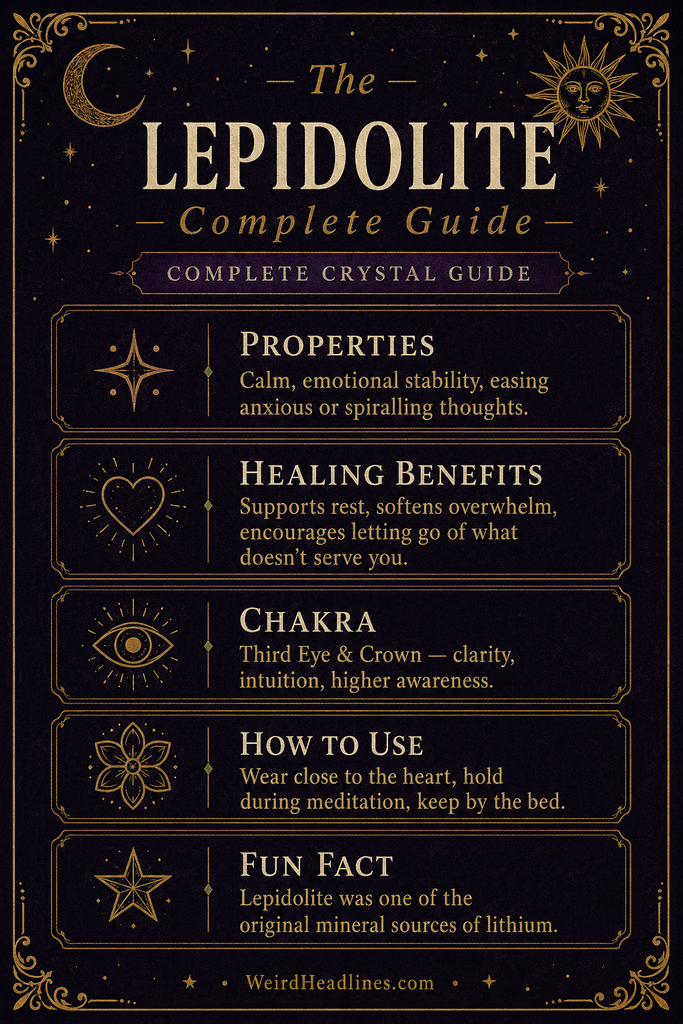
In crystal healing traditions, lepidolite is associated with:
- Calm, ease and emotional stability
- Releasing anxious or spiralling thought patterns
- Supporting deep, restful sleep
- Encouraging transitions and letting go of what no longer serves you
- Third eye and crown chakra alignment
These are traditional, belief-based associations rather than clinical claims. Think of lepidolite as a tool for ritual and intention rather than a treatment, in the same way a weighted blanket or a favourite playlist works as a cue for the body to settle, not a substitute for professional support when anxiety is a genuine, ongoing struggle.
Working With Lepidolite When Everything Feels Like Too Much
Jewellery. Lepidolite is soft for a stone used in jewellery, which is part of why it is more commonly seen in pendants and statement rings than everyday-wear bands. Wearing it close to the throat or heart is the traditional approach, kept as a physical touchstone you can return to during a stressful commute or a tense meeting.
Meditation. Hold a piece of lepidolite in your palm during a short breathing practice, letting its slightly gritty, layered texture give your hands something to focus on. This kind of tactile anchor is a genuinely useful grounding technique regardless of what you believe about the stone’s energy, simply because it interrupts a spiralling thought loop with a physical sensation.
Bedside and bedroom. Lepidolite is a popular choice on a nightstand for exactly the reasons above, placed somewhere it will be the last thing seen before sleep and the first thing seen on waking. Some practitioners tuck a small tumbled piece under the pillow, though given the stone’s softness this is worth doing with a pouch rather than loose against fabric that could pick up mineral dust.
Home and decor. A cluster of raw lepidolite on a shelf or altar space works as a quieter, more textural alternative to the sharper points of clear quartz or amethyst, and its pale lilac tone sits comfortably within Weird Headlines’ dark luxury palette as a soft accent rather than the main event.
If you are building out a full practice around calming stones, our guide to the best crystals for your work office covers several pieces that pair naturally alongside lepidolite for high-pressure environments.
Chakra Association
Lepidolite is most commonly linked to the third eye and crown chakras, the energy centres associated with intuition, higher awareness and mental clarity. Some practitioners also connect it loosely to the heart chakra when it appears alongside pink tourmaline inclusions, extending its traditional use into emotional healing as well as mental calm.
Cleansing and Charging Lepidolite
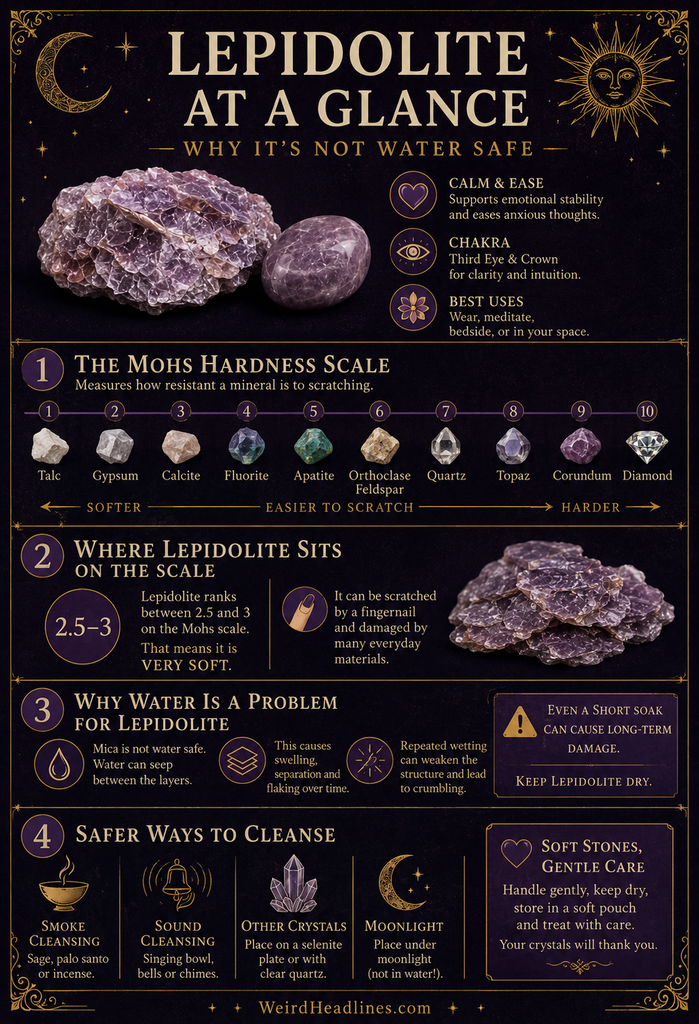
Lepidolite needs gentler handling than most crystals in a collection. As a soft mica, it is not water safe, and submerging or rinsing it risks the layered structure flaking or dulling over time.
Moonlight is the safest cleansing method for this stone, left on a windowsill overnight to recharge without any risk of water damage or sun-fading. Smoke cleansing with sage or palo santo works as a gentler alternative if moonlight is not practical, and a short rest on a bed of clear quartz or selenite can also refresh its energy between uses.
Pairing Lepidolite With Other Stones
Lepidolite tends to be layered with other stones rather than worked alone. Black tourmaline is a common pairing when the goal is calm plus protection, grounding lepidolite’s softer energy with something sturdier for particularly overwhelming stretches. Rose quartz brings a gentler, love-focused note when the anxiety in question is tied up with relationships or self-worth rather than external pressure.
Fun Facts About Lepidolite
- Lepidolite was one of the original commercial sources of lithium, discovered decades before lithium’s psychiatric applications were understood.
- Its name comes from the Greek lepidos, meaning scale, a nod to its flaky, layered structure.
- Some of the finest lepidolite specimens come paired naturally with pink tourmaline, creating stones that shift between lilac and rose depending on the light.
- It is one of the softer crystals commonly sold for healing purposes, closer to talc on the hardness scale than to quartz.
Final Thoughts
Lepidolite’s reputation as crystal healing’s calming stone is not built on vague folklore. It comes from a genuinely rooted, slightly startling piece of mineral history: this is the literal rock lithium came from, worked into a soft lilac stone that people now hold when they need their nervous system to settle. Treated as a ritual object rather than a remedy, it earns its place as one of the more grounded additions to a healing crystal collection.
If anxiety is something you are dealing with beyond the occasional stressful week, a crystal practice can sit alongside proper support, never in place of it.
What is your go-to stone when the day gets loud? Tell us in the comments, and if you have not built out a full calming crystal kit yet, our Crystal Journal has space to track exactly which stones work for you and when.