Two of Swords: Indecision, Avoidance & the Moment Before Clarity
We may earn money or products from the companies mentioned in this post.
Most readings of the Two of Swords stop at “you’re stuck.” Indecision, paralysis, a card to feel a bit uneasy about when it lands face up on the table. That reading isn’t wrong, exactly, but it misses what makes this card genuinely useful.
The Two of Swords isn’t only about being stuck. It’s about the deliberate pause that happens right before clarity, and the very real difference between a pause that’s doing its job and one that’s become a hiding place. Learning to tell those two states apart is what turns this card from a warning into a tool.
⚖️ Core Symbolism: Balance Held in Tension
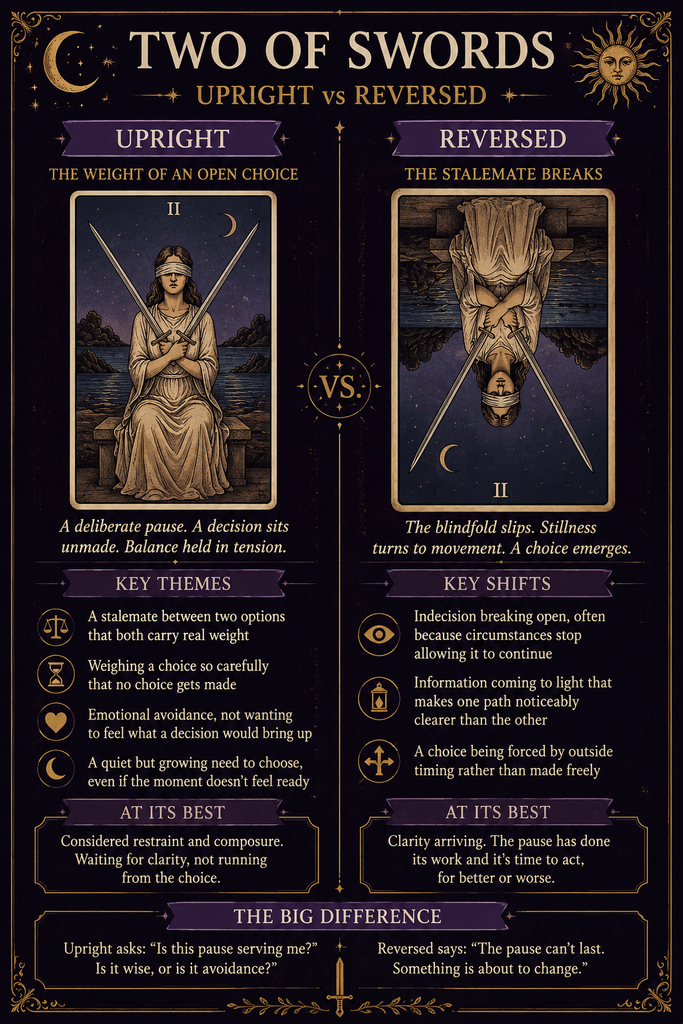
In the Rider-Waite-Smith deck, a blindfolded figure sits on a stone bench at the water’s edge, arms crossed, holding two swords in perfect balance. Behind her, the sea is calm. Rocky outcrops break the surface, and a crescent moon offers just enough light to see by, not enough to see clearly.
Enhance Your Spiritual Practice
Discover our collection of digital planners and mystical tools designed to deepen your journey with tarot, crystals, and astrology.
Visit Our ShopEvery element here is doing work. The blindfold isn’t ignorance so much as a deliberate withholding of visual judgement, a way of forcing a decision to come from somewhere other than the eyes. The crossed swords aren’t clashing; they’re held level, neither one winning, which is the whole point.
The calm water matters too. Nothing here suggests crisis. This is a card of stillness, not chaos, and that stillness is often mistaken for paralysis when it’s actually closer to composure. Traditionally, tarot readers describe this scene as balance held in tension rather than balance broken by stress.
🗡️ Upright Meaning: The Weight of an Open Choice
Upright, the Two of Swords tends to show up when a decision is sitting unmade. Two paths, two people, two versions of the truth, and a reader standing squarely between them, unwilling or unable to pick.
Common upright themes include:
- A stalemate between two options that both carry real weight
- Weighing a choice so carefully that no choice gets made
- Emotional avoidance, where the indecision is really about not wanting to feel what a decision would bring up
- A quiet but growing need to choose, even if the moment doesn’t feel ready
This is where a lot of readings go too far, framing the card as purely negative. In practice, many tarot practitioners read the upright Two of Swords as a card of considered restraint just as often as one of avoidance. The card describes a state of suspension. It doesn’t say whether that suspension is wise.
🌙 Reversed Meaning: The Stalemate Breaks
Reversed, the Two of Swords usually signals that the standoff has run its course. Something that’s been avoided is coming into view, whether that’s new information, a blunt conversation, or simply the reader’s own growing awareness that the middle ground has stopped being neutral.
This reversal can point to a few different shifts:
- Indecision breaking open, often because circumstances stop allowing it to continue
- Information coming to light that makes one path noticeably clearer than the other
- A choice being forced by outside timing rather than made freely
It’s worth being careful with language here. The reversed Two of Swords doesn’t guarantee a specific outcome, and it isn’t a promise that things will resolve neatly. It’s better read as a signal that the blindfold is slipping, for better or worse, and that stillness is about to become movement.
🧭 Productive Pause or Avoidance? How to Tell
This is the question the upright Two of Swords is really asking, and it rarely gets a straight answer in most card guides. A few honest questions tend to separate the two:
- Is new information likely to arrive if you wait, or are you just waiting? A productive pause is often waiting for something. Avoidance is usually waiting out of something.
- Does the pause feel calm, or does it feel like relief every time the decision gets pushed off again? Relief at delay is often the tell.
- Would you be comfortable explaining the wait to someone you trust? Considered patience explains itself easily. Avoidance tends to get defensive.
None of this is a formula, and tarot isn’t a substitute for sitting with the situation itself. But when the Two of Swords appears, treating it as an invitation to ask these questions, rather than a verdict either way, tends to be the more useful read.
🔗 Common Pairings
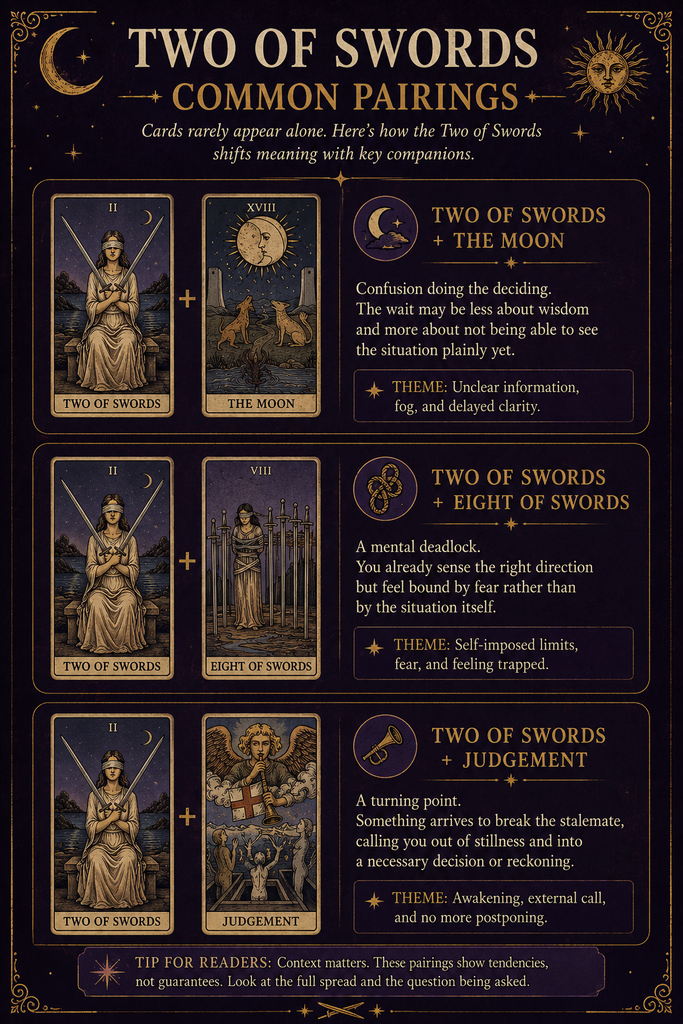
Cards rarely appear alone in a spread, and the Two of Swords shifts meaningfully depending on its neighbours.
Alongside The Moon: this pairing often points to confusion doing the deciding instead of the reader. The Moon’s fog and the Two of Swords’ blindfold reinforce each other, suggesting the wait may be less about wisdom and more about not being able to see the situation plainly yet.
Alongside the Eight of Swords: this combination tends to describe a mental deadlock. The Two of Swords’ held balance meets the Eight of Swords’ self-imposed restriction, and together they often suggest the reader already senses the right direction but feels bound by fear rather than by the situation itself.
Reading pairings like this is a habit worth building for anyone going deeper with tarot. For a broader grounding in how card meanings shift upright versus reversed, this guide to upright and reversed tarot is a useful companion piece, and newer readers may want to start with Tarot 101 for the fundamentals this card builds on.
✍️ A Reflection Prompt for This Card
When the Two of Swords turns up in a reading, it’s worth sitting with it rather than moving straight past it. Try journaling on these questions:
- What choice have I been holding at arm’s length, and what would it cost me to look at it directly?
- If I imagine taking the blindfold off, what’s the first thing I’d probably see?
- Is my current stillness protecting me, or postponing me?
Keeping a dedicated tarot journal nearby for moments like this can make the difference between a fleeting impression and a pattern you can actually track over time, especially for a card as introspective as this one.
The Takeaway
The Two of Swords isn’t a card that punishes hesitation. It’s a card that asks you to notice what kind of hesitation you’re in. A pause held with open eyes, even behind a metaphorical blindfold, is different from a pause used to avoid looking at all.
Next time this card shows up, resist the urge to read it as simply “get unstuck.” Ask instead what the stillness is actually doing for you, and whether it’s still doing it.