Amber Crystal Meaning: Fossilised Sunlight, Protection & Grounding
We may earn money or products from the companies mentioned in this post.
Most crystal profiles skip the fact that amber is not actually a mineral at all. It is fossilised tree resin, decades or millions of years in the making, which makes its place on a crystal shelf a little unusual and its traditional meaning a little more grounded than most. Here is what amber actually is, where it comes from, and the belief-based associations that have followed it for thousands of years.
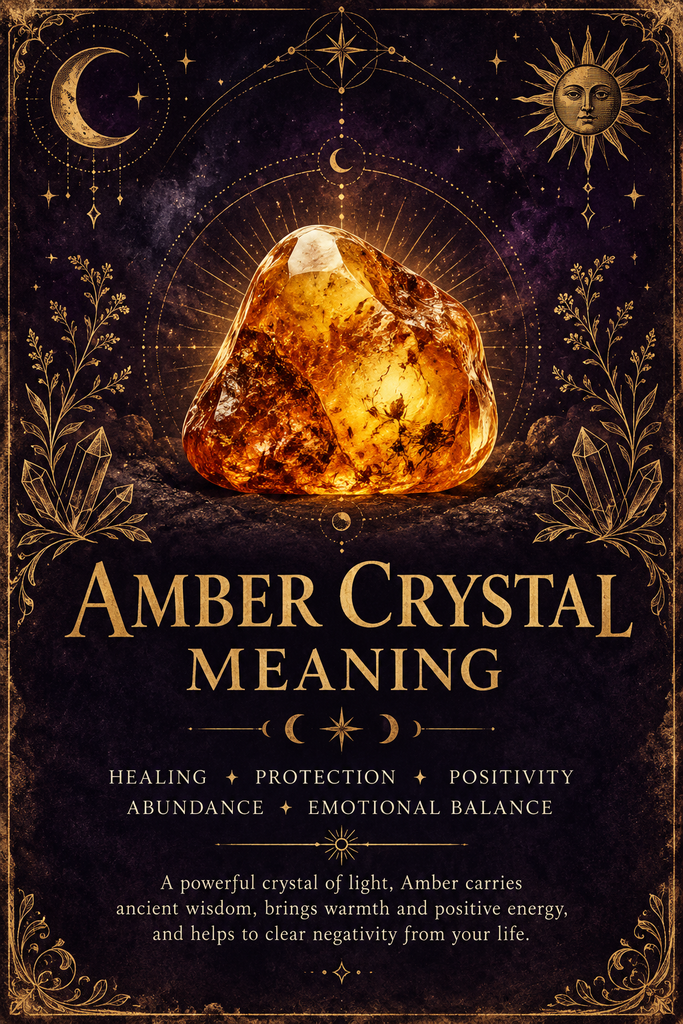
🟠 What Amber Actually Is
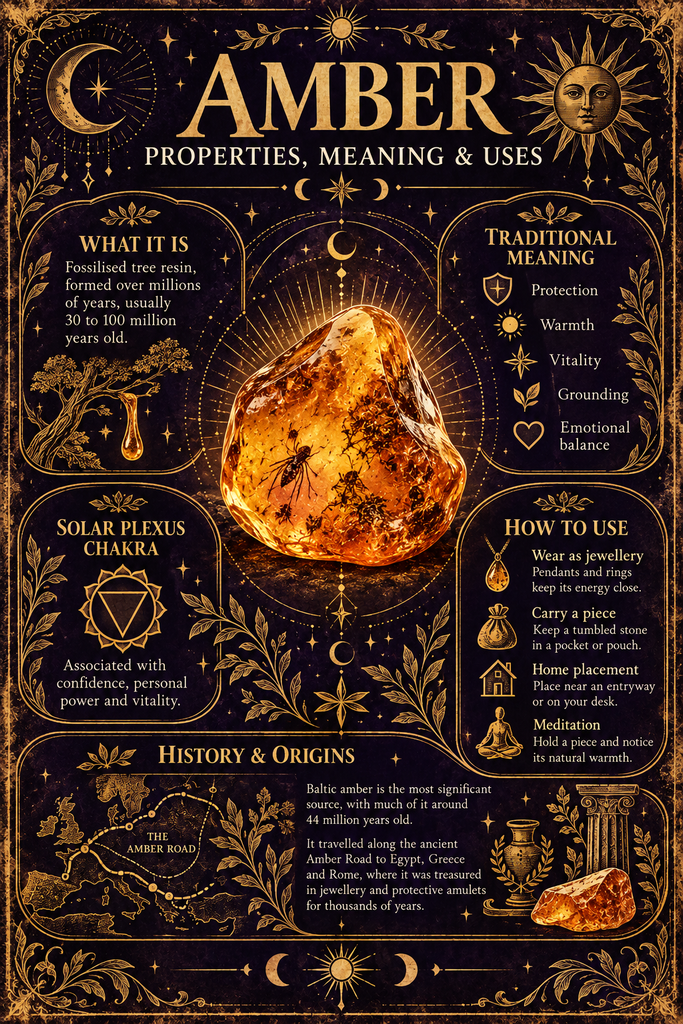
Amber begins as resin, the sticky substance certain trees release as a natural defence when their bark is damaged. Over millions of years, buried under sediment and subjected to heat and pressure, that resin slowly polymerises into the stable, fossilised material we call amber. Most amber in circulation formed somewhere between 30 and 100 million years ago, though some deposits run older still.
That origin story is exactly why amber earns its spot alongside true minerals and crystals in belief practice, even though geologically it belongs in its own category entirely. It is treated as a stone of the earth’s memory: warmth and life, captured and held.
Enhance Your Spiritual Practice
Discover our collection of digital planners and mystical tools designed to deepen your journey with tarot, crystals, and astrology.
Visit Our Shop🔍 Appearance and Characteristics
Amber typically ranges from pale honey-gold through deep cognac and orange-brown, with cloudier and clearer pieces both common depending on how the resin cooled and settled. It is notably light for its size, warm to the touch almost immediately, and soft compared to true crystals, which makes it easy to scratch or mark if handled carelessly.
The most prized pieces contain inclusions: insects, seeds, or fragments of plant matter trapped in the resin before it hardened. These are not flaws. They are the clearest physical evidence of amber’s origin, and pieces with visible inclusions are often the most sought after by collectors as well as by anyone drawn to the stone’s history.
🏺 Origins and Historical Significance
Baltic amber, sourced from the Baltic Sea region, is the most significant source in the world and among the oldest, with much of it around 44 million years old. Dominican amber, mined in the Dominican Republic, tends to run younger and is prized for its clarity and the frequency of visible inclusions, sometimes showing a blue fluorescence in daylight. Colour and clarity vary considerably between sources, which is part of why no two pieces of amber look quite alike.
Amber’s trade history runs deep. The Amber Road, a network of ancient trade routes, carried Baltic amber south to the Mediterranean, where it reached Egypt, Greece, and Rome and was worked into jewellery and amulets across those cultures for thousands of years. Its warm colour and organic origin made it a natural fit for talismans meant to carry warmth, life, and protection with the wearer, a role it has held in one form or another ever since.
Amber’s folklore sits alongside a much wider body of belief and legend that has grown up around stones and crystals across cultures and centuries. If the myths and stories behind other well-known crystals interest you as much as amber’s own history does, Crystal Folklore: Myths and Legends Behind Popular Crystals is worth a look.
🕯️ Traditional and Belief-Based Meaning
In crystal and belief practice, amber is associated above all with protection, warmth, and vitality. Its traditional role as a protective talisman traces directly back to that ancient amulet history, carried by people who believed the stone’s captured sunlight offered a kind of shield.
Amber is also connected to grounding, in a gentler, warmer register than the colder grounding stones like smoky quartz or black tourmaline. Practitioners who work with the chakra system often place it at the solar plexus, linking it to confidence, personal power, and vitality rather than the root-level grounding associated with darker stones. Some traditions also draw an emotional association, treating amber as a stone that encourages steadiness and warmth in the wearer rather than dramatic transformation.
It is worth drawing a distinction here, since amber gets grouped with other warm-toned stones fairly often. Where a stone like sunstone leans into solar energy and abundance, amber’s warmth comes from a different place entirely: it is ancient captured resin rather than a mineral catching light, and its traditional associations lean toward protection and steady vitality rather than active solar power.
These are traditional and belief-based associations, not medical claims. Amber is not a treatment for any condition, and any benefit here is a matter of belief and personal practice rather than established fact.
💍 How to Use Amber
Jewellery is the most common way amber is worn and has been for millennia, continuing that unbroken amulet tradition in a genuinely practical form. A pendant worn close to the chest or a ring worn on the hand are both traditional placements if the goal is keeping the stone’s protective association close.
Carrying a small tumbled piece in a pocket or pouch is a simple, low-commitment way to work with amber day to day. For home placement, many practitioners keep a piece near an entryway, following the same protective logic as the jewellery tradition, or on a desk where the solar plexus association with confidence feels most relevant. Holding a piece during meditation, simply to notice its warmth against the skin, is a common and genuinely low-effort way to work with the stone’s grounding associations.
🧼 Caring for Amber
Amber is soft and genuinely sensitive to heat and household chemicals, more so than most crystals kept on a shelf. Avoid perfume, hairspray, and harsh cleaning products near amber jewellery, and keep it away from direct heat sources, since both can dull or damage the surface over time.
For cleansing and recharging amber as part of a belief practice, the full guide to cleansing and charging your crystals covers every method in detail, including which ones are gentle enough for a soft stone like amber.
✨ Spotting Real Amber
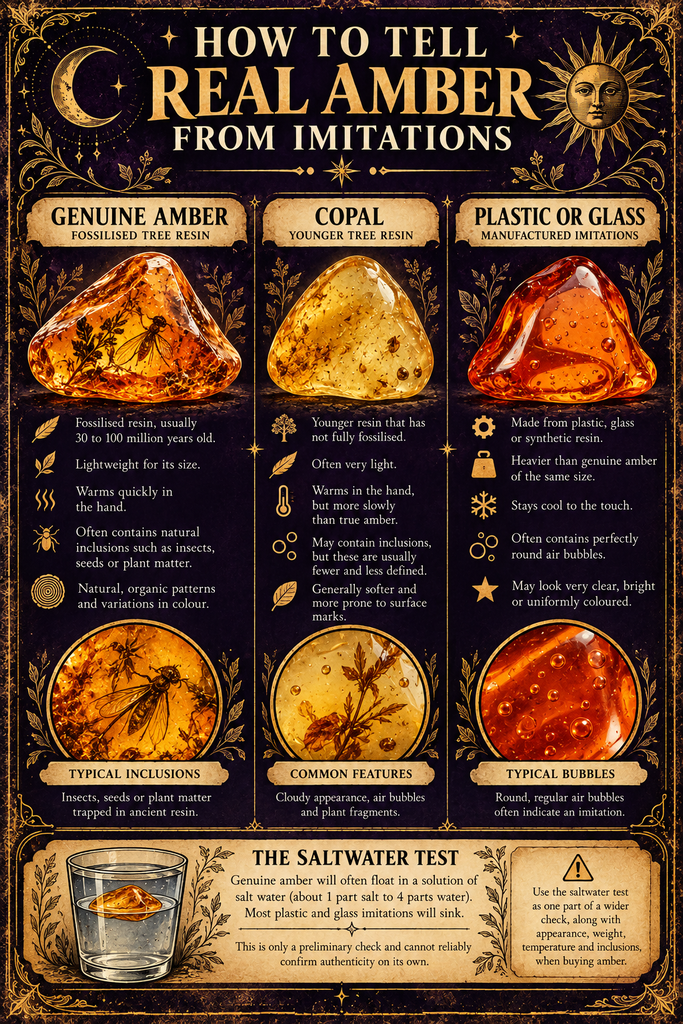
Genuine amber is often confused with two imitators: copal, a younger and softer tree resin sometimes sold as amber, and plastic or glass reproductions. Real amber is notably light and feels warm quickly in the hand, while plastic and glass imitations tend to feel colder and heavier by comparison.
A simple saltwater test can help at home. Genuine amber floats in a strong saltwater solution, while most plastic imitations sink, though this is a helpful starting point rather than a definitive lab test. Buying from a seller who can speak to the amber’s origin remains the more reliable route if authenticity really matters to you.
❓ Quick Answers on Amber
Is amber a crystal? Not technically. It is fossilised tree resin rather than a mineral, which is why some purists separate it from true crystals, though it is grouped with crystals in belief practice because of its long shared history as a worn and carried stone.
What colour is real amber? Genuine amber ranges from pale honey to deep cognac and orange-brown, and even greenish or reddish tones exist depending on the source and how the resin aged. A colour that looks unnaturally uniform or overly bright is worth a second look before buying.
Can amber lose its colour over time? Amber can darken and deepen in tone with age and light exposure, which is part of its character rather than a flaw. Keeping it away from prolonged direct sunlight will slow that process if you want to preserve its current colour.
🌞 Final Thoughts
Amber’s appeal has never really needed the crystal shelf to make sense. It is genuinely ancient, holding tangible traces of a world tens of millions of years gone, and it has carried a consistent thread of protection and warmth through every culture that has worked with it since. That is a rarer thing than it sounds, and worth sitting with the next time you hold a piece up to the light and notice what is caught inside it.
Do you carry or wear amber, and what drew you to it in the first place? Share your own experience in the comments.