Peridot Crystal Meaning: Summer’s Stone of Renewal & Abundance
We may earn money or products from the companies mentioned in this post.
Most peridot guides read like a specification sheet — hardness, chakra, done. That misses what makes this stone worth reaching for right now. Peridot is a summer stone through and through, carrying an energy of renewal, abundance, and lightness of being that lines up almost perfectly with the season it’s tied to. If you’ve been drawn to it lately, that’s not a coincidence worth ignoring.
This guide covers where peridot comes from, what its core properties actually mean, and — most usefully — how to work with it while summer’s energy is still in full swing. If you’re reading this during Leo season, the timing lines up especially well — both are built around confidence, warmth, and stepping into more of yourself.
Where Peridot Comes From
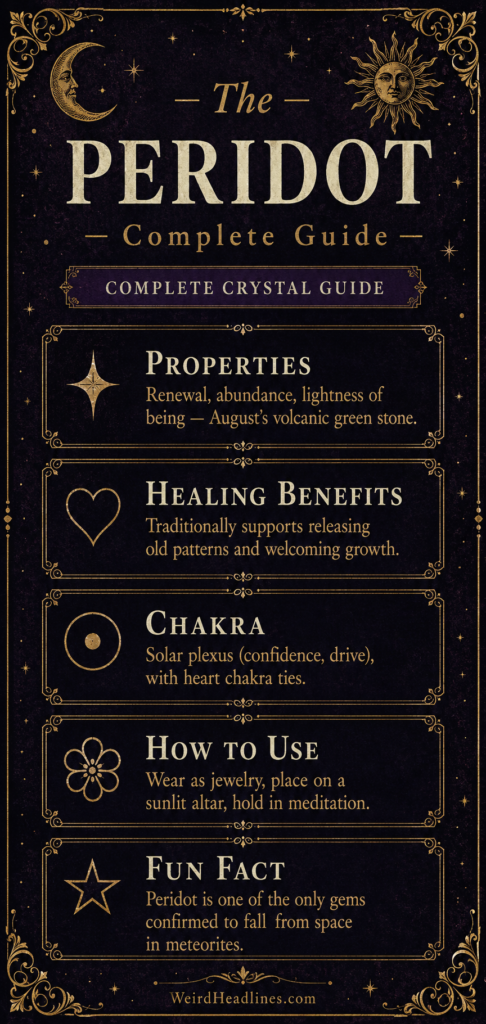
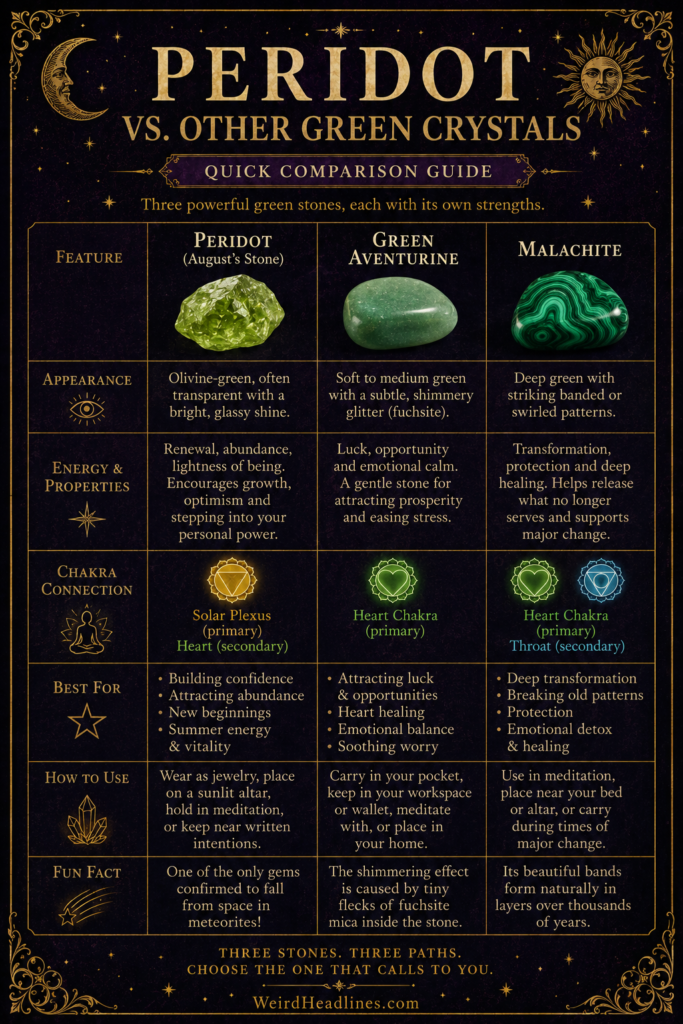
Peridot is the birthstone for August, and its origin story is stranger than most crystals can claim. It forms deep in the earth’s upper mantle and gets carried to the surface by volcanic activity, which is why it’s sometimes called the “volcano gem.” Hawaii’s beaches even have patches of green sand made almost entirely of tiny peridot crystals, washed out of old lava flows.
Enhance Your Spiritual Practice
Discover our collection of digital planners and mystical tools designed to deepen your journey with tarot, crystals, and astrology.
Visit Our ShopIt’s also one of the only gemstones confirmed to fall from space. Small peridot crystals have been found inside pallasite meteorites, a rare stony-iron type studded with olivine (peridot’s mineral name) suspended in a metal matrix. Between its volcanic birth and its meteoric appearances, peridot has a genuinely dual origin story: born of the earth’s interior, and occasionally delivered from beyond it.
Ancient Egypt prized the stone heavily, mining it on the Red Sea island of Zabargad as early as 1500 BCE. Egyptian miners reportedly worked at night, since peridot’s green was said to be easier to spot under torchlight than in the glare of the desert sun. Some gemologists have proposed that Cleopatra’s famous “emeralds” were in fact peridot, given that Egypt’s ancient emerald sources were far less productive than its peridot mines — though the emerald-vs-peridot question is still debated among historians and hasn’t been settled definitively.
The Core Properties: Why Peridot Reads as a Summer Stone
Peridot’s traditional associations cluster around three ideas: renewal, abundance, and lightness of being. Each one maps onto what summer represents on its own.
Renewal shows up in peridot’s own volcanic backstory — a stone forged from molten rock cooling into something solid and green. In crystal lore, it’s associated with clearing out old patterns and making room for a fresh start, which is exactly the energy that mid-year and late-summer transitions tend to call for.
Abundance is peridot’s other major throughline. It’s traditionally linked to prosperity and growth, the kind of expansive, things-are-opening-up feeling that high summer carries with it. This is part of why it pairs so naturally with other abundance-oriented stones, which we’ll get to below.
Lightness of being is the least talked-about of the three, but it might be the most seasonal. Peridot’s traditional lore describes it as a stone that eases heaviness and self-criticism, encouraging a kind of buoyant, sun-warmed outlook. That’s the emotional register of a long summer evening — unhurried, a little looser than usual, in no rush to be anywhere else.
Chakra Connection
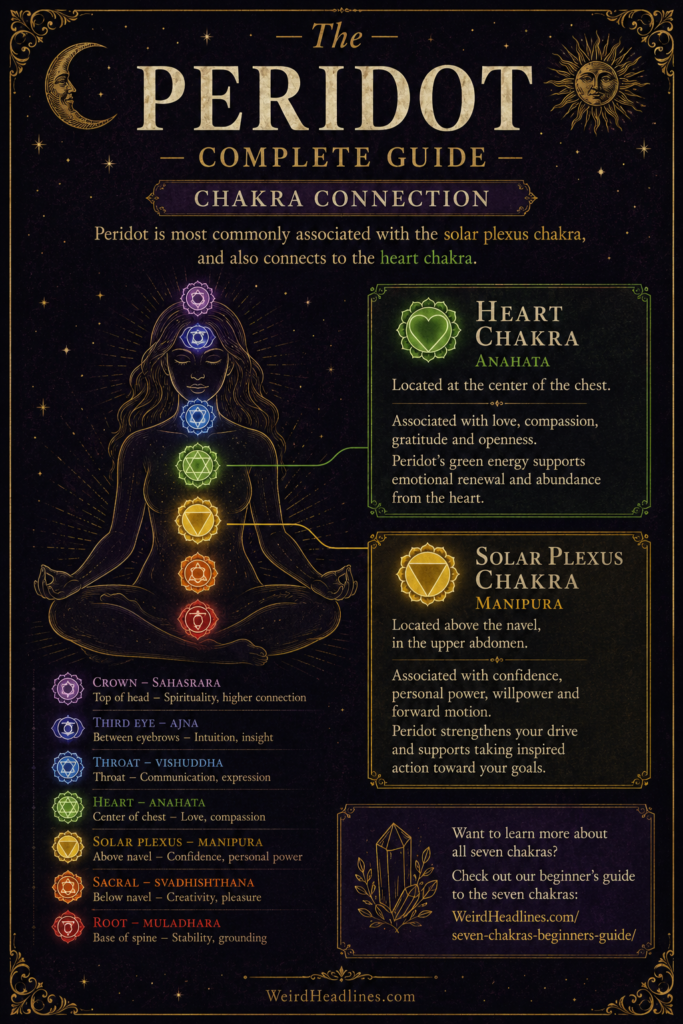
Peridot is most commonly associated with the solar plexus chakra, the energy center linked to confidence, personal power, and a sense of forward motion — if that system is new to you, our beginner’s guide to the seven chakras is a good starting point. Some traditions also connect it to the heart chakra, given its consistent green color and its abundance associations, which many systems treat as heart-adjacent territory.
In practice, this dual association means peridot works well for two related but distinct kinds of intention-setting: solar plexus work when you’re focused on confidence and taking action, and heart-centered work when you’re focused on openness and gratitude. Abundance work often benefits from touching both, since real abundance tends to require confidence to pursue it and openness to receive it.
Ways to Work With Peridot This Season
Jewelry. Peridot is a genuinely wearable stone — hard enough for daily use and bright enough that it doesn’t disappear against summer wardrobes. A pendant sitting near the heart or solar plexus keeps its intention close throughout the day, and a bracelet works well if you want a quick visual reminder of a renewal intention every time you glance down.
Altar placement. If you keep a seasonal altar, peridot fits naturally alongside sun symbols, greenery, or anything representing growth. Placing it where morning light reaches it — even briefly — plays into its solar plexus association and gives the stone a small daily “recharge” in the process.
Meditation. Holding peridot during meditation is a straightforward way to work with its renewal properties. A simple approach: hold the stone in your non-dominant hand, focus on the solar plexus, and mentally name one thing you’re ready to let go of and one thing you’re ready to grow into.
Intention-setting. Peridot responds well to written intentions kept nearby — a note tucked under the stone, or the stone placed directly on a journal page. Given its abundance associations, this works particularly well for goals around opportunity, growth, or simply making more room in your life for what you actually want.
Pairings for Abundance and Renewal Work
Peridot doesn’t need company to be effective, but a few pairings amplify specific intentions if you want to build them out:
- Peridot + citrine — doubles down on abundance and joy, both being sunny, high-energy stones associated with prosperity.
- Peridot + green aventurine — leans into growth and opportunity specifically, useful if your renewal work is tied to a concrete goal like a job change or new project.
- Peridot + selenite — a simple cleansing pairing, and useful if your renewal intention involves clearing something out before building something new.
A simple ritual to try: at the height of summer, set peridot alongside one abundance-pairing stone on a windowsill that gets direct sun for a few hours. As it charges, write down what you’re releasing and what you’re inviting in. Revisit the note at the end of the season to see what actually shifted.
Cleansing and Care
Peridot is sensitive in ways some other crystals aren’t, so a few practical notes are worth keeping in mind. It can be scratched by harder stones and jewelry, so store it separately rather than tossing it in with quartz or amethyst pieces. It’s also sensitive to sudden temperature changes and to household chemicals, so skip steam cleaning, ultrasonic cleaners, and anything involving prolonged heat or harsh cleaning products.
For everyday cleansing, moonlight is the gentlest option — leaving peridot on a windowsill overnight works well and ties naturally into its lunar-adjacent renewal associations. Sound cleansing (a singing bowl or bell) is another safe, low-risk method. If you use sunlight, keep exposure brief; peridot’s color can fade with prolonged direct sun over time, which is a bit ironic for a stone so tied to solar energy, but worth knowing.
Final Thoughts
Peridot’s summer resonance isn’t a marketing angle tacked onto a generic stone — it’s built into the crystal’s own volcanic origin, its historical ties to a sun-scorched Egyptian mining island, and the specific trio of properties (renewal, abundance, lightness) that define it. Working with it while summer is still in motion, rather than saving it for a generic “someday,” is where it tends to earn its reputation.
If you’ve picked up a piece of peridot this season, what drew you to it — the color, the story, or the timing? However you found your way to this stone, there’s no wrong entry point.