Citrine Crystal: The Sunshine Stone of Abundance & Joy
We may earn money or products from the companies mentioned in this post.
There’s a reason citrine has been called the merchant’s stone for centuries. Warm, golden, and radiating an almost tangible energy, it’s one of those crystals that immediately feels like something — even before you know what it’s supposed to do. Whether you’re drawn to it for its solar colour, its reputation for attracting prosperity, or simply because it catches the light in a way that makes you smile, citrine has a lot to offer.
In this guide, we’re covering everything you need to know about citrine: what it looks like, where it comes from, what it’s believed to do, and how to actually work with it in your everyday life. As always, we’ll keep it honest — citrine isn’t a magic wand, but as a ritual tool and intentional companion, it can be genuinely powerful.
What Is Citrine? Appearance and Characteristics
Citrine is a variety of quartz, and its colour ranges from pale lemon yellow all the way through to deep amber and smoky golden-orange. That sunny hue comes from trace amounts of iron within the crystal structure, and the depth of colour varies quite a bit depending on where the stone was formed. Naturally occurring citrine tends to be lighter and more translucent, while the deeper, more saturated orange tones are usually heat-treated amethyst — a totally common and widely accepted practice in the crystal world, though worth knowing.
Enhance Your Spiritual Practice
Discover our collection of digital planners and mystical tools designed to deepen your journey with tarot, crystals, and astrology.
Visit Our ShopIn terms of structure, citrine shares quartz’s classic hexagonal crystal form, often found as points, clusters, or tumbled stones. It’s a relatively hard mineral, sitting at a 7 on the Mohs scale, which makes it durable enough for everyday wear and handling. It won’t scratch easily, and it doesn’t require the careful handling that softer stones like selenite need.
One thing to watch for when buying citrine: a lot of what’s sold commercially is heat-treated amethyst. The giveaway is usually a very uniform, deep orange-amber with slightly white or cloudy bases on points or clusters. True natural citrine tends to be paler and more varied in colour. Neither is “better” — it’s simply useful to know what you’re getting.
Citrine Through History
Citrine has been prized since antiquity, with its warm colour making it a natural choice for decorative and protective use. Ancient Greeks and Romans carved it into intaglios and set it into jewellery, valuing it as a talisman against evil thoughts and snake venom. In the 17th century it became fashionable in Scottish jewellery — particularly in the handles of daggers — and the style spread throughout the British Isles.
The stone’s reputation as a prosperity attractor is longstanding. Merchants would keep a piece in their cash drawers or on their shop counters, believing it would draw wealth and good fortune to the business. This is where the nickname “merchant’s stone” comes from, and the tradition has carried through into modern crystal practice. You’ll still find recommendations to keep citrine near a till, in a wallet, or on a business desk — a nice through-line from ancient commerce to the modern abundance mindset.
Citrine’s Spiritual Meaning & Properties
In the world of crystal healing and energy work, citrine sits firmly in the territory of the solar plexus chakra — the energy centre associated with personal power, confidence, self-worth, and will. It’s sometimes also linked to the sacral chakra, which governs creativity, pleasure, and motivation. Putting those two together, citrine is essentially positioned as a stone that helps you feel capable, clear, and energised enough to actually go after what you want.
Here’s what citrine is most often associated with in crystal practice:
- Abundance and prosperity — attracting opportunities, financial growth, and openness to receive
- Joy and optimism — lifting heavy or stagnant energy and inviting a lighter emotional state
- Confidence and self-belief — strengthening your sense of personal power and inner radiance
- Manifestation — supporting inspired action toward goals, not just visualisation
- Clarity and motivation — clearing mental fog and boosting the willpower to follow through
It’s worth saying clearly: these are metaphysical and symbolic associations. There’s no scientific evidence that crystals have measurable energetic effects. What citrine genuinely offers is a beautiful, intentional focal point for the mindset work you’re already doing — a ritual object that helps anchor affirmations around abundance, confidence, and action. Plenty of people find that useful, and there’s nothing wrong with that.
If you’re curious about how crystals slot into a broader practice, our guide on how to use crystals in your daily meditation practice is a good place to start.
Citrine and the Solar Plexus Chakra
The solar plexus chakra — or Manipura in Sanskrit — sits just above the navel and is considered the seat of personal power, confidence, and sense of self. When this chakra feels blocked or underactive, you might notice patterns of self-doubt, indecisiveness, or difficulty taking action. Citrine’s warm, solar energy is said to directly speak to this centre, helping to clear stagnation and reignite the inner “yes” that gets things moving.
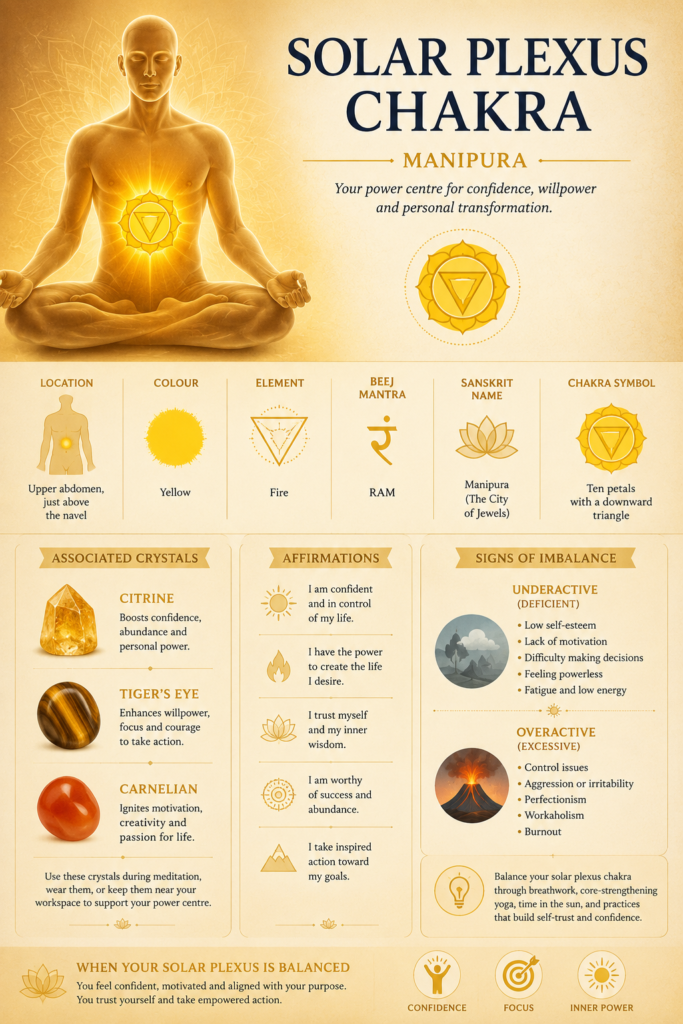
If you’re new to chakra work, it’s worth getting the full picture. Our complete beginner’s guide to the seven chakras covers all seven energy centres in detail, including how to identify imbalances and which practices support each one.
Healing Benefits and How Citrine Is Used
Crystal practitioners describe citrine as one of the few stones that doesn’t absorb or hold onto negative energy — it’s said to transmute rather than accumulate, which is why you’ll see it recommended as a low-maintenance choice in any collection. Whether or not you subscribe to that concept, citrine is genuinely a feel-good stone: bright, warming, and easy to love.
In practice, people use citrine in several key ways:
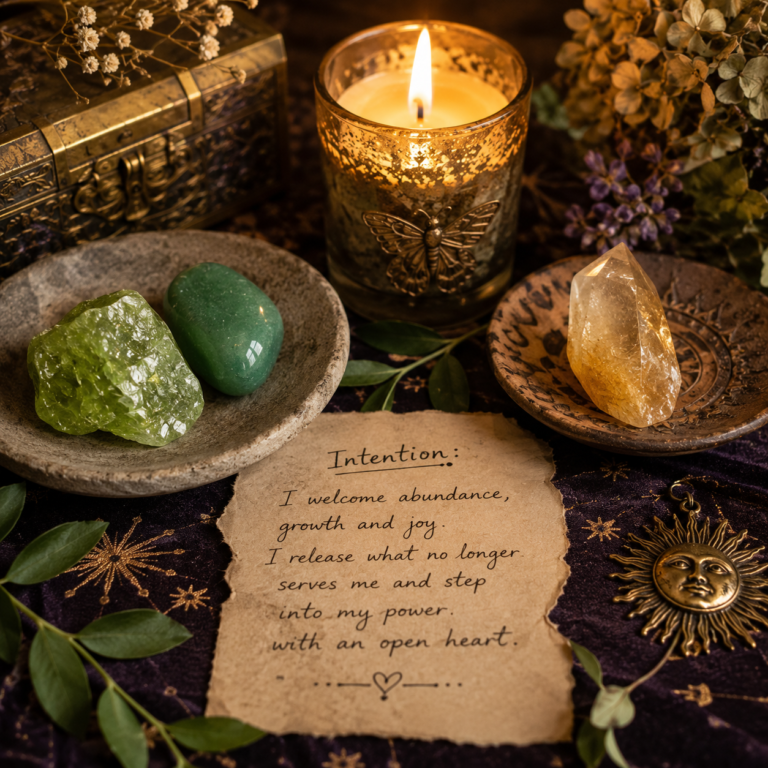
- On an abundance altar or workspace — placing citrine near where you work or handle finances as a symbol of openness and prosperity
- In meditation — holding it on or near the solar plexus to connect with confidence and personal power
- During intention-setting — journalling with citrine nearby to anchor affirmations around career, money, or self-worth
- In a wallet or purse — a small tumbled stone carried as a daily reminder of abundance mindset
Citrine is also commonly used in crystal grids, particularly for manifestation layouts. It works beautifully alongside green aventurine for a prosperity-focused grid — if that’s something you’re building, our post on green aventurine and attracting luck and abundance is a natural companion read.
Wearing Citrine as Jewellery
One of the most practical ways to work with any crystal is to wear it, and citrine is particularly popular in jewellery because of its warm, versatile colour. A citrine pendant near the solar plexus is considered especially resonant, though any point of contact works. Because it sits at a 7 on the Mohs scale, it’s hard enough to wear regularly without worrying too much about damage.
If you’re building a collection and want to document your stones — their properties, how you use them, which combinations you’ve tried — a dedicated crystal journal is a lovely way to track your practice. We have a Crystal Journal available in our shop [add product link] if you’d like something designed specifically for this kind of work.
Citrine and Manifestation
Citrine is probably the crystal most closely associated with the law of attraction and manifestation work, and it’s easy to see why. Its energy is described as active and action-oriented rather than passive — it’s not just about visualising what you want, but generating the clarity, motivation, and belief to actually pursue it. That aligns well with how most experienced manifestation practitioners describe the process: intention plus inspired action.
The 7 spiritual laws of manifestation post covers this beautifully if you want to go deeper on the philosophy. Pairing that understanding with a physical anchor like citrine can make your practice feel more grounded and tactile — which, for many people, genuinely helps.
Citrine vs Other Abundance Crystals
Citrine isn’t the only crystal with a reputation for prosperity and positive energy. It’s worth knowing how it compares to a few others you might already have in your collection.
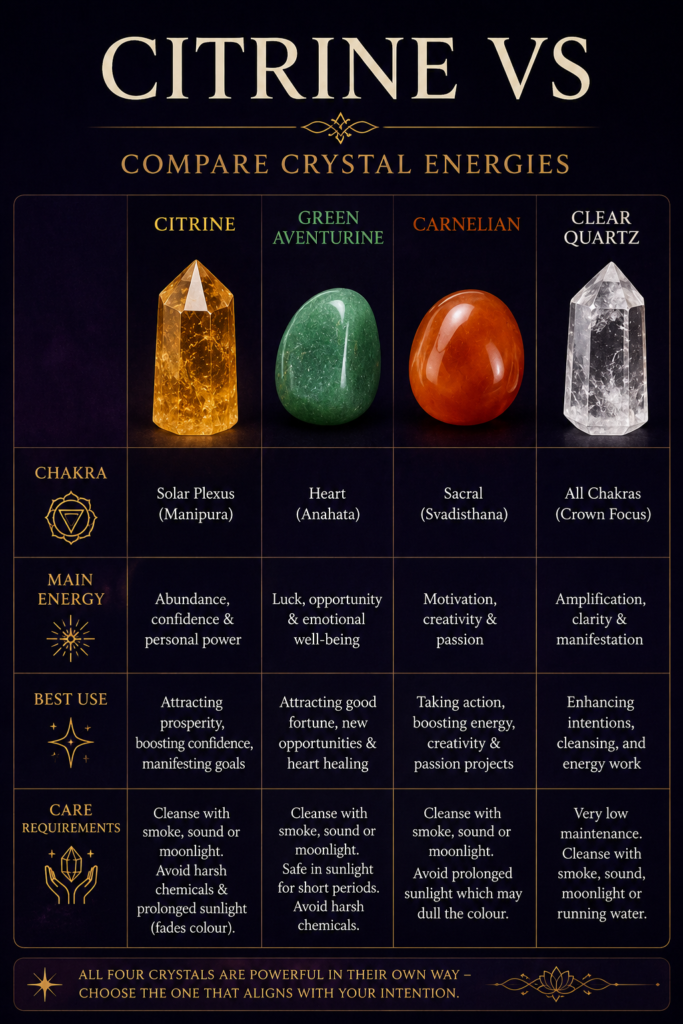
Citrine vs Green Aventurine: Green aventurine is often called the “lucky” stone — it’s associated with fortune, opportunity, and being in the right place at the right time. Citrine is more about confidence and taking action toward what you want. Together, they’re a popular pairing for abundance work.
Citrine vs Carnelian: Carnelian shares citrine’s warm, fiery energy and is also linked to the sacral chakra. Where citrine is about confidence and prosperity, carnelian leans more into creativity, courage, and motivation. They complement each other well.
Citrine vs Clear Quartz: Clear quartz is considered an amplifier — it works with and magnifies the energy of whatever intention or crystal it’s paired with. Using clear quartz alongside citrine can intensify your manifestation or abundance work.
How to Care for Your Citrine
Citrine is one of the easier crystals to care for. Its hardness means it’s not going to scratch or chip with normal handling, and it’s generally safe to cleanse with water, unlike softer or porous stones. That said, extended exposure to direct sunlight can fade the colour over time, so it’s worth keeping it out of bright windows if you want to maintain that warm, golden hue.
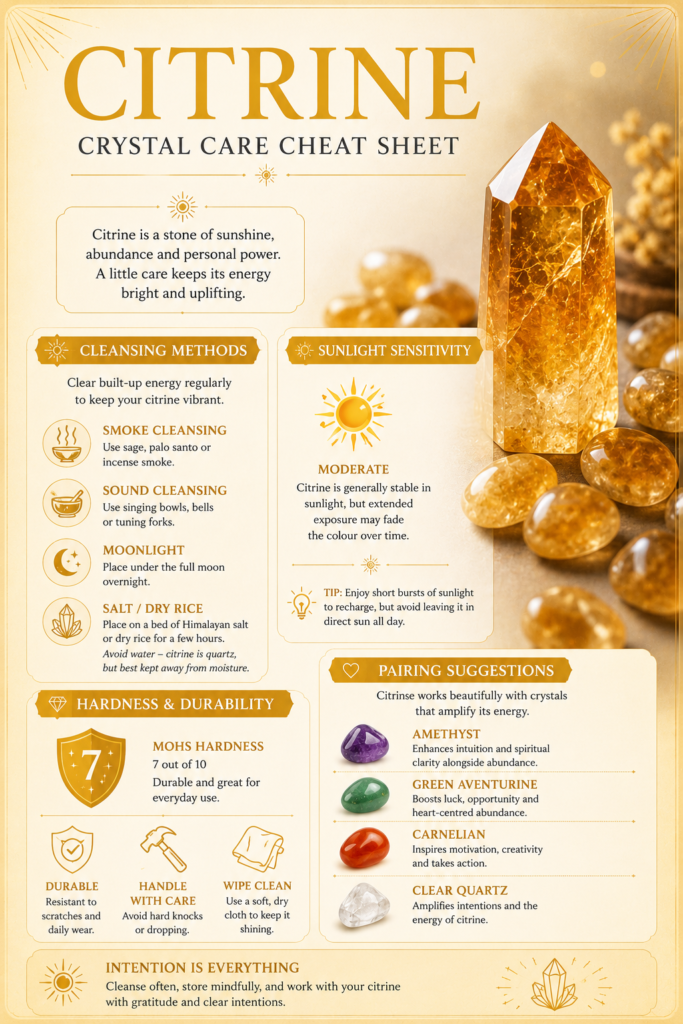
Common cleansing methods for citrine include:
- Moonlight cleansing overnight (particularly around the full moon)
- Sound cleansing with a singing bowl or tuning fork
- Brief rinse under cool running water
- Smoke cleansing with sage, palo santo, or your preferred herb
Because citrine is believed to transmute rather than absorb negativity, some practitioners feel it doesn’t need cleansing as regularly as other crystals — but doing so regularly as part of your ritual practice is never a bad habit.
Fun Facts About Citrine
- Citrine takes its name from the French word citron, meaning lemon, a nod to its characteristic yellow colouring.
- The world’s largest faceted citrine is over 20,000 carats and is displayed in the Smithsonian Institution’s National Museum of Natural History.
- Brazil is the world’s primary source of citrine, particularly from the state of Rio Grande do Sul, though deposits are also found in Spain, Madagascar, and parts of the United States.
- Scottish citrine, known as “Cairngorm,” was historically set into kilt pins, brooches, and sporrans, and pieces from this tradition are still highly collectible today.
- Citrine is the birthstone for November, alongside topaz, and is also associated with the 13th wedding anniversary.
Bringing Citrine Into Your Practice
Citrine is a genuinely lovely crystal to work with — not just because of its associations, but because it’s simply a pleasure to own. That warm golden light on a grey day is hard to argue with. Whether you’re drawn to it for abundance work, confidence rituals, solar plexus chakra healing, or just because you like how it looks, there are so many ways to let it be part of your practice.
If you’re just getting started with crystals, you might also enjoy our guides on labradorite for magic and transformation and moonstone for intuition and lunar energy — both offer very different but equally powerful energies to explore.
Remember, crystals are companions, not cures. Citrine won’t do the work for you — but as a beautiful, intentional reminder of where you’re headed, it’s hard to beat.
Continue Your Journey
- How to Use Crystals in Your Daily Meditation Practice — practical guidance on building a crystal meditation routine
- The Seven Chakras: A Complete Beginner’s Guide — understand the energy centres citrine works with
- Green Aventurine Crystal: Attracting Luck & Abundance — citrine’s natural prosperity partner
- Carnelian Crystal: Ignite Your Creativity, Courage & Confidence — another fiery crystal for motivation and action
- The 7 Spiritual Laws of Manifestation (How They Actually Work) — the philosophy behind manifestation work
Do you work with citrine in your practice? Drop a comment below and let us know how you use it — whether it’s in your wallet, on your desk, or in a crystal grid, we’d love to hear your experience.
Ready to take your crystal practice deeper? Sign up for our newsletter for new crystal guides, spiritual insights, and a little sunshine in your inbox every week.