Lughnasadh / Lammas 2026: First Harvest Rituals & Abundance Magic
We may earn money or products from the companies mentioned in this post.
Lughnasadh, also called Lammas, marks the first of the three harvest festivals on the Wheel of the Year. It sits at the midpoint between the summer solstice and the autumn equinox, a moment when the growing season tips from effort into reward. If you are newer to sabbat work, this is a good one to start with: the correspondences are simple, the rituals are hands-on, and the whole point is noticing what you have already grown, rather than reaching for something new.
This guide skips the long history lecture. Below you will find the practical version: what actually shifts in 2026, a gratitude altar you can build in an afternoon, an abundance ritual with two options depending on your time, correspondences to work with, and a small set of tarot and journaling prompts to close the practice out.
🌾 What is Lughnasadh, and why does the date shift in 2026?
Lughnasadh is the first harvest sabbat, traditionally tied to the grain harvest and named for the Irish god Lugh. It falls between the abundance of high summer and the quieter, colder months ahead, which is why so much of its symbolism centres on bread, grain, and gathering in what has been grown before the season turns.
Enhance Your Spiritual Practice
Discover our collection of digital planners and mystical tools designed to deepen your journey with tarot, crystals, and astrology.
Visit Our ShopIn 2026, you will see two dates used for Lughnasadh, and both are legitimate depending on which tradition you are following.
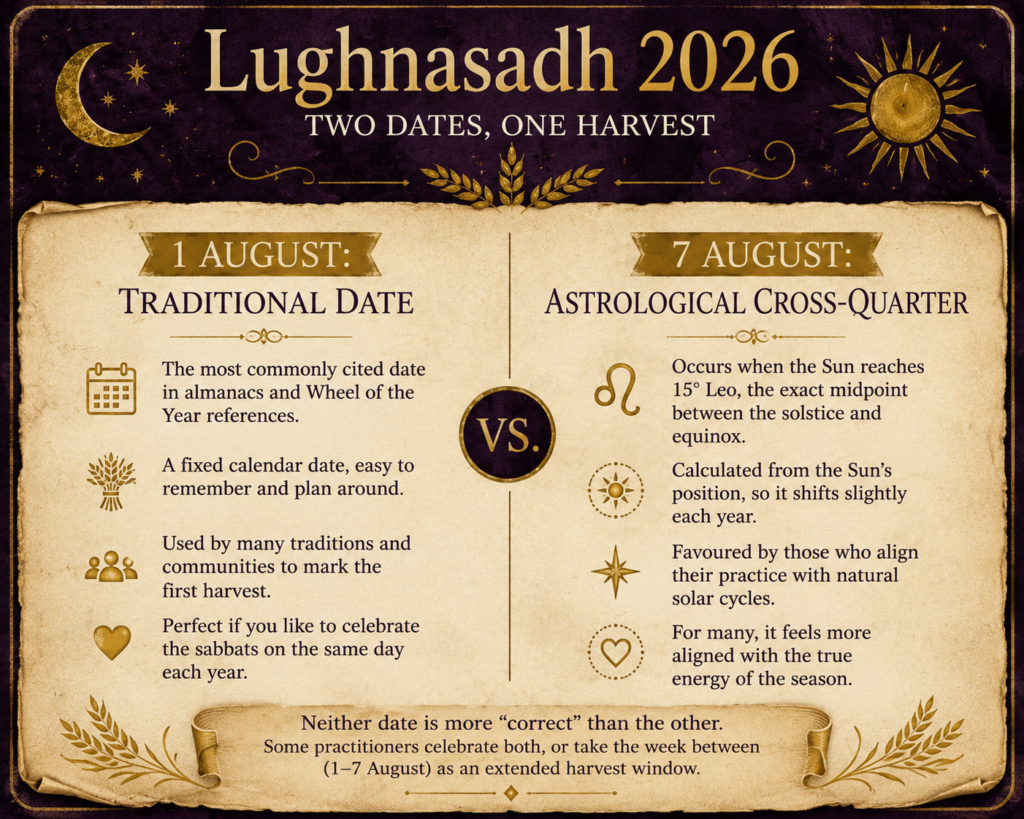
The traditional calendar date is 1 August. This is the date most commonly cited in almanacs and general Wheel of the Year references, and it is the one to use if you like to mark the sabbats on a fixed day each year.
The astrological cross-quarter point, favoured by practitioners who prefer to track the sabbats by the Sun’s actual position rather than the calendar, falls on 7 August 2026, when the Sun reaches 15 degrees Leo, the exact midpoint between the summer solstice and the autumn equinox. This date moves slightly year to year because it is calculated from the Sun’s position rather than fixed on the calendar.
Neither date is more “correct” than the other. Some practitioners mark both, treating 1 August as the cultural date and 7 August as the astrological one, with the week between as an extended harvest window. If you are new to this, it is worth trying both and noticing which one feels more aligned with your own practice.
🕯️ How to set up a first harvest gratitude altar
A Lughnasadh altar does not need to be elaborate. The focus is gratitude for what has already grown, so the materials are deliberately simple and mostly things you can find in your kitchen or garden.
What you will need:
- A small cloth in gold, orange, or warm yellow
- Bread, ideally homemade or from a local bakery, or a few stalks of wheat or grain if you can find them
- A candle in gold, orange, or brown
- A small bowl of seasonal fruit or vegetables
- Sunflowers or any late-summer flowers, if available
- A piece of paper and pen
Setting it up:
Lay the cloth down first, then place the bread or grain at the centre. Set the candle behind it and arrange the fruit or vegetables and flowers around the edges. This is meant to look like a small, personal harvest table, not a formal shrine.
The ritual itself:
Light the candle and take a moment to look at what is in front of you. Then write down three things you have “harvested” this year. These do not need to be literal. They might be a finished project, a habit you built, a relationship that grew, or simply a season you got through. Read the list aloud, or silently if you prefer, and place it under the bread or bowl of fruit.
Sit with the altar for a few minutes before blowing out the candle. Many practitioners like to leave the bread out overnight as an offering, then compost it or leave it outside the next day rather than eating it, though this part is entirely your own choice.
🍞 An abundance ritual for Lughnasadh 2026
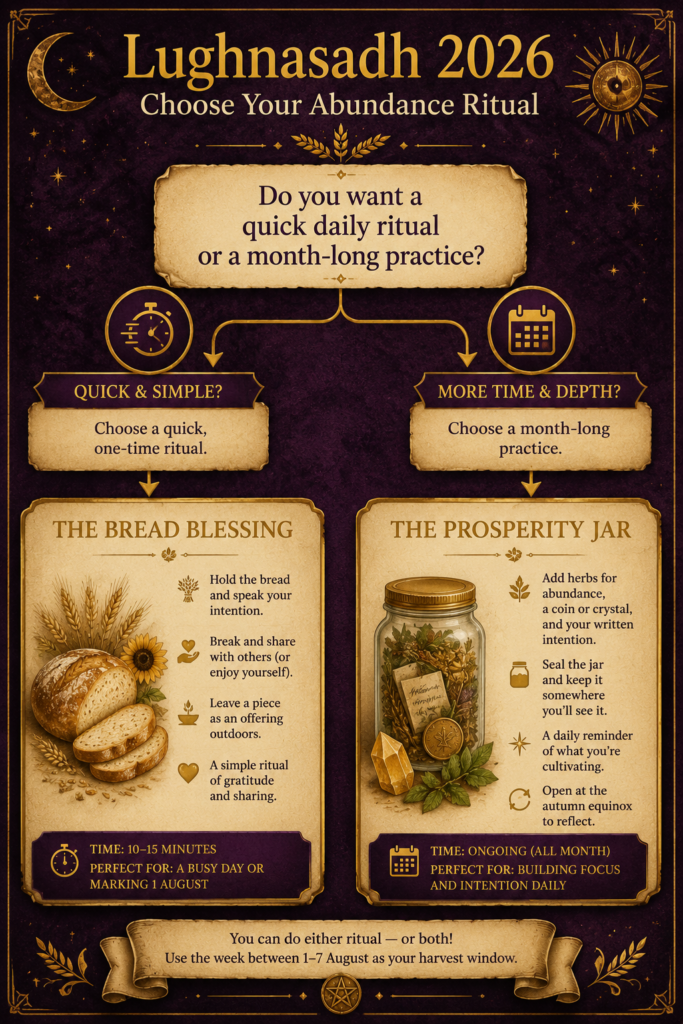
Once the gratitude altar is set up, you can extend the practice into an abundance ritual. Two options are given here. Pick whichever suits your time and resources, or do both across the week between 1 and 7 August.
Option one: the bread blessing
This works well if you already baked or bought bread for the altar above.
Hold the bread in both hands and speak an intention over it, either aloud or in your head. This can be as simple as naming what you would like more of in the coming months, whether that is stability, creative momentum, or rest. There is no fixed wording. The bread is a stand-in for what you are asking to grow, in the same way the grain harvest represents effort turning into something you can hold.
Break the bread and share a piece with anyone else present, or eat a piece yourself and leave a piece as an offering outdoors. Sharing bread has been part of harvest customs across many cultures, and using it here as a gesture of intention rather than a guarantee keeps the practice grounded rather than superstitious.
Option two: the prosperity jar
This is a slower ritual you can keep going for the full month if you like.
Take a small jar and add a few pinches of dried herbs associated with abundance, such as basil, cinnamon, or mint (see the correspondences below), along with a coin or a small piece of citrine if you have one. Write a short intention on a slip of paper, fold it, and add it to the jar. Seal the jar and keep it somewhere you will see it, such as a windowsill or your altar space.
The idea is not that the jar produces a guaranteed outcome. It works more like a focus point, a small daily reminder of the intention you set at the first harvest. Some practitioners open the jar at the autumn equinox to reflect on what shifted in the meantime.
🔮 Correspondences for Lughnasadh: colours, herbs, and crystals
These are the correspondences most commonly used in Lughnasadh practice. Use them as a starting toolkit for your altar, ritual, or journaling rather than a strict list.
- Colours: gold, orange, yellow, and deep brown, reflecting ripening grain and late summer light.
- Herbs: wheat and other grains, basil, cinnamon, sunflower, heather, and mint. Basil and cinnamon in particular are associated with abundance and prosperity work.
- Crystals: citrine for abundance, tiger’s eye for confidence and grounding, and carnelian for creative energy and motivation.
You do not need every item on this list. Even one or two, placed on your altar or carried with you through the week, is enough to work with.
🃏 Tarot and journaling prompts for the first harvest
Whether you pull cards, journal, or do both, these prompts are built around the core theme of Lughnasadh: recognising what has already grown and setting intention for what comes next.
Tarot prompts (pull one card per question, or use them as a three-card spread):
- What have I harvested so far this year?
- What still needs tending before the next season turns?
- What do I want to plant now for the months ahead?
Journaling prompts, if you prefer to write instead of pulling cards:
- Where in my life did effort turn into something I can now hold or use?
- What am I ready to let go of, now that its season has passed?
- What would “abundance” look like for me in the next three months, in specific, concrete terms rather than in general?
There is no need to interpret any of this as a fixed prediction. The value in this kind of reflection sits in the noticing, not in treating a card or a journal entry as a guarantee of what is coming.
✨ The takeaway
Lughnasadh 2026 can be marked on 1 August, the traditional calendar date, or 7 August, when the Sun reaches the astrological cross-quarter point at 15 degrees Leo. Either is valid, and many practitioners use the week between the two as an extended harvest window.
At its simplest, the sabbat asks you to build a small gratitude altar, run a short abundance ritual such as a bread blessing or a prosperity jar, and reflect on what you have already grown before turning your attention to what comes next. None of it needs to be elaborate. The first harvest is about recognising effort that has already paid off, not about predicting what happens next.