Sunstone Crystal: Vitality, Freedom & Solar Energy
We may earn money or products from the companies mentioned in this post.
There’s something almost theatrical about sunstone. Hold it up to the light and it seems to catch fire, flashing copper and gold, like trapped sunlight moving inside the stone. It’s one of those crystals that needs no introduction, because it basically introduces itself.
Sunstone has been steadily growing in popularity within the crystal and wellness world, and it’s not hard to see why. In a culture that’s permanently exhausted, endlessly scrolling, and quietly desperate for more energy and confidence, a crystal that promises warmth, vitality, and the courage to actually be yourself sounds very appealing indeed.
This guide covers everything you need to know about sunstone: its geology, its history, what it’s said to do, and how to actually work with it. As always, we’re approaching this from a researcher’s perspective. We find the folklore and metaphysical claims genuinely interesting, but we’re not going to pretend there’s scientific proof behind them.
Enhance Your Spiritual Practice
Discover our collection of digital planners and mystical tools designed to deepen your journey with tarot, crystals, and astrology.
Visit Our ShopWhat Is Sunstone?
The Geology Behind the Glow
Sunstone is a variety of feldspar, specifically a member of the oligoclase or labradorite feldspar group, and it gets its name from one very distinctive optical phenomenon called aventurescence. That’s the technical term for the sparkling, glittery internal shimmer you see when light hits the stone. In sunstone, this effect is caused by tiny platelets of copper, hematite, or goethite suspended within the crystal structure.
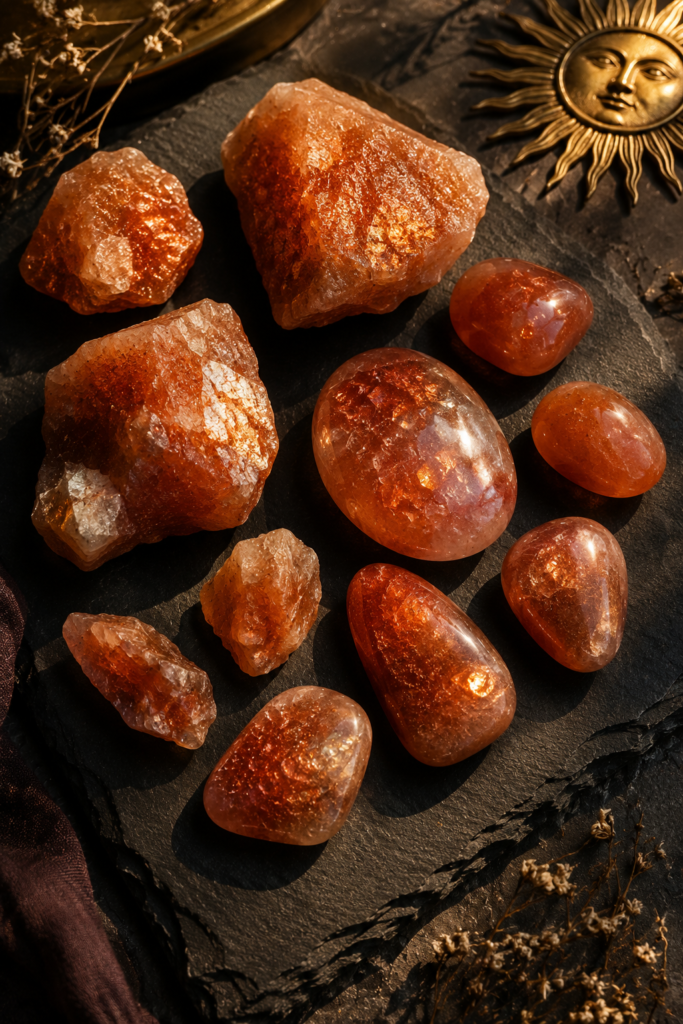
The result is a stone that seems to glow from within, throwing off metallic flashes of orange, red, gold, and occasionally green or blue depending on the specific deposit. It’s genuinely beautiful, and it’s entirely a product of natural geology with no treatment required.
Oregon is probably the most famous source, producing copper-bearing sunstone that ranges from pale champagne to deep red. Other significant deposits are found in India, Norway, Canada, and Russia. The Oregon material is particularly prized because the copper inclusions create unusually rich, vivid aventurescence, and some pieces are so densely coloured they look almost like gemstones.
Hardness and Care
Sunstone sits at around 6–6.5 on the Mohs scale, which makes it reasonably durable but not indestructible. It can handle everyday wear in jewellery, though it’s worth treating it with a degree of care: avoid knocking it against hard surfaces and keep it away from chemicals. Cleansing with lukewarm water and mild soap is fine; ultrasonic cleaners are not recommended.
Sunstone in History and Mythology
The Norse Navigation Stone
Perhaps the most intriguing historical claim around sunstone is its alleged use as a navigation tool by Viking seafarers. The theory goes that Norse sailors used translucent calcite (and potentially feldspar sunstone) as “solar compasses” to locate the sun even on overcast days, by observing how polarised light passed through the crystal.
Historical sagas do reference something called a sólarsteinn, or “sun stone,” used for navigation, and there is archaeological evidence of similar stones being found on Viking ships. A piece of Icelandic spar (calcite) discovered in a 16th-century shipwreck in 2013 was found to have navigational properties consistent with these descriptions. Whether this was the same mineral as what we call sunstone today remains debated, but the connection is fascinating enough that the story has stuck firmly in crystal culture.
Ancient Solar Associations
Across multiple cultures, sunstone’s warm, glowing appearance was read as a direct connection to solar deities. Ancient Greek sources reportedly believed the stone carried the spirit of a sun god and could harness solar energy for whoever possessed it. In India, sunstone was considered sacred and protective, a stone that deflected harmful intentions and brought good fortune to its owner.
This long-running association with solar energy, vitality, and protection forms the backbone of sunstone’s metaphysical reputation today. The symbolism has simply been updated from ancient talismanic use into contemporary wellness language: same stone, different vocabulary.
Sunstone Meaning and Metaphysical Properties
The Stone of Leadership and Independence
In modern crystal culture, sunstone is consistently described as a stone of personal power, confidence, and independence. Crystal guides call it a “stone of leadership” — not in the corporate sense of managing spreadsheets, but in the older sense of standing in your own authority, knowing your own worth, and having the courage to act from that place.
This is closely linked to its reputation for dissolving self-doubt. If you’re someone who struggles to say no, who second-guesses themselves constantly, or who tends to shrink to fit other people’s expectations, sunstone is frequently recommended as a supportive companion for that work. The idea is that it helps reconnect you with your own light and your own particular flavour of confidence and joy, rather than borrowing it from elsewhere.
It’s also specifically associated with freedom and independence. Several crystal traditions link it to breaking free from codependency, unhealthy obligations, or situations where you’ve given your power away. If Obsidian Crystal: Shadow Work & Powerful Protection is the crystal for confronting what’s keeping you stuck, sunstone is what you reach for once you’re ready to walk in a different direction.
Vitality, Stamina, and Energy
The other major theme in sunstone’s metaphysical profile is sheer vitality. It’s described across contemporary crystal guides as boosting energy levels, stamina, and motivation, which is a natural fit for the solar symbolism. The sun, in both mythology and astrology, is the ultimate symbol of life-force and creative energy, and sunstone is seen as a physical embodiment of that.
This makes it a popular choice for people dealing with burnout, low motivation, seasonal fatigue, and what one source poetically calls “depleted life-force.” The Psychic Tree, a UK-based crystal retailer, specifically mentions sunstone in connection with Seasonal Affective Disorder and lethargy, ailments that feel particularly relevant in a country where the sun disappears for months at a time.
To be clear: there is no clinical evidence that holding a crystal boosts your energy or helps with SAD. But as a ritual object, a visual reminder, and a focal point for intention-setting around vitality and renewal, it can absolutely play a supportive role for people who work with crystals in that way.
Joy, Optimism, and Emotional Warmth
Beyond confidence and energy, sunstone carries a strong association with warmth, joy, and optimism. It’s described as mood-lifting, radiating a kind of cheerful, generous, life-affirming energy. If citrine is the crystal of abundance and manifestation (and Citrine Crystal: The Sunshine Stone of Abundance & Joy is worth reading for context on that), sunstone operates in a similar emotional register but with more emphasis on personal empowerment and self-expression.
It’s a stone for people who feel they’ve lost their sparkle, who’ve been doing what they need to do but have stopped enjoying it. The qualities sunstone is said to embody aren’t passive (like, say, peace or stillness). They’re active: joy, enthusiasm, creative fire, the pleasure of being genuinely, unapologetically yourself.
Sunstone and the Chakras
Sunstone is most commonly associated with two chakras: the sacral chakra (Svadhisthana) and the solar plexus chakra (Manipura). These are the energy centres governing creativity, sexuality, passion, confidence, willpower, and personal identity, which maps very neatly onto sunstone’s metaphysical themes.
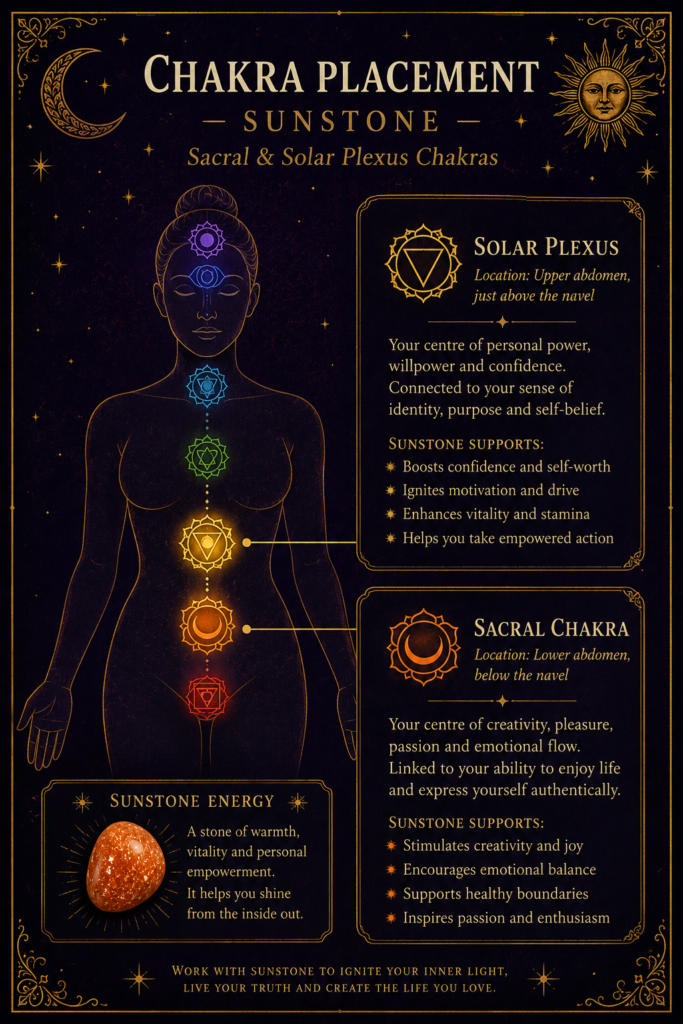
- Sacral chakra sits in the lower abdomen and governs creative energy, emotional fluidity, pleasure, and desire. When it’s blocked or depleted, people often feel creatively dry, disconnected from pleasure, or emotionally flat. Sunstone is used to reawaken this energy centre.
- Solar plexus chakra sits in the upper abdomen and governs personal power, self-worth, confidence, and the ability to act from your own authority. This is the chakra most directly connected to sunstone’s leadership and empowerment themes.
If you’re already exploring chakra work, The Seven Chakras: A Complete Beginner’s Guide covers all seven in detail, which is useful background for understanding where sunstone fits within a broader energetic framework.
Sunstone and Astrology
Zodiac Connections
Sunstone’s primary zodiac associations are with Leo and Libra, though some traditions also link it to Aries. The Leo connection is almost self-explanatory: Leo is ruled by the sun and embodies many of the same qualities sunstone is associated with, including warmth, confidence, generosity, creative self-expression, and natural leadership. Sunstone is often listed as one of Leo’s signature crystals.
The Libra connection is more subtle. Libra can struggle with self-doubt, people-pleasing, and difficulty making decisions, and sunstone’s energy of independent confidence and personal authority is considered balancing for this sign. The idea is that it helps Libra access their own centre rather than constantly seeking input from others.
Aries, the first fire sign, connects to sunstone through the theme of bold action, initiative, and vitality, all solar qualities. If you’re interested in how fire sign energy works more broadly, Aries Season: Ignite Your Fire & Take Bold Action offers a nice complementary read.
Sun in Astrology
The astrological sun represents your core identity, life purpose, vitality, and the authentic self you’re here to express. Sunstone, as a solar crystal, is naturally aligned with strengthening and supporting whatever your natal sun signifies in your chart. For anyone working with The Sun in Astrology: Your Core Identity & Life Purpose, sunstone makes an obvious companion crystal for that exploration.
How to Use Sunstone
Wearing Sunstone as Jewellery
Sunstone’s warm colouring and visual sparkle make it genuinely beautiful in jewellery, and wearing it is probably the most accessible way to work with it. Rings, pendants, and bracelets all work well. The idea is that keeping it close to the body means you’re in continuous contact with its energy, which is particularly relevant if you’re working with confidence, self-expression, or vitality themes.
Practically speaking, sunstone is durable enough for everyday jewellery wear at 6–6.5 on the Mohs scale, though it’s worth taking rings off before heavy manual work or exercise to avoid knocking the stone.
Meditation and Intentionwork
Holding sunstone during meditation is a popular practice, especially for work around:
- Building self-confidence and self-worth
- Clearing blocks around creativity or self-expression
- Reconnecting with joy and enthusiasm
- Working through codependency or people-pleasing patterns
- Setting intentions around energy, vitality, and motivation
Sunstone’s warm, energising quality means it tends to feel most natural in active, intention-setting meditations rather than deeply passive or receptive ones. It pairs interestingly with practices that involve the sacral or solar plexus chakras, such as breathwork, movement, or visualisation focused on the belly. For anyone building a regular practice, How to Use Crystals in Your Daily Meditation Practice has practical guidance on integrating crystals into your routine.
Solar Charging
One of the most popular practices specific to sunstone is solar charging: placing the crystal in direct morning sunlight to “recharge” its energy. The symbolism here is obvious, and there’s something genuinely enjoyable about a ritual that literally involves sitting your crystal in the sun on a summer morning. Most guides recommend a few hours of morning light rather than intense midday sun, and it’s worth noting that prolonged UV exposure can fade some crystals’ colours over time (though sunstone is fairly robust in this regard).
The practice of charging crystals in sunlight, moonlight, or using smudging is explored more broadly in crystal culture. It’s about cleansing residual energy and reinvesting the stone with fresh intention rather than a strictly mechanical process. If you approach it as a meaningful ritual rather than a literal battery charge, it works well.
Home and Workspace
Sunstone placed in a workspace is said to support confidence, clarity, and energised action, making it a popular desk crystal for creatives, freelancers, and anyone who needs to regularly access motivated self-expression. Its warm, solar aesthetic also makes it a beautiful object in its own right: orange-gold feldspar sitting on a windowsill in afternoon light genuinely does something to the atmosphere of a room.
For spaces where energy tends to feel stagnant, heavy, or low, sunstone is recommended as a brightener, both visually and energetically.
Sunstone Compared to Other Solar Crystals
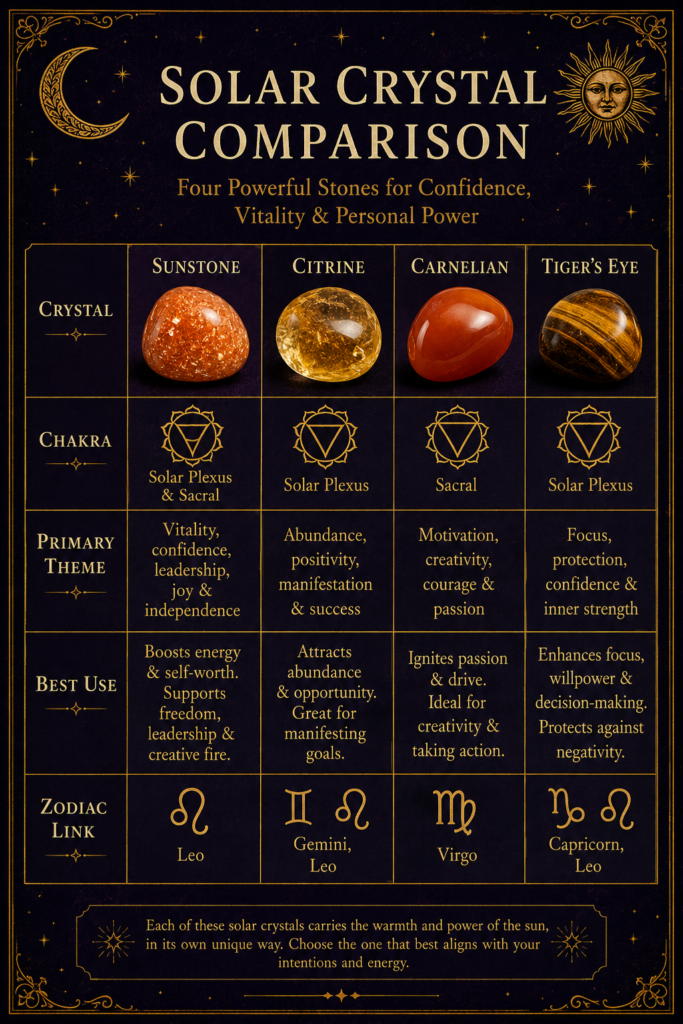
Sunstone is part of a broader family of “solar” crystals that share themes of warmth, confidence, and solar energy. It’s worth knowing how they differ:
- Citrine: Also a solar crystal, but more specifically associated with abundance, manifestation, and prosperity. Citrine’s energy is often described as more outwardly focused, drawing good fortune and opportunity toward you. Sunstone’s energy is more inwardly focused, building the internal confidence and vitality to go after what you want.
- Tiger’s Eye: Shares the confidence and personal power themes, but with a more grounded, protective quality. Tiger’s Eye Crystal Meaning: The Stone of Grounded Courage is a natural companion piece to sunstone. Where tiger’s eye steadies and grounds, sunstone sparks and energises.
- Carnelian: Both carnelian and sunstone are linked to the sacral chakra and share themes of creativity and confidence, but carnelian is more associated with motivation, action, and physical vitality. Carnelian Crystal: Ignite Your Creativity, Courage & Confidence covers that stone in depth.
Fun Facts About Sunstone
- Oregon sunstone is the official state gemstone of Oregon, one of only a handful of US states with a feldspar gemstone in that role.
- The aventurescence in Oregon sunstone is caused by native copper inclusions, which is unusual. Most other sunstones get their shimmer from hematite or goethite platelets instead.
- Some sunstones are “schiller” stones, where the metallic flash appears to move and shift as you rotate the stone. The effect is similar to labradorite’s labradorescence, though produced by a different optical mechanism.
- The Norse sólarsteinn navigation stone is mentioned in the medieval Icelandic saga Rauðúlfs þáttr, dating to the 13th century, making it one of the earliest written references to using a crystal for directional purposes.
Closing Thoughts on Sunstone
Sunstone is one of those crystals where the folklore, the aesthetics, and the metaphysical associations all feel coherent with each other. It looks like the sun. It has historical solar connections going back centuries. And its modern metaphysical profile of vitality, confidence, joy, leadership, and independent spirit maps neatly onto what solar energy has symbolised across cultures for thousands of years.
Whether you’re drawn to it as a beautiful geological specimen, a meaningful talismanic object, or a practical tool for intention-setting around confidence and energy, sunstone earns its reputation. It’s a genuinely lovely stone: warm, sparkly, and completely unapologetic about being exactly what it is.
Which feels rather appropriate for a crystal that’s all about authenticity.
Continue Your Journey
- Citrine Crystal: The Sunshine Stone of Abundance & Joy — another solar crystal, this time focused on abundance and manifestation
- Carnelian Crystal: Ignite Your Creativity, Courage & Confidence — shares sunstone’s sacral chakra energy with a focus on action and creative fire
- Tiger’s Eye Crystal Meaning: The Stone of Grounded Courage — the grounded, protective counterpart to sunstone’s sparkling confidence
- The Seven Chakras: A Complete Beginner’s Guide — understand the sacral and solar plexus chakras sunstone is linked to
- Crystals for Emotional Healing: 8 Stones to Soothe a Heavy Heart — expand your crystal toolkit beyond solar energy
Have you worked with sunstone? Drop a comment below. I’d love to hear whether you notice a difference when you use it around confidence or creative work, and whether you’ve tried solar charging it.
Want more crystal guides, tarot deep-dives, and seasonal spiritual content? Subscribe to the Weird Headlines newsletter and get new posts straight to your inbox.