Crystals for Anxiety & Stress Relief: 8 Stones to Calm Your Mind
We may earn money or products from the companies mentioned in this post.
If it feels like everyone around you is a little more on edge lately, you’re not imagining it. Recent surveys put the share of US adults who feel more anxious than they did a year ago at close to half, and stress has quietly become something most of us are just managing day to day rather than something unusual. Search interest in crystal healing has climbed right alongside it, and it makes sense: it’s a low-barrier, tactile way to build a small pocket of calm into a day that doesn’t always offer one.
This guide is not a promise that a stone will fix anything. It’s a look at how eight specific crystals are traditionally used within calming and grounding practices, and how you might work with them if that kind of ritual appeals to you.
🌙 A Belief-Based Practice, Not a Medical Treatment
Crystal work sits in the same category as a lot of self-care rituals: journalling, candle lighting, a specific cup of tea before bed. It’s a practice rooted in intention and belief, not a clinical intervention, and nothing here is meant to replace therapy, medication, or support from a mental health professional.
Enhance Your Spiritual Practice
Discover our collection of digital planners and mystical tools designed to deepen your journey with tarot, crystals, and astrology.
Visit Our ShopPlenty of people fold crystals into a wider toolkit alongside actual mental health care, treating a stone as a small physical anchor rather than a solution. That’s really the spirit this guide is written in. Think of it as one small ritual among many, not a stand-in for the support that matters most, and if anxiety is something you’re struggling with day to day, a stone is worth adding to your routine, not swapping in for professional care.
🔮 8 Calming Stones to Know
Each of these stones has its own traditional associations within crystal practice, built up over generations of practitioners rather than any single source. None of them are one-size-fits-all, so it’s worth reading through slowly and noticing which ones you’re actually drawn to, rather than picking whichever is most popular.
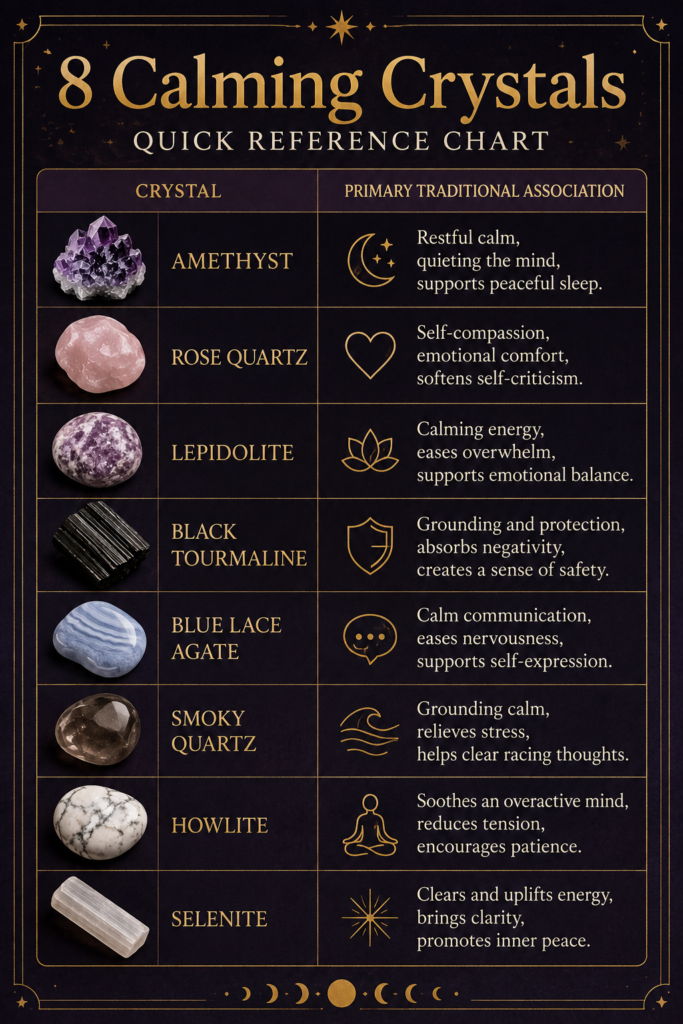
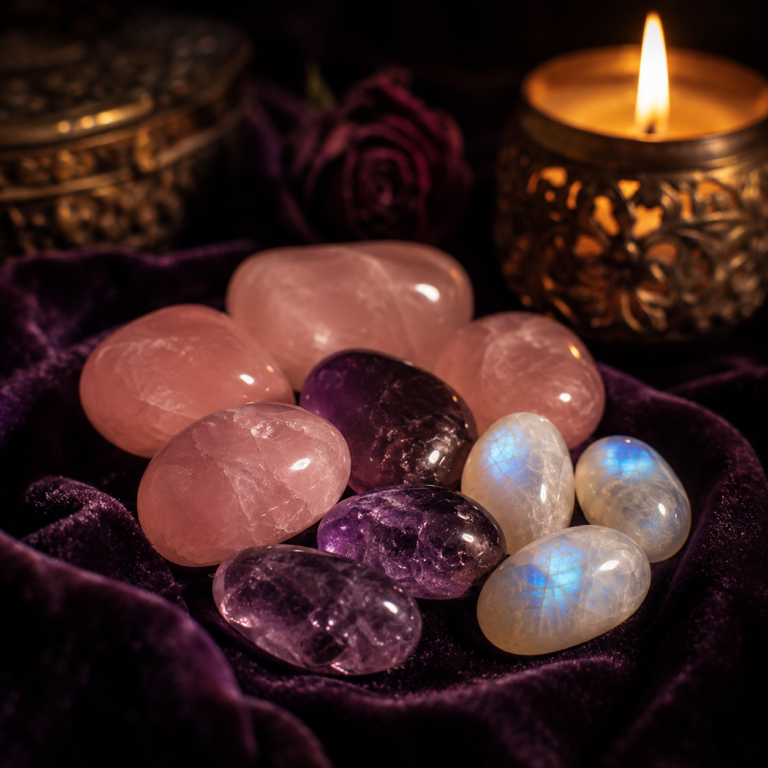
Amethyst. Amethyst is one of the most commonly reached-for stones for anxiety, and practitioners tend to associate its soft violet colour with a settled, quieter mind. It’s traditionally kept on a nightstand for restless nights, carried in a pocket during stressful days, or held for a few minutes during meditation. It’s often the first stone people buy when they start exploring crystal work, largely because it’s easy to find and easy to love. If you want the deeper history and full range of traditional uses, our amethyst guide covers it in more detail.
Rose Quartz. Rose quartz is usually linked to the heart space rather than the mind specifically, associated with self-compassion and softening self-criticism. Many practitioners keep a piece near where they sleep or wear it as jewellery, treating it as a quiet reminder to be gentler with themselves during an anxious stretch, especially when anxiety shows up as harsh self-talk rather than racing thoughts. Our rose quartz piece goes further into its traditional lore.
Lepidolite. Lepidolite is a lilac-grey mica stone that shows up often in modern crystal-for-anxiety lists, largely because of its natural lithium content, which practitioners treat as symbolic of its calming reputation (worth noting this is a traditional association, not a pharmacological claim). It’s typically carried during the day or placed by the bed, and some practitioners pair it with slow breathing exercises or use it during moments of overwhelm at work.
Black Tourmaline. Where the stones above are associated with softness, black tourmaline is generally used for grounding, the sense of feeling steady and protected rather than overwhelmed. It’s a popular choice for people who feel like anxiety shows up as a kind of static or overstimulation, particularly in crowded or high-stimulus environments. Carrying a piece in a bag or pocket is the most common approach, and some practitioners place one near the front door as a kind of household grounding point. Our black tourmaline guide has more on its grounding associations.
Blue Lace Agate. This pale blue banded stone is tied to calm communication and is often reached for by people who find their anxiety shows up most around speaking up or being heard. It’s typically held during moments of nervousness, such as before a difficult conversation or a presentation, or kept nearby while journalling through a stressful thought.
Smoky Quartz. Smoky quartz carries a grounding reputation similar to black tourmaline, but with a gentler, warmer association, often described by practitioners as taking the edge off racing thoughts without feeling heavy. A tumbled smoky quartz stone is an easy, low-cost way to start, and some people prefer keeping it close throughout the day by wearing it on the wrist instead, so it’s there without needing to remember to carry it separately.
Howlite. Howlite is a soft white stone, usually marbled with grey veining, and it’s one of the gentler stones on this list. Practitioners associate it with quieting an overactive mind, particularly around bedtime, and it’s often placed on a nightstand or held briefly before sleep as part of a wind-down routine, especially for people whose anxiety tends to spike right as they’re trying to fall asleep.
Selenite. Selenite is prized less for calming a specific feeling and more for creating a sense of clarity and open space, practitioners often describe working with it as clearing mental clutter rather than easing a particular emotion. A selenite wand or tower is a common addition to a meditation corner or altar space, and some practitioners sweep it lightly over other crystals as a way of refreshing them. Our selenite guide covers its full traditional meaning.
🧭 How to Choose Which Stone to Start With
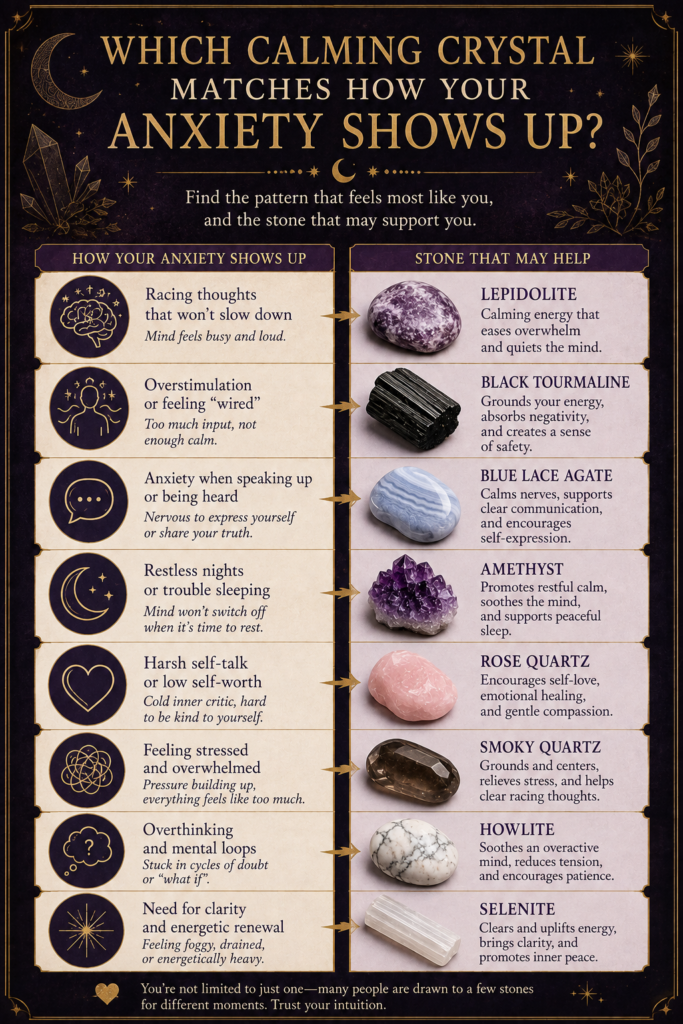
If more than one stone from the list above caught your attention, that’s normal, and there’s no wrong answer here. A lot of practitioners simply go with whichever stone they felt physically drawn to while reading, rather than overthinking which one is “supposed” to match their exact symptoms. Others prefer to match the stone to the specific way their anxiety tends to show up: a racing, sleepless mind might lean toward amethyst or howlite, while a body that feels keyed up or overstimulated might respond better to something grounding like black tourmaline or smoky quartz. Either approach is a reasonable way in, and you can always add a second or third stone once you’ve spent some time with your first.
🕯️ Simple Rituals to Try as a Beginner
You don’t need an elaborate setup to start working with any of these stones, and it’s worth resisting the urge to buy a whole kit before you’ve tried anything. A few simple approaches practitioners use:
- Grounding hold. Sit quietly, hold your chosen stone in both hands, and take five slow breaths, noticing the weight and texture of the stone as you go.
- Bedside placement. Keep a calming stone like amethyst or howlite within reach of your bed as part of a wind-down routine, so it becomes a cue that the day is winding down too.
- Breathwork pairing. Hold a grounding stone like black tourmaline or smoky quartz while doing a slow four-count inhale, four-count exhale pattern, letting the physical weight of the stone anchor your attention.
- Pocket carry. Slip a small tumbled stone into your pocket or bag on days you know will be stressful, and touch it as a brief pause when things feel like a lot.
If you’re new to pairing breathwork or meditation with any kind of ritual object, our meditation for beginners guide is a good place to start before adding a crystal into the mix, since the breathing technique itself does most of the heavy lifting.
🧼 Choosing and Cleansing Your First Crystals
When you’re starting out, there’s no need to buy all eight stones at once. Pick the one or two that felt most interesting as you read through the list above, that instinct is usually a good enough starting point, and you can always add more later once you know what you actually reach for.
Look for tumbled stones if you’re new to this. They’re inexpensive, comfortable to carry, and don’t require any special care beyond an occasional wipe-down with a soft cloth. Once you bring a new stone home, many practitioners like to cleanse it first, more as a way of starting fresh with the stone and clearing whatever energy it picked up before reaching you, than anything else. There are several traditional methods, from moonlight to sound to smoke, and our full cleansing and charging guide walks through each one in detail so you can pick whatever feels right for your space and your routine.
💜 A Gentle Closing Thought
None of these eight stones are a fix for anxiety, and they were never meant to be. What they offer is a small, tactile ritual, something to hold onto, literally, on a hard day, alongside whatever else is actually supporting you, whether that’s therapy, medication, a good night’s sleep, or all three.
If this kind of stone-based practice resonated with you, our guide to crystals for emotional healing is a natural next read, covering a different set of stones for grief, heartbreak, and heavier emotional weather.