Smoky Quartz Crystal: Grounding, Protection & Releasing Negativity
We may earn money or products from the companies mentioned in this post.
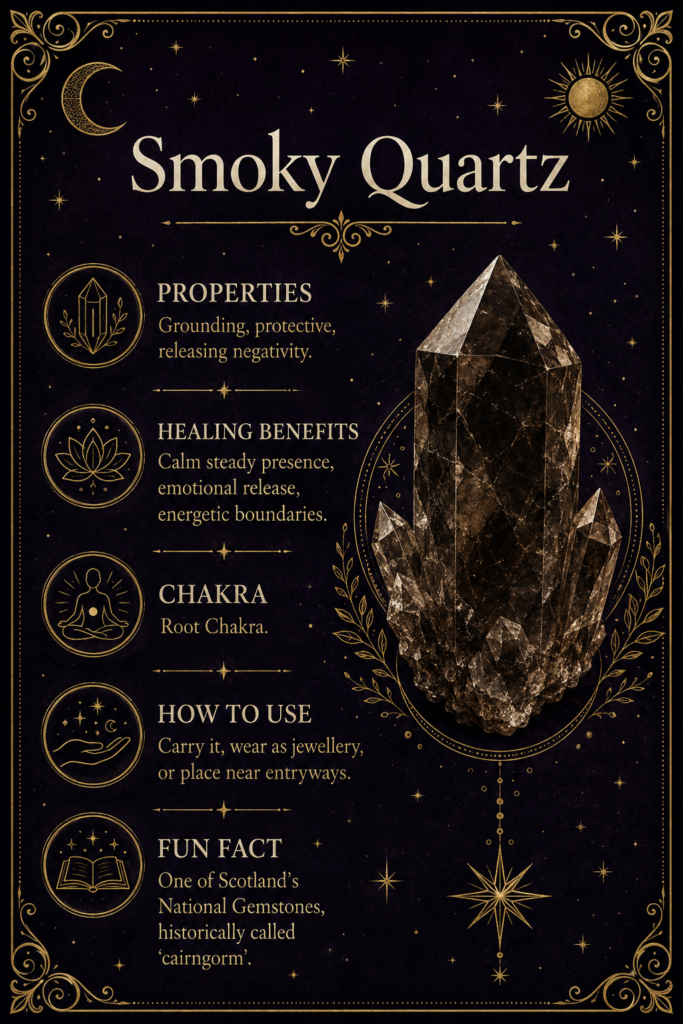
Few crystals feel as quietly steadying as smoky quartz. Its smudged, earthy tones sit somewhere between grey mist and dark chocolate, and in crystal practice it’s known as one of the most reliable grounding stones you can own. If your shelf is already full of bright, high-vibration crystals, smoky quartz is the one that pulls you back down to earth.
This guide walks through what smoky quartz is believed to do, how practitioners use it for grounding, protection and releasing negativity, and how to care for the stone itself.
🌫️ What Is Smoky Quartz?
Smoky quartz is a variety of quartz (silicon dioxide) that gets its grey-to-brown colouring from natural irradiation. Trace aluminium within the crystal structure reacts with background radiation in the earth over long stretches of time, gradually shifting the quartz from clear to smoky. Some commercial stock is also gently irradiation-enhanced to deepen the tone, though the underlying quartz structure and grounding associations are considered the same either way.
Enhance Your Spiritual Practice
Discover our collection of digital planners and mystical tools designed to deepen your journey with tarot, crystals, and astrology.
Visit Our ShopFolklore around smoky quartz spans Celtic, Scottish and Druidic traditions, where dark, earth-toned stones were often associated with protection and connection to the land. It’s a cousin of clear quartz, sharing the same “master healer” reputation but with a heavier, more grounded energy.
💎 Appearance & Characteristics
Smoky quartz ranges from a pale, smoke-like grey to a deep, nearly opaque brown-black. It typically forms in six-sided prisms, sometimes as clusters, and is graded at a 7 on the Mohs hardness scale, the same as clear quartz, which makes it a genuinely durable, everyday-wearable stone. Because the colour comes from irradiation rather than a separate mineral, prolonged direct sunlight can gradually fade a piece from smoky to pale or clear, so it’s worth keeping loose stones and jewellery out of strong, direct sun for extended periods.
🌍 Grounding: Staying Rooted in the Present
Grounding is smoky quartz’s signature association. Practitioners describe it as a stone that encourages a felt sense of being anchored, present and steady, rather than scattered or overwhelmed. In practice, that usually looks like holding a piece during meditation, keeping one in a pocket during a stressful day, or placing one at the base of a crystal grid to “root” the other stones’ energy.
If you’re building this into a regular meditation habit, our guide on using crystals in your daily meditation practice has practical ways to work a grounding stone like this into a short daily ritual.
🛡️ Protection: Shielding Your Energy
Alongside grounding, smoky quartz has a long-standing reputation as a protective stone, believed by practitioners to help create a sense of energetic boundary between yourself and outside stress or negativity. It’s often placed near doorways or workspaces, or carried during situations that feel draining.
It sits alongside other dark protective stones in this tradition. If you want to compare notes, black tourmaline is the other grounding-and-protection staple many practitioners pair with smoky quartz on a nightstand or altar.
Worth being clear on: this is a belief and practice framework, not a guaranteed or measurable effect. Think of it the way you’d think of a favourite ritual or habit that helps you feel more settled, rather than a scientifically proven shield.
🌊 Releasing Negativity: Rituals & Practices
The third pillar of smoky quartz work is releasing what no longer serves you, whether that’s a difficult emotion, a stuck pattern, or simply the residue of a hard week. Common practices include:
- Holding the stone during a short journaling session, naming what you’re ready to set down
- Pairing it with a brief meditation focused on exhaling tension with each breath
- Using it as a focal point during a “letting go” ritual at a new moon, when many practitioners favour release-oriented intentions
None of this is about a guaranteed outcome. It’s a structure some people find genuinely helpful for processing difficult feelings, and one that’s worth trying with realistic expectations rather than as a substitute for other support.
✨ Cleansing & Charging Your Smoky Quartz
Because it sits at a 7 on the Mohs scale, smoky quartz is water-safe, unlike softer stones such as selenite. A quick rinse under cool running water for 30 to 60 seconds is enough for a light refresh, or you can soak it in room-temperature water for a few hours for a deeper cleanse.
Other cleansing options practitioners use:
- Smoke cleansing: passing the stone through the smoke of a smouldering herb bundle for 30 to 60 seconds
- Sound cleansing: using a singing bowl, chime or tuning fork near the stone
- Charging: placing it in moonlight overnight, or resting it on a cluster of clear quartz or selenite, both known for their amplifying properties
If you do charge it in sunlight, keep the exposure brief. As above, smoky quartz’s colour is UV-sensitive, and fading from long stretches in direct sun is generally permanent.
💍 Choosing Your Form: Raw, Jewellery or Home Decor
How you use smoky quartz often comes down to the form you choose:
- Raw or tumbled stones are the most flexible option, easy to carry in a pocket, hold during meditation, or place on a desk
- Jewellery, like a bracelet or pendant, keeps the stone in near-constant contact with you throughout the day, which many practitioners prefer for grounding on the go
- Home placement, such as by an entryway or in a workspace, is favoured for its protective associations, particularly in rooms where you want a calmer, steadier atmosphere
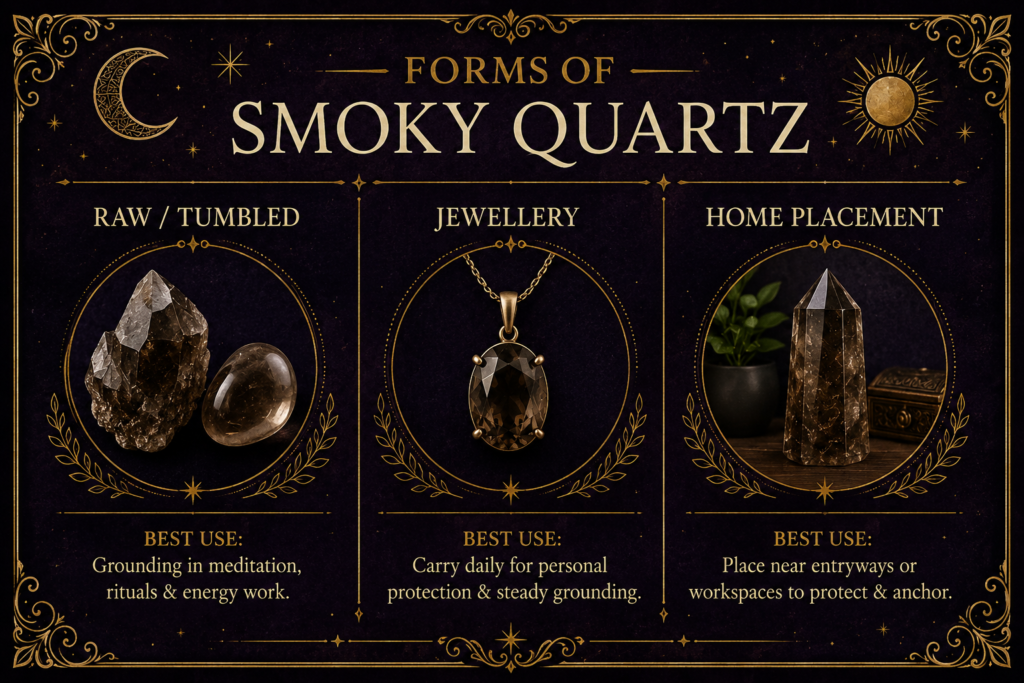
There’s no single “correct” way to work with it. Most practitioners choose based on how often they want contact with the stone.
🔮 Fun Facts About Smoky Quartz
- Smoky quartz is one of the National Gemstones of Scotland, closely tied to traditional Scottish jewellery
- Its colour comes from the same natural background radiation process that, in far larger concentrations, geologists use to help date certain rock formations
- Large, museum-quality smoky quartz specimens have been found in the Cairngorm mountains, which is where the stone’s old regional name, “cairngorm,” comes from
🕯️ Final Thoughts
Smoky quartz earns its reputation the quiet way: not through flash, but through steadiness. Whether you’re drawn to it for grounding, protection or simply releasing a heavy week, it’s a low-maintenance, durable stone that fits easily into a daily practice.
Do you already keep a piece of smoky quartz nearby, or is this your first look at it? Let us know how you use yours in the comments.