Saturn in Astrology: The Planet of Lessons, Discipline & Long-Term Rewards
We may earn money or products from the companies mentioned in this post.
There’s a reason Saturn has a reputation as the most feared planet in astrology. When it shows up in a transit or sits prominently in your birth chart, people tend to brace themselves. But here’s the thing — Saturn isn’t out to punish you. It’s the most honest planet in the sky, and once you understand what it’s actually doing, you might find yourself grateful for it.
Saturn is the planet of structure, discipline, karma, and long-term rewards. It asks more of you than any other planet, but what it gives back — hard-won authority, unshakeable resilience, and genuine, lasting success — is something no quick-win transit can match. This post covers everything you need to know about Saturn: its mythology, its meaning in your birth chart, how its transits work, and what to actually do when Saturn comes calling.
Saturn in Mythology
The Roman God of Time and Harvest
In Roman mythology, Saturn (Saturnus) was the god of agriculture, time, and wealth — a powerful deity who presided over the golden age of humanity. He was associated with the harvest, with cycles, and with the passing of time. The Roman festival of Saturnalia, held each December, was one of the most significant celebrations of the year: a time of feasting, gift-giving, and a temporary inversion of the social order.
Enhance Your Spiritual Practice
Discover our collection of digital planners and mystical tools designed to deepen your journey with tarot, crystals, and astrology.
Visit Our ShopSaturn’s Greek counterpart was Kronos (sometimes spelled Cronus), the Titan who ruled before the Olympian gods. Kronos was known for devouring his own children, fearing that one of them would overthrow him — which, of course, eventually happened when Zeus (Jupiter) dethroned him. This myth speaks directly to Saturn’s astrological energy: the tension between clinging to control and accepting the inevitability of change and growth.
Saturn Across Cultures
In Hindu astrology, the equivalent figure is Shani — a deity associated with justice, karma, and consequence. Shani is considered one of the most powerful and demanding of the planetary deities, capable of both great hardship and extraordinary blessings depending on how well you’ve lived. In Norse tradition, Saturn’s energy maps loosely onto Odin in his aspect as the god of wisdom and discipline acquired through suffering.
Across traditions, the common thread is the same: this is the principle of cause and effect, of time revealing all, and of long-term consequence.
Saturn in Astronomy
Saturn is the sixth planet from the Sun and the second-largest in the solar system, with a diameter roughly nine times that of Earth. Its iconic ring system — made of ice and rock particles — extends hundreds of thousands of kilometres into space. Saturn takes approximately 29.5 years to complete one orbit of the Sun, which is why astrologers talk about the Saturn Return as a defining life event: it marks the first time Saturn returns to the exact position it occupied at the moment of your birth.

One Saturn day lasts only about 10.7 hours (it rotates extraordinarily fast despite its size), and its axial tilt of 26.7 degrees gives it distinct seasons. Astronomically, Saturn is a gas giant with no solid surface — which is rather fitting for a planet whose astrological lesson is learning to build solid foundations precisely because nothing in life is guaranteed.
What Saturn Represents in Astrology
Core Themes
Saturn governs a specific set of themes that you’ll recognise once you know what to look for:
- Discipline and structure — Saturn rules the systems, boundaries, and frameworks that hold life together
- Responsibility and duty — where Saturn falls, you’re being asked to step up and own your choices
- Time and patience — Saturn rewards sustained effort over shortcuts and instant gratification
- Karma and consequence — in many traditions, Saturn is the planet of karmic reckoning
- Authority and mastery — the long-term reward for doing Saturn’s work is becoming genuinely good at something
- Limitations and boundaries — Saturn shows where you hit walls, and why those walls exist
Saturn’s energy isn’t easy, but it is fair. It doesn’t punish randomly. It reflects back exactly what you’ve put in.
Saturn’s Ruling Signs
Saturn rules Capricorn and, traditionally, Aquarius (before Uranus was discovered, Saturn was Aquarius’ ruler, and many astrologers still consider it a co-ruler).
In Capricorn, Saturn is in its home sign — fully expressed and extremely powerful. Capricorn energy is ambitious, structured, and relentlessly focused on long-term achievement. Saturn here is the ultimate taskmaster, pushing toward legacy-building and career mastery.
In Aquarius, Saturn operates through collective systems, social responsibility, and innovation within structure. Where Capricorn Saturn builds personal empires, Aquarius Saturn builds institutions, movements, and communities designed to last.
Saturn and the Elements
Fire signs (Aries, Leo, Sagittarius): Saturn cools and focuses the fire here. The natural impulsiveness of fire signs gets tempered — sometimes frustratingly so. The lesson is learning to channel enthusiasm into disciplined action rather than burning bright and burning out.
Earth signs (Taurus, Virgo, Capricorn): Saturn is most comfortable in earth signs. Here, its energy flows naturally into practicality, methodical progress, and material-world building. Earth sign Saturn placements often produce exceptional craftspeople, builders, and long-term strategists.
Air signs (Gemini, Libra, Aquarius): Saturn in air signs brings structure to communication, thought, and relationships. There can be a tendency toward serious, weighty thinking — sometimes pessimism or self-doubt around intellectual abilities, which, when worked through, transforms into genuine authority and wisdom.
Water signs (Cancer, Scorpio, Pisces): Saturn in water signs often shows up as emotional restriction or difficulty expressing vulnerability. The work here is learning that structure doesn’t mean suppression — and that real emotional maturity is its own form of Saturn mastery.
Saturn in Your Birth Chart
By Sign
The sign Saturn occupies in your natal chart describes the flavour of your karmic work — the style and context in which you’ll face Saturn’s lessons.
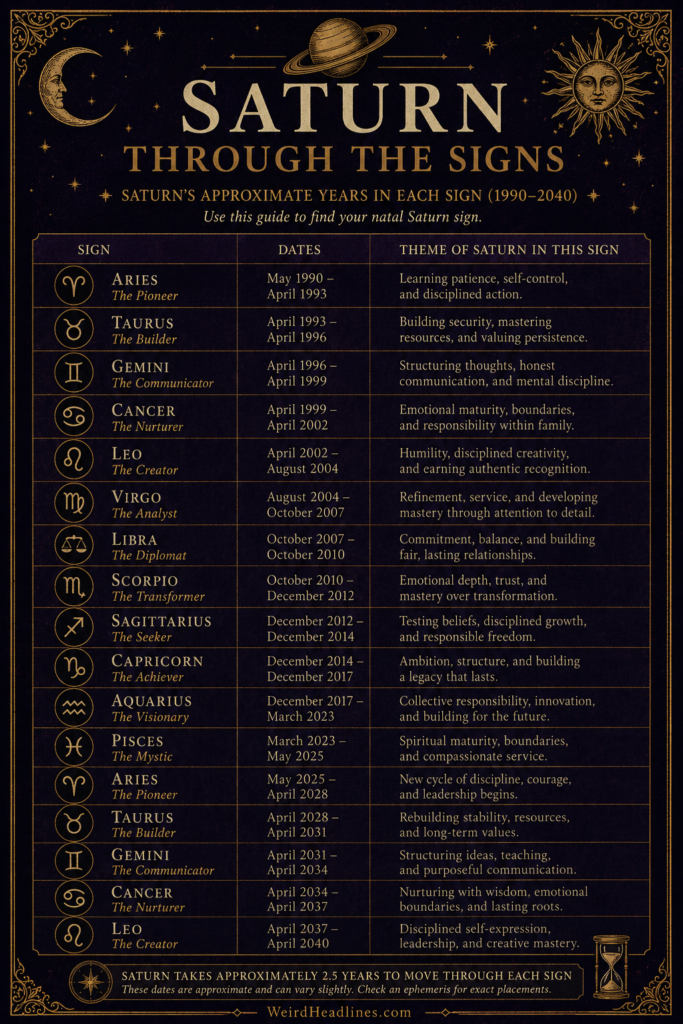
- Saturn in Aries: Lessons around impulsivity, patience, and learning to act from strength rather than fear
- Saturn in Taurus: Lessons around material security, self-worth, and building genuine abundance slowly
- Saturn in Gemini: Lessons around communication, the mind, and learning to trust your own intelligence
- Saturn in Cancer: Lessons around home, family, emotional vulnerability, and nurturing without losing yourself
- Saturn in Leo: Lessons around creative expression, ego, leadership, and receiving recognition authentically
- Saturn in Virgo: Lessons around perfectionism, service, and learning that “good enough” done consistently beats perfection never delivered
- Saturn in Libra: Saturn is exalted in Libra — lessons around relationships, fairness, and genuine commitment
- Saturn in Scorpio: Lessons around power, control, transformation, and letting go
- Saturn in Sagittarius: Lessons around belief systems, freedom vs responsibility, and philosophical integrity
- Saturn in Capricorn: Saturn in its home sign — intense focus on career, reputation, and what you’re building for the long term
- Saturn in Aquarius: Lessons around authenticity within community, collective responsibility, and sustainable innovation
- Saturn in Pisces: Lessons around boundaries, escapism, spiritual discipline, and grounding vision in reality
By House
Where Saturn sits in your birth chart shows the area of life where you’ll do your deepest work — and where, eventually, you’ll develop genuine mastery. If you want to understand how houses work in a chart context, understanding your birth chart houses is a great place to start.
- 1st House: Identity, self-image, and how you present to the world
- 2nd House: Money, resources, and self-worth
- 3rd House: Communication, learning, and local community
- 4th House: Home, family, foundations, and private self
- 5th House: Creativity, romance, pleasure, and self-expression
- 6th House: Daily routines, health, and work ethic
- 7th House: Relationships and partnerships — often indicates serious, committed partnerships that come with responsibilities
- 8th House: Shared resources, transformation, mortality, and depth
- 9th House: Belief, higher education, travel, and philosophical frameworks
- 10th House: Career, reputation, and public legacy — Saturn here is in its natural domain
- 11th House: Community, long-term goals, and social responsibility
- 12th House: The unconscious, hidden limitations, spiritual discipline, and isolation
Saturn Aspects: How It Interacts With Other Planets
Saturn’s aspects in the birth chart show where its energy of restriction, discipline, and structure touches other planetary drives.
Saturn conjunct the Sun: Identity is deeply tied to achievement, responsibility, and working hard for recognition. There can be a tendency toward excessive self-criticism, but enormous capacity for disciplined self-expression.
Saturn conjunct the Moon: Emotional restriction and difficulty with vulnerability, often rooted in childhood experiences of responsibility or emotional unavailability. The long-term work leads to exceptional emotional maturity.
Saturn–Mars aspects: The relationship between discipline and drive. Harmonious aspects can produce extraordinary ambition and staying power. Tense aspects (square, opposition) can create frustration, blocked action, or difficulty asserting boundaries — and, when worked through, an unbreakable work ethic. Mars in astrology covers the full picture of how Mars energy expresses in a chart.
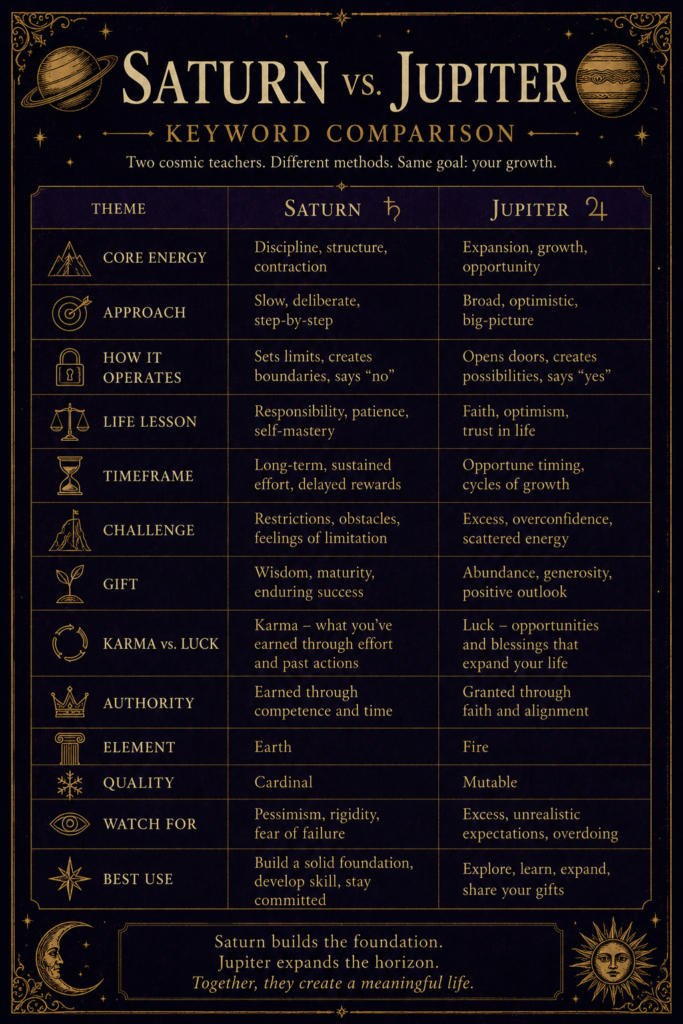
Saturn–Jupiter aspects: The tension between expansion and contraction, optimism and realism. Jupiter wants to grow; Saturn wants to consolidate. When these two work together well, they produce measured, sustainable growth. For more on Jupiter’s role in the chart, see Jupiter in Astrology: The Planet of Abundance.
Saturn–Pluto aspects: Intense, generational energy around power structures, transformation, and breaking down what no longer serves. This combination appears prominently in the charts of people who go through significant upheaval — and emerge restructured. For context on Pluto’s transformative energy, Pluto in astrology is worth reading alongside this one.
Saturn–Neptune aspects: The tension between structure and dissolution, reality and fantasy. Can indicate difficulty with boundaries, escapism, or confusion around responsibility — which, when worked through, becomes a capacity for disciplined spiritual practice.
Saturn Retrograde
Saturn goes retrograde for approximately four to five months every year, so a natal retrograde Saturn is quite common. When Saturn stations retrograde in transit, its themes become more internal — a period of reviewing, reconsidering, and internalising the lessons Saturn has been presenting.
During Saturn retrograde:
- Structures and commitments that weren’t solidly built often wobble or require attention
- There’s a pull toward reviewing past decisions, especially around responsibilities and long-term goals
- Internal discipline matters more than external structure — it’s a good time for personal accountability work
- What has been avoided tends to resurface; Saturn retrograde has a way of bringing unfinished business back around
A natal Saturn retrograde in the birth chart often indicates someone who tends to be internally driven rather than motivated by external authority — someone who, once they develop their own framework of discipline and values, becomes exceptionally self-directed.
Saturn Transits: Through the Houses
When Saturn transits through a house in your chart, it typically spends two to three years there. This isn’t a brief visit — it’s a sustained period of maturation, testing, and eventually mastery in that area of life.
Saturn through the 1st or 7th houses often brings significant shifts in identity or relationships — new responsibilities, endings of outdated dynamics, or a more serious approach to partnerships.
Saturn through the 10th house is one of the most significant career transits in astrology. Depending on the work you’ve put in, this period can bring either significant public achievement or a reckoning around career direction.
Saturn through the 4th or 8th houses tends to bring up foundational themes — family dynamics, property, shared finances, or deep psychological material that’s been avoided.
Whatever house Saturn is transiting, the advice is the same: don’t resist, do the work, and trust that the pressure is purposeful.
The Saturn Return: The Most Significant Transit of All
The Saturn Return — when Saturn completes its approximately 29.5-year orbit and returns to the position it held at your birth — is one of the most talked-about transits in astrology, and for good reason. It’s a genuine turning point.
The first Saturn Return (ages 28–31) is when many people experience the transition from extended youth into genuine adulthood. Relationships that aren’t built on solid foundations often don’t survive it. Careers that were chosen for the wrong reasons tend to show cracks. It’s a time when life essentially asks: who are you actually building, and is that aligned with what you genuinely want?
The second Saturn Return (ages 57–60) is a similar reckoning, but deeper. At this stage, the questions are around legacy, authenticity, and whether the structures built in the decades between returns are truly your own.
✦ Saturn’s Return ✦
When Does Saturn Come Home?
Find your Saturn Return windows
First Saturn Return
The first Saturn Return marks the transition from extended youth into genuine adulthood. Relationships, careers, and life paths that aren’t truly yours tend to show cracks. Saturn is asking: what are you actually building, and is it aligned with who you really are? This is one of the most significant turning points in life — not a crisis, but a clarification.
Second Saturn Return
The second Saturn Return invites a deeper reckoning with legacy, authenticity, and what you’ve truly built over the decades between returns. The structures that belong to you — and those that were borrowed or imposed — become unmistakably clear. A time of distillation: keeping what is genuinely yours, releasing what is not.
Saturn takes approximately 29.5 years to orbit the Sun, so these windows are estimates. For exact dates, consult your full birth chart.
The Saturn Return gets a fearsome reputation because it tends to coincide with major change. But the change is rarely arbitrary — it's almost always pointing toward something more aligned, more honest, and more enduring. The Capricorn season guide touches on some of these themes of building for the long term, which aligns closely with Saturn's core energy.
Saturn and Karma: The Planet of Consequences
In Vedic astrology especially, but also in Western traditions, Saturn is considered the primary karmic planet — the one whose transits and placements reflect the results of past actions, and whose lessons push toward balance and integrity.
This doesn't mean Saturn is a punishment machine. It means Saturn reflects back what's true. If you've been avoiding a difficult conversation for years, Saturn's transit will tend to bring it to a head. If you've been consistently disciplined and honest in your work, Saturn's major transits tend to bring recognition and reward. The karmic lens is useful precisely because it removes the sense of randomness — Saturn isn't happening to you, it's reflecting you.
This also connects to how Saturn works with other slower-moving planets like Pluto. The Pluto Retrograde 2026 guide covers some of the collective-level pressure that happens when Pluto and Saturn both activate similar themes in the sky.
What Saturn Wants From You
If you distil Saturn's energy down to its core ask, it's this: show up, do the work, and be honest about where you're cutting corners.
Saturn doesn't require perfection. It requires integrity and sustained effort. The areas of life where you feel most blocked, most tested, or most like an impostor — those are almost always Saturn's zones of mastery waiting to be claimed. The discomfort isn't a sign you're doing something wrong. It's often a sign you're doing something that matters.
Some practical ways to work with Saturn rather than against it:
- Take your responsibilities seriously without using them as an excuse to avoid joy
- Build systems and routines that support long-term goals rather than relying on willpower alone
- Stop avoiding the hard conversations and difficult work — Saturn will simply bring them back, louder
- Honour time. Saturn rules time, and how you use yours says everything about what you're building
- Learn from setbacks rather than dismissing them. Saturn's delays are usually information
If you're drawn to working more intentionally with larger life patterns, the 7 Spiritual Laws of Manifestation offers a framework for aligning effort with intention — which is very much Saturn territory. And if you want to track your Saturn transits and major life cycles more deeply, the Witchy Planner from the Weird Headlines shop is designed to help you stay connected to these longer rhythms throughout the year.
Key Takeaways
Saturn is demanding, there's no getting around it. But it's also the most rewarding planet in the solar system — not in the fast, flashy way of Jupiter, but in the deep, earned, I built this way that nothing else can touch.
- Saturn rules Capricorn and co-rules Aquarius, and is at its most powerful in these signs
- Its house and sign placement in your natal chart shows where you'll do your deepest work — and where real mastery is possible
- The Saturn Return (around ages 28–31 and 57–60) marks genuine life turning points
- Saturn retrograde encourages internal review rather than external restructuring
- Saturn's rewards are slow, solid, and lasting — and they come to those who do the work honestly
The planet that gets called the taskmaster, the cosmic disciplinarian, the great teacher — it's all true. But the teacher who changed your life wasn't the easy one. It was the one who pushed you, believed in your capacity for more, and refused to let you take the shortcut.
That's Saturn.
Continue Your Journey
- Understanding Your Birth Chart: Houses Explained — get to grips with where Saturn (and every other planet) sits in your personal chart
- Jupiter in Astrology: The Planet of Abundance — Saturn's cosmic counterpart, the planet of expansion and good fortune
- Pluto in Astrology: Transformation, Power & Rebirth — another slow-mover with equally profound long-term impact
- Mars in Astrology: The Warrior Planet — understand the planet that Saturn most often tests and disciplines
- Capricorn Season: Building Foundations That Actually Last — Saturn's home territory in full seasonal focus
Where are you in your Saturn cycle right now — and what is it teaching you? Drop your thoughts in the comments.
Want more astrology, tarot, and crystal wisdom delivered to your inbox? Sign up for the Weird Headlines newsletter and stay connected to the cosmic calendar.