Samhain 2026: Ancestor Rituals, Divination & the Witch’s New Year
We may earn money or products from the companies mentioned in this post.
For many practitioners, the turning of the year does not happen in January. It happens when the nights close in, the harvest is done and the last light of October fades into November.
Samhain is the Witch’s New Year in modern practice: a time to honour those who came before, look ahead with divination and let go of what you no longer want to carry. This guide is written for people who already follow the Wheel of the Year, and it ends with a workable solo ritual you can adapt to your own tradition.
🍂 What Samhain Is (and What It Is Not)
Samhain is pronounced SOW-in or SAH-win, and it comes from the Gaelic tradition. It is one of four seasonal festivals in the old Irish calendar, alongside Imbolc, Beltane and Lughnasadh.
Enhance Your Spiritual Practice
Discover our collection of digital planners and mystical tools designed to deepen your journey with tarot, crystals, and astrology.
Visit Our ShopIn the Northern Hemisphere, it is traditionally observed from the evening of 31 October into 1 November. In 2026, 31 October falls on a Saturday, which makes the timing easy for many people to plan around.
Some practitioners prefer the astronomical midpoint between the autumn equinox and the winter solstice. In 2026, that lands around 7 November, so it is a reasonable option if the 31st does not suit your schedule.
In the Southern Hemisphere, many pagans turn the Wheel to match their own seasons. That means observing Samhain around 30 April to 1 May.
Samhain is not a Halloween explainer, and this guide does not treat it as one. The two have influenced each other over centuries, but the practice described here belongs to the Wheel of the Year as it is used today.
📜 Historical Samhain and Modern Practice
It helps to be clear about what we know and what we have built since. The word appears in early Irish literature, with references to gatherings, feasts and the opening of the Otherworld around the start of winter.
A related word appears on the Coligny calendar, a Gaulish bronze calendar from around the second century. Scholars debate exactly what it tells us about festivals.
The historian Ronald Hutton has argued that the evidence for a pan-Celtic “New Year” festival on 1 November is thinner than popular accounts suggest. That does not mean nothing was observed, but it does mean we should be careful with big claims.
Modern Wiccan and Neopagan practice, including the idea of Samhain as the Witch’s New Year, is a twentieth-century development. It draws on older folklore and seasonal customs, but it is not an unbroken ancient Celtic religion.
Many practitioners find this clarifying rather than disappointing. You can honour the older roots while being honest that your own ritual is a living, modern practice. Celtic Reconstructionists approach the festival differently again, with a stronger focus on historical sources.
If you work with the wider Celtic mythology, our guide to Celtic mythology is a good companion read.
🌫️ The Thin Veil: A Traditional Belief
Many traditions hold that at Samhain, the boundary between the living and the dead is thinner than at other times. This is a belief, not a proven fact, and it is worth treating it that way in your practice.
Within the belief, the season makes sense. The land is dying back, the dark half of the year begins and people have long turned to thoughts of endings and those who have gone.
In practical terms, it gives the season a purpose. It is a time to remember, to listen and to be more reflective.
Many practitioners describe the veil as a metaphor for attention. When you slow down and look inward, you may feel closer to memory, family and the sense of continuity that ancestors represent.
Whether you take the veil literally or symbolically, the practices that follow are traditional ways of marking the time.
🕯️ Building an Ancestor Altar
An ancestor altar is a small, dedicated space where you remember and honour those who came before you. It can be as simple or as elaborate as you like.
Start by choosing a surface. A shelf, windowsill, small table or the corner of a bookcase will all work.
Then gather items that connect you to your ancestors:
- Photographs of family members who have died
- A piece of jewellery, a book or an object that belonged to someone
- A family recipe card, a letter or a handwritten note
- A candle in a safe holder, to represent remembrance
- A small bowl of water or a glass of something your ancestor enjoyed
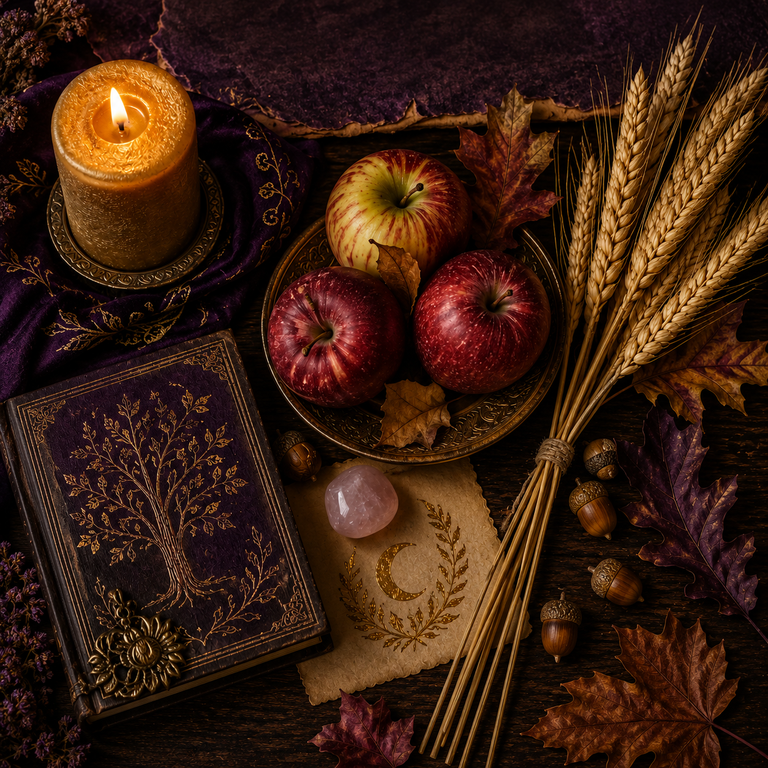
- Seasonal items such as apples, rowan berries, autumn leaves or seed pods
Not everyone has photographs or family heirlooms, and not everyone has a comfortable relationship with their family. Your ancestors can include teachers, mentors, chosen family, cultural ancestors or the people whose work shaped your practice.
If you are building a lasting altar space, our guide to a moon phase altar has useful ideas for arranging a small devotional space.
Candle and fire safety
Please take this seriously. Altars with candles are a real fire risk.
- Always use a stable, heat-proof holder
- Keep flames away from paper, fabric, leaves and dried herbs
- Never leave a burning candle unattended
- Keep candles out of reach of children and pets
- Have a way to put the flame out, such as a snuffer or a bowl of water nearby
- If you cannot burn a real candle safely, use a flameless LED candle instead
🍽️ The Dumb Supper
The dumb supper is a quiet meal shared with the dead. The word “dumb” here means silent, and the tradition is associated with modern folk magic and Wiccan practice.
It is an intimate ritual, and it works well alone or with a small group of people who understand its purpose.
A simple way to hold one:
- Set a table with a place for each ancestor you want to honour, plus your own.
- Use a candle at the head of the table to mark the beginning of the meal.
- Serve food simply. Choose something seasonal or something an ancestor would have recognised.
- Eat in silence. If thoughts or memories arise, let them.
- When you finish, say thank you out loud and put out the flame.
- Leave the ancestors’ portion outside as an offering, or compost it if that is more practical.
Some practitioners also write a question or message on paper and place it by an empty plate. This is a traditional-use practice, and what you receive from it is a matter of personal belief and reflection.
It is also worth saying that this is a different tradition from other living ancestor festivals around the world, such as Día de Muertos. Those have their own histories, communities and customs, and they should not be treated as interchangeable with the Wheel of the Year.
🔮 Samhain Divination
Samhain is a natural time for divination because the tradition places the year’s end beside the year’s beginning. Many practitioners use it to take stock and set intentions.
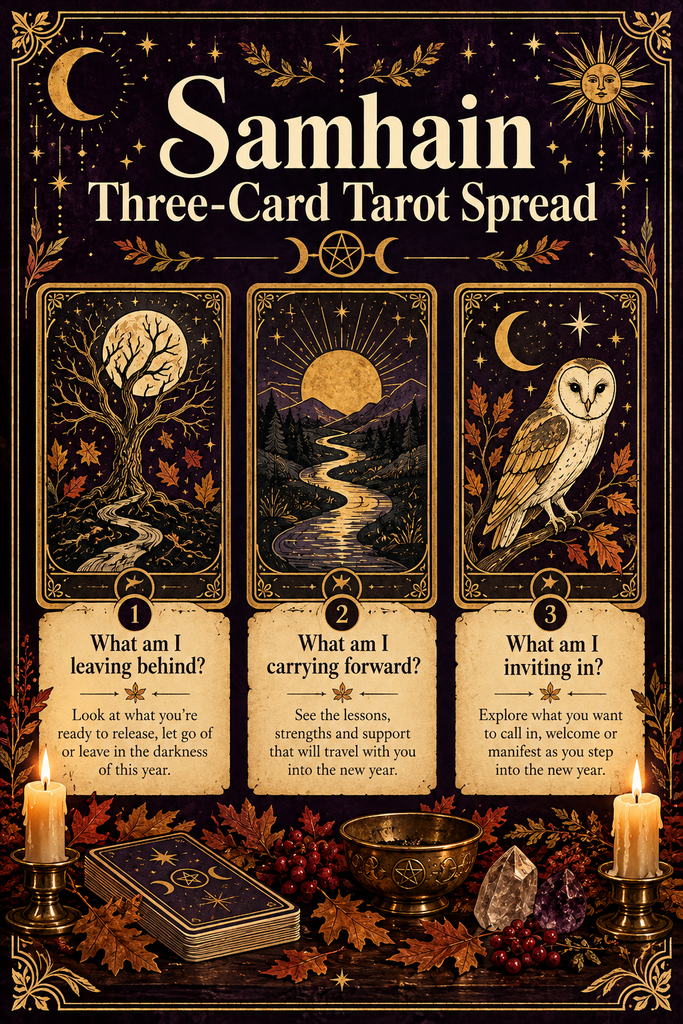
Tarot
A simple Samhain spread can help you reflect on the year that is closing and the year ahead. Try three cards: what you are leaving behind, what you are carrying forward and what you are inviting in.
Before you read, consider cleansing your deck in whatever way is part of your practice. Some people pass a selenite rod over their cards, while others use smoke, sound or moonlight.
If you are new to spreads, our guide to basic tarot spreads walks you through several layouts. A reading deck with clear Rider-Waite-Smith imagery is a good starting point for ritual work.
Scrying
Scrying means gazing into a reflective or dark surface and noticing the images, feelings and thoughts that arise. Practitioners traditionally use a bowl of dark water, a black mirror or a polished stone.
Dim the room and soften your gaze. Do not force anything. Many people report that scrying is more about relaxing the mind than seeing literal pictures.
Obsidian is a traditional scrying stone, and our obsidian crystal guide covers its folklore and uses. A black obsidian scrying mirror is a popular tool for this practice.
Runes and other methods
Rune casting is another favourite at this time of year. Pull a single rune, or cast three for the past, present and future.
Other cultures have their own methods too. Our overview of divination in different cultures offers a broader perspective.
Setting intentions for the year ahead
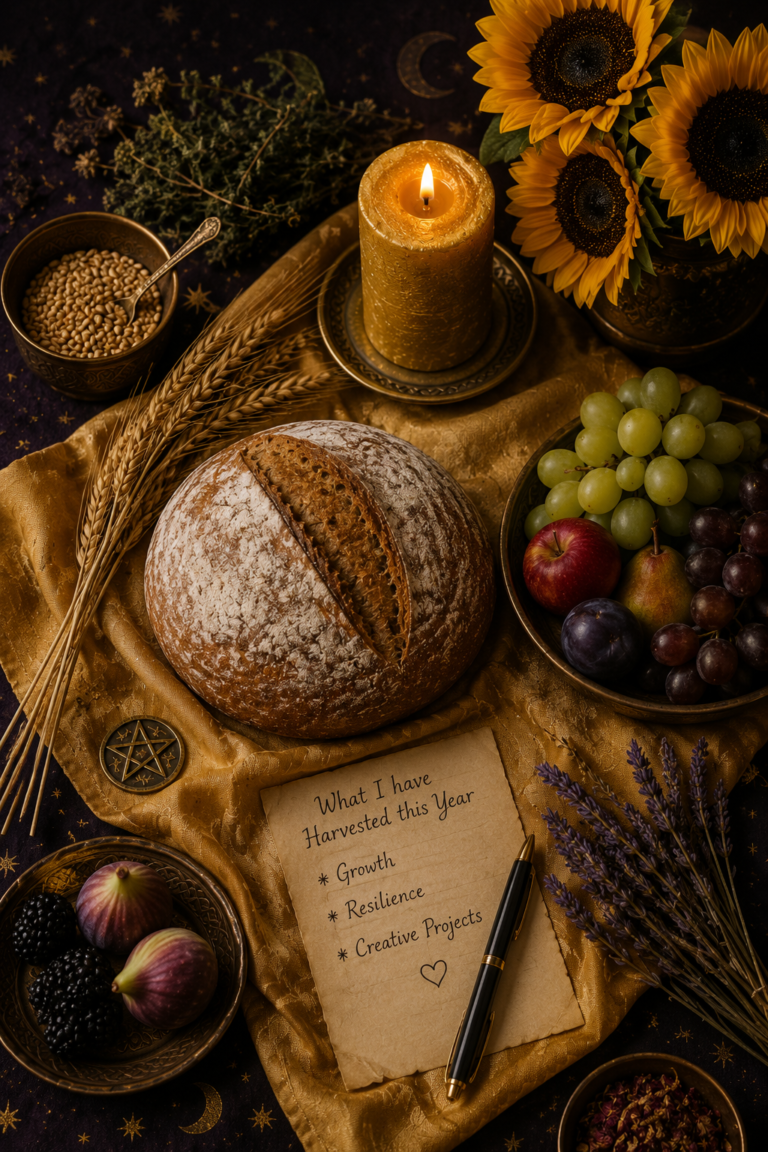
If Samhain is your New Year, it makes sense to set intentions now. Write down a few things you want to cultivate and keep them short and specific.
Intentions are best framed as invitations rather than guarantees. “I am open to deepening my practice” is more honest than “I will become a master of tarot by spring”.
🔥 A Solo Samhain Release Ritual
This ritual is designed for one person and takes around 30 to 45 minutes. It works well on the evening of 31 October, but you can adapt the timing.
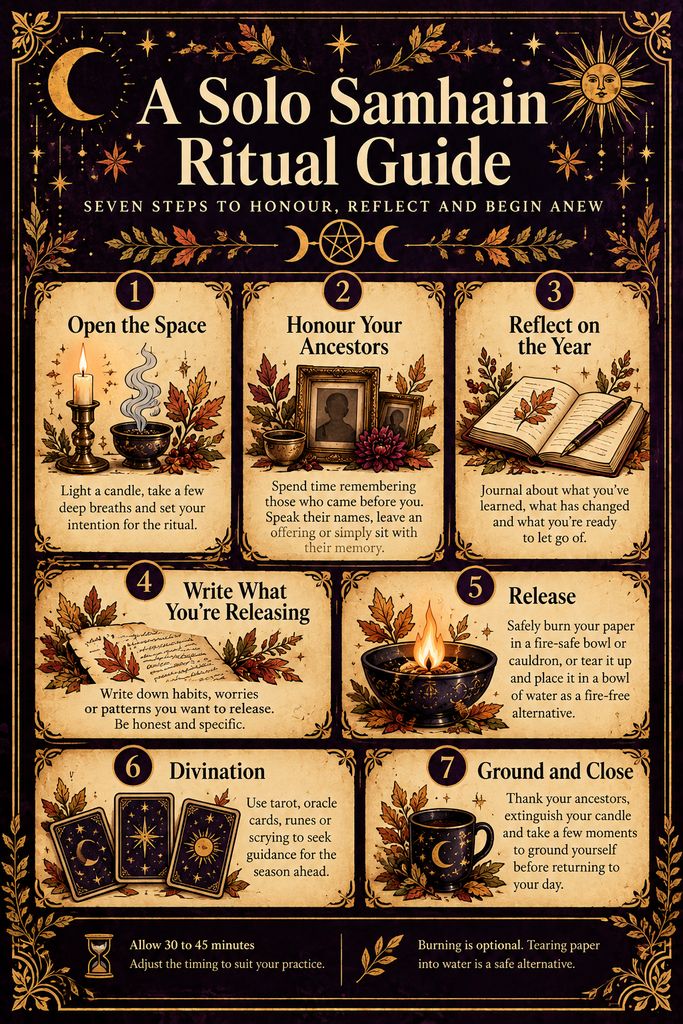
It is a symbolic act of letting go, framed in belief and tradition. It is not a substitute for medical, therapeutic or mental health support, and it makes no promises about outcomes.
What you will need
- A heat-proof dish or cauldron, with a little sand or salt in the base
- Two candles in stable holders
- Paper and a pen
- A small bowl of water
- A grounding item such as a stone, a piece of bread or a cup of tea
- Your ancestor altar, if you have one
Before you begin
Clear a quiet space and make sure you will not be interrupted. Check your fire safety measures. Silence your phone.
Step 1: Open the space
Light the first candle. Take three slow breaths. Say, in your own words, that you are beginning a ritual of remembrance and release.
If you cast a circle or call quarters in your tradition, do so now.
Step 2: Honour your ancestors
Light the second candle at your altar. Say the names of those you want to remember. If you do not know names, you can simply say “my ancestors” or “those who came before”.
Offer a few words of thanks. It can be as simple as “thank you for what you passed on to me”.
Step 3: Reflect on the year
Sit quietly for a few minutes. Think about the past twelve months. What has been good? What has been hard? What has run its course?
Step 4: Write what you are releasing
On the paper, write down habits, fears, relationship patterns or beliefs that you are ready to put down. Keep it short.
You do not need to dig into anything painful. If a topic feels too heavy, leave it for another time or for a trusted professional.
Step 5: Release
Fold the paper and, with great care, place it in the heat-proof dish. Light one corner using the candle flame and let it burn completely in the dish.
Never hold burning paper. If you prefer not to use fire, tear the paper into small pieces and drop them into the bowl of water, or bury them in soil.
As it burns or dissolves, say something like: “I release what no longer serves me.”
Step 6: Divination
Draw a tarot card, cast a rune or sit with your scrying surface. Ask a gentle question, such as “What would be helpful for me to remember in the coming year?”
Write down anything that comes up. Treat it as a reflection, not a prophecy.
Step 7: Ground and close
This step matters. After working with release and the dead, bring yourself back into the present.
- Eat or drink something. A little bread, fruit or tea is traditional.
- Hold your grounding stone and feel your feet on the floor.
- Say thank you to your ancestors and to anything else you invited.
- Close the circle if you opened one.
- Put out your candles safely. Leave the dish until it is completely cool.
Some practitioners like to keep a pocket-sized piece of smoky quartz nearby as a grounding anchor. It is a traditional-use stone, associated in crystal lore with grounding. You can read more in our smoky quartz crystal guide.
If you want to build a regular practice around release and reflection, our shadow work for beginners guide offers a gentle introduction.
🎨 Samhain Correspondences
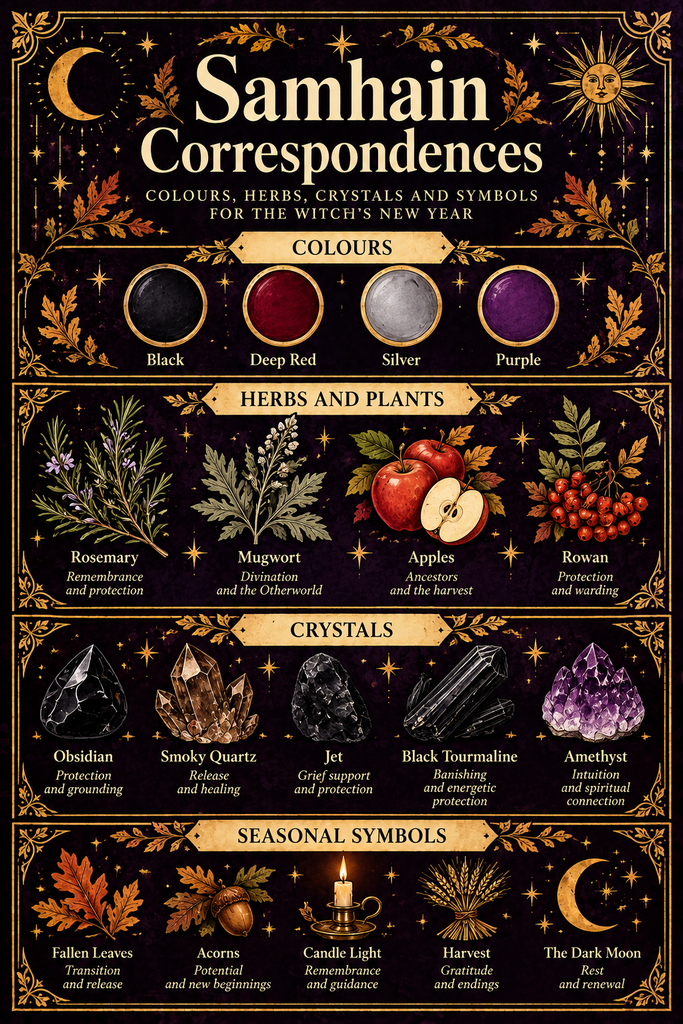
Correspondences are traditional associations, and they vary between practitioners and traditions. Treat the following as starting points and follow your own sources.
Colours
- Black, for the dark half of the year and for protection in many traditions
- Orange and deep red, for the last of the harvest
- Silver or white, for the moon and remembrance
- Purple, for spirit and divination
Herbs and plants
- Mugwort, associated with dreams and divination
- Rosemary, associated with remembrance
- Sage and thyme, often used in ritual and seasonal cooking
- Apples, long associated with Samhain and the Otherworld in folklore
- Rowan, traditionally linked with protection in Celtic folklore
Always research any herb before burning or ingesting it. Some plants are unsafe for pregnant people, pets or those on medication.
Crystals
- Obsidian, for scrying and shadow work
- Smoky quartz, for grounding
- Jet, historically used in mourning jewellery
- Black tourmaline, for protective practices
- Amethyst, for spiritual practice and intuition
Our Black Tourmaline guide covers its traditional uses in more depth.
♏ Scorpio Season and Samhain
Samhain falls in the middle of Scorpio season, which in 2026 runs from 23 October to 22 November. Scorpio is traditionally associated with transformation, depth, endings and rebirth.
This overlap is one reason many practitioners find the themes of Samhain and Scorpio so natural together. Both invite you to look at what is hidden and let go of what has finished.
The moon adds to the picture in 2026. The Full Moon falls on 26 October, a few days before Samhain, and the New Moon in Scorpio follows on 9 November. These dates make a useful frame if you want to stretch your work over a fortnight.
For more on the season, see our Scorpio season guide.
❓ Frequently Asked Questions
When is Samhain in 2026?
In the Northern Hemisphere, Samhain is observed from the evening of 31 October to 1 November. In the Southern Hemisphere, many practitioners observe it around 30 April to 1 May.
Is Samhain the Celtic New Year?
In modern pagan practice, it is often called the Witch’s New Year. Historians disagree about how widely it was observed as a New Year in the ancient Celtic world, so it is best described as a modern tradition with older roots.
Do I need an ancestor altar to celebrate Samhain?
No. A candle, a photograph and a few quiet minutes are enough. The altar is a focus for remembrance, not a requirement.
Can I do Samhain rituals if I do not know my ancestors?
Yes. You can honour ancestors of place, ancestors of craft, mentors, teachers and chosen family. Many practitioners find this just as meaningful.
What if I cannot burn candles?
Use LED candles. A safe practice matters far more than the flame itself.
Is it safe to do this ritual if I am grieving?
Samhain can bring up strong feelings. Take it gently, keep the ritual simple and consider asking a trusted person for company. If grief feels overwhelming, please speak to a doctor or a qualified counsellor.
🌙 Carrying the Season Forward
Samhain is not about dramatic gestures. It is about attention: to the people who came before you, to the year that has passed and to the one beginning.
If you do only one thing, light a candle safely, say a name and sit quietly for a few minutes. That alone is a meaningful way to mark the Witch’s New Year.
If you want to keep going through the dark half of the year, the next turning is the Winter Solstice, and the last gathering of the harvest season is covered in our Mabon guide.
How will you mark Samhain this year? Share your traditions in the comments.